Storm Damage Restoration in Fort Lee
24/7 storm damage restoration in Fort Lee, NJ. IICRC-certified, insurance billing accepted. Call (855) 650-7422.
Our IICRC-certified technicians are dispatched from our Fair Lawn, NJ headquarters and are typically on-site in Fort Lee within 60 minutes of your call.
When a nor’easter or a remnant tropical system rolls through Bergen County, Fort Lee takes the hit differently than most of New Jersey. The borough sits atop the Palisades cliffs, and that elevation means storm runoff doesn’t spread — it accelerates straight down toward lower streets, pooling against foundations and pushing into crawl spaces and basement-level parking garages faster than standard drainage can handle. After Ida soaked the region in 2021, calls from Fort Lee flooded in from Coytesville’s older two- and three-family homes, high-rise towers along the cliff edge, and commercial spaces in the Hudson Lights complex — all in the same 24-hour window. The Restoration Group responds around the clock, and understanding how this specific geography behaves is the difference between a fast recovery and a months-long repair.
Why Fort Lee Properties See Disproportionate Storm Damage
Fort Lee’s topography is the first factor any restoration crew needs to understand. The steep grade running from the Palisades down toward the Hudson River creates natural water channels that funnel runoff directly toward structures. In Coytesville and The Hill, where much of the housing stock dates to the early and mid-twentieth century, foundations were not engineered to modern waterproofing standards. Brick mortar joints in those older buildings absorb storm-driven rain and wick moisture inward for days after the storm has passed — long after a homeowner assumes the problem is over.
High-rise buildings along the Palisades face a different but equally serious exposure. Flat or low-pitched rooftop assemblies on condominium towers are vulnerable to wind-driven debris and membrane punctures during severe weather. A small roof breach on the 20th floor becomes a cascading problem as water travels through mechanical chases and wall cavities, appearing as damage several floors below the actual entry point. In a stacked residential building, one storm event can generate insurance claims across multiple units simultaneously — a coordination challenge that requires a crew experienced with both residential and commercial-scale losses.
The Main Street business district and mixed-use developments like Hudson Lights add commercial complexity to storm response. Storefronts with large glass frontages, below-grade retail, and shared loading areas all present specific vulnerabilities when wind speeds climb and debris becomes a factor.
Our Storm Damage Restoration Process in Fort Lee
Every job begins with a thorough damage assessment before any material is moved or removed. In Fort Lee’s high-rise buildings, that means tracing moisture migration vertically — using thermal imaging and moisture meters to map exactly how far water has traveled through wall assemblies and concrete floor slabs. In older wood-framed homes in Coytesville, the assessment includes checking subfloor systems and rim joists, where storm-driven water commonly hides.
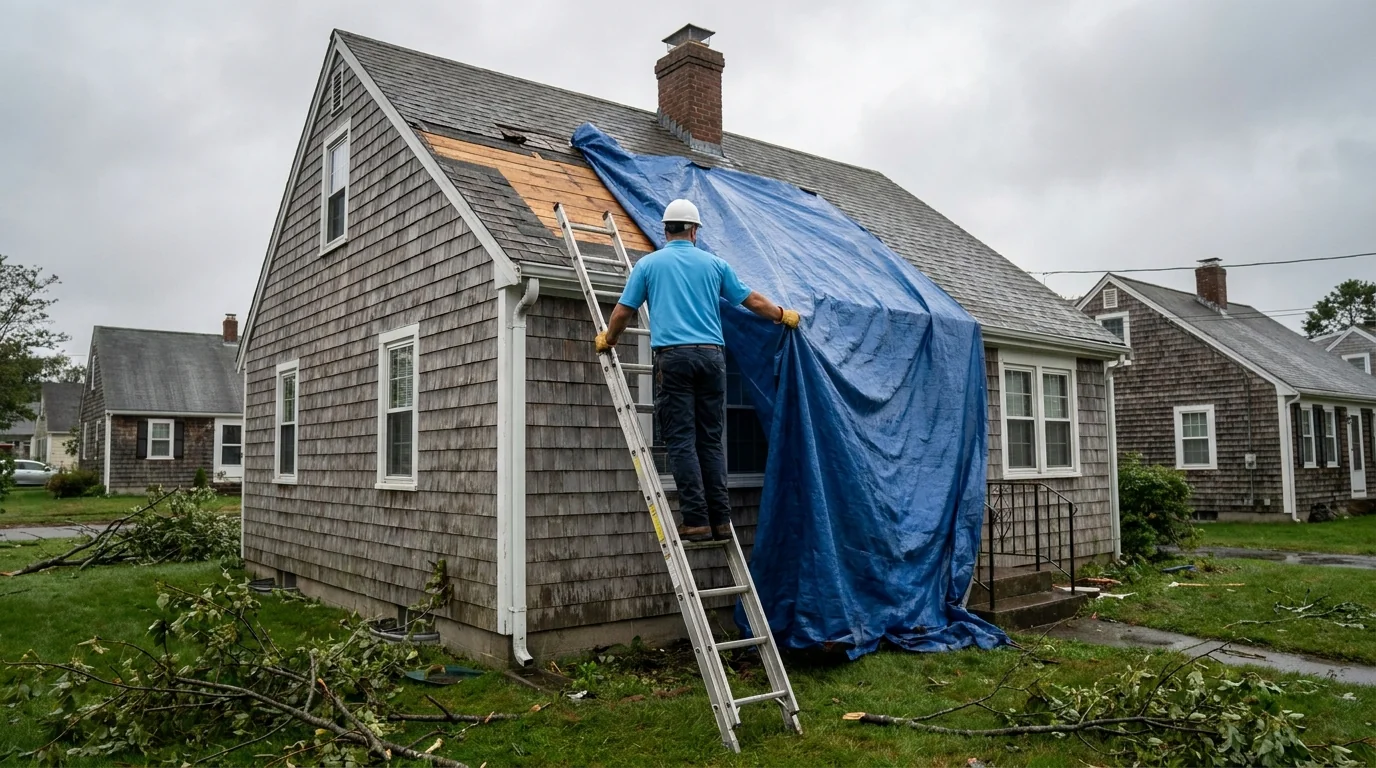
Once the scope is documented, the process moves through four phases: emergency stabilization (tarping roof damage, boarding compromised openings, extracting standing water), structural drying (industrial air movers and dehumidifiers calibrated to the building type and ambient conditions), materials assessment (determining what can be dried in place versus what requires controlled demolition), and repair and reconstruction. All drying is performed to IICRC S500 and S520 standards — the industry benchmarks for water and storm damage drying — and moisture readings are logged daily so both the property owner and the insurance adjuster have a clear, defensible record.
For high-rise condo work, we coordinate directly with building management and HOA boards before mobilizing equipment, since elevator access, noise restrictions, and common-area staging rules vary by property.
Fort Lee Insurance and HOA Coordination
Storm damage claims in Fort Lee frequently involve multiple layers of coverage — the individual unit owner’s HO-6 policy, the building’s master policy, and sometimes a commercial policy for mixed-use spaces. Sorting out which policy responds to which portion of the loss is one of the more time-consuming parts of storm recovery, and it’s where property owners often feel most overwhelmed.
The Restoration Group documents losses with photo and moisture-log evidence formatted for insurance submission. We communicate directly with adjusters and, when a building’s HOA or management company is involved, keep that stakeholder loop open so work doesn’t stall waiting on approvals. In ZIP code 07024, where high-rise condo associations often have their own approved-vendor requirements or required notification windows before repairs begin, we’ve learned to ask those questions on the first call rather than discovering the restriction on day three.
Getting to Fort Lee from Kenilworth
Our crews dispatch from Kenilworth and reach Fort Lee via the New Jersey Turnpike to Route 1/9 north, or via I-95 to the upper level of the George Washington Bridge approach — a route that keeps us off local surface streets during peak traffic. Because Fort Lee’s street grid tightens considerably around the GWB plaza and along Lemoine Avenue, we stage equipment at the property rather than on the street when possible, and we confirm parking and loading access with the property contact before arrival. For Coytesville addresses in the northern end of the borough, the approach through Palisade Avenue is typically faster than routing through Central Fort Lee.
The Restoration Group operates 24 hours a day, seven days a week — so whether the call comes in during a Sunday-night storm or a Tuesday afternoon, a live dispatcher takes it and a crew is moving.
Local Note
One thing that catches out-of-area crews working in Fort Lee’s older Coytesville and Palisade-area homes: the original plaster-on-wood-lath wall construction common in pre-1950 buildings holds moisture in a fundamentally different way than modern drywall. Plaster is dense and slow to release absorbed water, which means moisture readings can appear deceptively low on the surface while the lath cavity behind it stays saturated for days. Rushing to close out drying too early in these buildings is a reliable path to secondary mold growth. We extend drying cycles and take readings at multiple wall depths in any structure where original plaster is present — it adds time, but it prevents a callback three weeks later.
If storm damage has hit your Fort Lee property — whether it’s a single-family home in Coytesville, a condo unit above the Palisades, or a commercial space near Hudson Lights — call The Restoration Group at (855) 650-7422. We’ll assess the damage, walk you through the recovery timeline, and handle the documentation your insurance company needs to process the claim.
Serving Fort Lee from our Fair Lawn headquarters — ★ 4.8 · 158 Google reviews
“Great customer service. I was kept well informed throughout the entire process. I received nothing but respect and sympathy from everyone I dealt with.” — Ryan, July 2026Read our reviews on Google →
Storm Damage Restoration in Fort Lee: Service Coverage
Frequently Asked Questions
How fast can you arrive for storm damage restoration in Fort Lee?
How quickly can The Restoration Group reach Fort Lee after a storm?
Are older homes in Coytesville and The Hill more vulnerable to storm damage than Fort Lee's high-rises?
A storm damaged my condo unit in a Fort Lee high-rise. Does the building's HOA policy cover my unit, or does my own insurance?
Fort Lee's steep Palisades grade sends a lot of runoff toward foundations — what does storm restoration look like for a basement or below-grade space?
What does storm damage restoration typically involve for a commercial space in the Hudson Lights or Main Street corridor?
Storm Damage Restoration response in Fort Lee
Most Fort Lee calls see a technician on-site within 60 minutes from our Fair Lawn headquarters.