Mold Remediation in Fort Lee
24/7 mold remediation in Fort Lee, NJ. IICRC-certified, insurance billing accepted. Call (855) 650-7422.
Our IICRC-certified technicians are dispatched from our Fair Lawn, NJ headquarters and are typically on-site in Fort Lee within 60 minutes of your call.
Fort Lee’s stack of high-rise condominiums along the Palisades creates a mold exposure pattern unlike almost anywhere else in Bergen County. When a supply line fails on the 18th floor of a tower near Hudson Lights or along the Main Street corridor, water migrates through concrete slab joints and drywall cavities across multiple units below before anyone notices the stain on a ceiling. By the time a resident in 07024 calls, mold colonies can already be establishing in wall cavities — spores take as little as 24 to 48 hours to begin colonizing wet cellulose materials.
Why Fort Lee Properties See Mold Issues
The building stock here runs two very different risk profiles. Along the Palisades ridge, post-1970 high-rise towers rely on aging plumbing risers and HVAC condensate systems that, when they fail, send water through fireproofing layers and into finished living spaces. Condensation is also a persistent issue: the Hudson River microclimate keeps relative humidity elevated, and poorly ventilated mechanical closets in these towers are prime mold territory.
In Coytesville and The Hill, the picture shifts to older wood-frame and brick multifamily buildings — many built before 1960 — where original fiberglass batt insulation and unpainted masonry block moisture in wall assemblies for weeks. Storm Ida in 2021 pushed water into below-grade spaces across Bergen County, and Fort Lee’s steep Palisades grade means runoff from upper streets funnels hard into lower-level units and crawl spaces in these older neighborhoods. That combination of legacy construction and topography-driven drainage keeps mold calls coming long after the visible water is gone.
Our Mold Remediation Process in Fort Lee
Every job starts with a thorough visual inspection and moisture mapping using thermal imaging and calibrated moisture meters — not a visual guess. In Fort Lee’s high-rises, that means checking not just the reported unit but adjacent walls and the unit directly below, because water in a concrete-framed building travels laterally in ways that surprise owners who assume damage is contained.
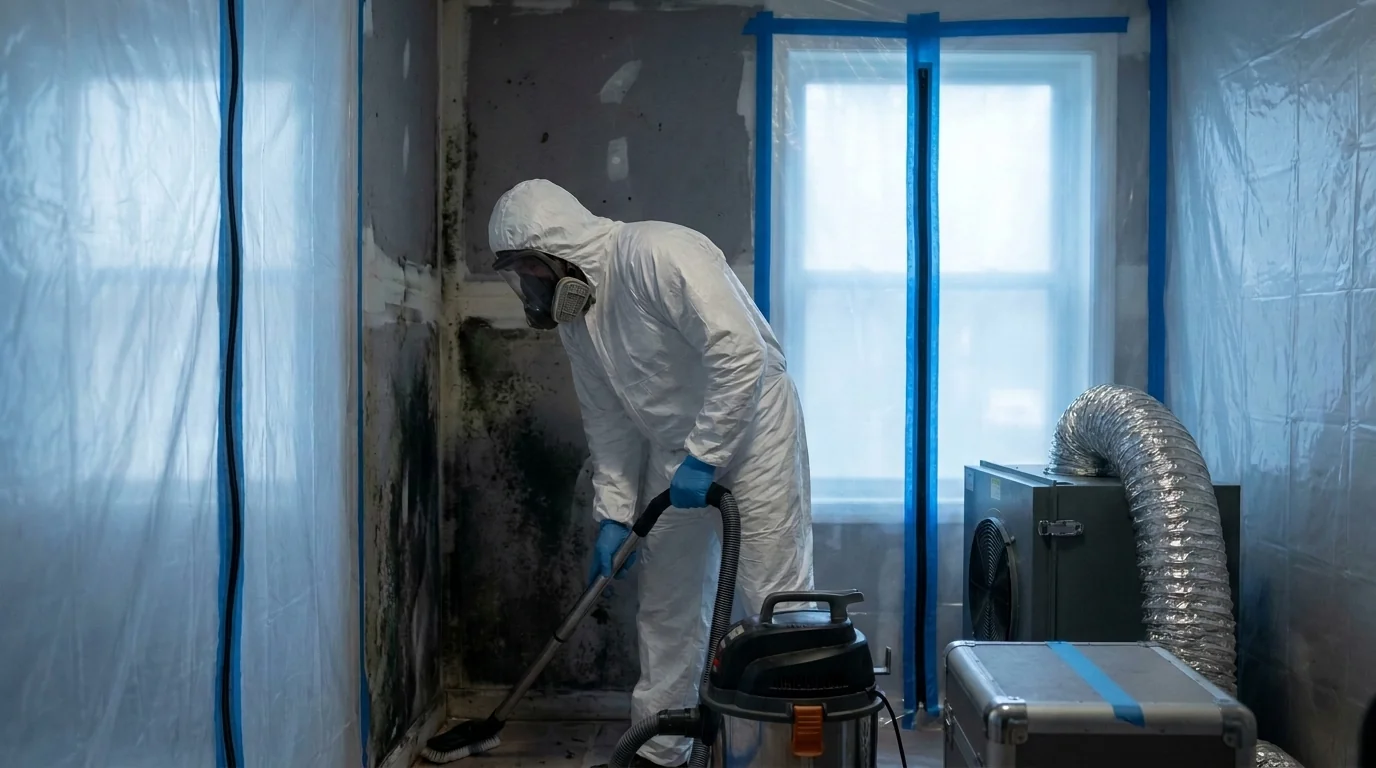
Once the affected area is scoped, we establish negative-air containment using 6-mil poly barriers and HEPA-filtered air scrubbers to prevent cross-contamination to neighboring units — a step that matters especially in shared-wall condo buildings. Mold-affected drywall, insulation, and porous materials are removed, bagged, and disposed of per New Jersey DEP guidelines. Structural surfaces are then treated and dried to IICRC S520 protocol standards before any reconstruction begins. We document every phase with photographs and moisture readings, which supports insurance claims and satisfies HOA management requests for remediation records.
Reaching Fort Lee from Kenilworth
The Restoration Group operates 24/7 out of Kenilworth, NJ. Fort Lee sits roughly 25 miles northeast via I-78 E to the New Jersey Turnpike or Route 9W north — a route our crews run regularly for Bergen County calls. For properties near the George Washington Bridge approach or along the Main Street business district, the Palisades Interstate Parkway northbound from the lower level provides a direct line in. We dispatch around the clock, so whether a building manager at a Coytesville multifamily discovers water damage at 2 a.m. or a condo owner near Fort Lee Historic Park notices a musty smell on a Sunday afternoon, the call gets answered and a crew gets moving.
Fort Lee Insurance & HOA Coordination
Mold remediation in Fort Lee’s condo towers almost always involves at least two parties: the unit owner’s HO-6 policy and the building’s master policy, and sometimes a third-party property management company with its own documentation requirements. We’ve worked through that coordination before. Our team prepares itemized scope-of-work reports, moisture logs, and pre- and post-remediation photographs formatted for carrier review, which reduces the back-and-forth that delays approvals. For buildings managed by HOAs — common in the Hudson Lights mixed-use complex and along the Palisades high-rise corridor — we can provide a written clearance summary to satisfy board requirements before walls are closed.
Local Note
Something worth knowing if you’re in one of Fort Lee’s older Coytesville or The Hill buildings: pre-1960 plaster-and-lath wall assemblies hold moisture differently than modern drywall. The plaster itself is relatively mold-resistant, but the wood lath behind it is not, and it dries slowly — often taking 30 to 40 percent longer to reach acceptable moisture content than standard half-inch drywall would. Rushing to reconstruction before those readings normalize is one of the most common reasons mold returns in these older buildings. We extend the drying phase on lath-and-plaster assemblies specifically because of this, and we re-test before any new drywall goes up.
If you’re seeing discoloration, a persistent musty odor, or recently dealt with water intrusion in a Fort Lee property, the right move is an inspection before the problem spreads to adjacent units or floors. Call The Restoration Group at (855) 650-7422 — we’re available around the clock and familiar with the specific challenges mold remediation presents in Fort Lee’s mix of high-rise towers and older neighborhood homes.
Serving Fort Lee from our Fair Lawn headquarters — ★ 4.8 · 158 Google reviews
“Great customer service. I was kept well informed throughout the entire process. I received nothing but respect and sympathy from everyone I dealt with.” — Ryan, July 2026Read our reviews on Google →
Mold Remediation in Fort Lee: Service Coverage
Frequently Asked Questions
How fast can you arrive for mold remediation in Fort Lee?
How does mold spread between units in Fort Lee's high-rise condo buildings?
Are older homes in Coytesville and The Hill more difficult to remediate for mold?
Does Fort Lee's HOA or condo board documentation process affect how mold remediation is handled?
What does the mold containment setup look like inside a Fort Lee apartment?
How does Fort Lee's proximity to the Hudson River affect mold risk in residential buildings?
Will my homeowners insurance cover mold remediation in Fort Lee?
Mold Remediation response in Fort Lee
Most Fort Lee calls see a technician on-site within 60 minutes from our Fair Lawn headquarters.