Storm Damage Restoration in Bayonne
24/7 storm damage restoration in Bayonne, NJ. IICRC-certified, insurance billing accepted. Call (855) 650-7422.
Our IICRC-certified technicians are dispatched from our Fair Lawn, NJ headquarters and are typically on-site in Bayonne within 60 minutes of your call.
Bayonne sits on a narrow peninsula where Newark Bay presses against one side and the Kill Van Kull against the other, and when a nor’easter or a remnant tropical system tracks up the coast, there is nowhere for storm surge to go except inland. The flooding that swallowed low-lying blocks near Constable Hook and the Newark Bay waterfront during Sandy in 2012 was not a fluke — it was a preview of what concentrated coastal exposure does to a densely built city of early 20th-century frame homes and brick rowhomes. When a storm hits Bayonne hard, the damage compounds fast, and the window to prevent secondary mold and structural rot is measured in hours, not days.
Why Bayonne Properties Face Compounding Storm Damage
The housing stock in Bayonne is a significant part of the story. Two- and three-family frame homes built before 1950 are common throughout Bergen Point and the blocks running north toward Uptown, and those structures carry decades of deferred maintenance into every storm season. Aging roof sheathing fails under wind-driven rain before the shingles even lift. Original cast-iron drains in finished basements back up when storm volume overwhelms the combined sewer system — a pattern that repeats in nearly every significant rain event across the 07002 ZIP code. Once water enters a basement with original supply plumbing and a finished ceiling, you are dealing with hidden saturation inside wall cavities that a surface inspection will miss entirely.
The peninsula’s low elevation also means that properties near Stephen R. Gregg Park and along the waterfront corridors can experience both wind damage from above and surge pressure from below in the same event. That combination — roof breach plus groundwater intrusion — is what turns a manageable loss into a structural problem if the drying response is delayed.
Our Storm Damage Restoration Process in Bayonne
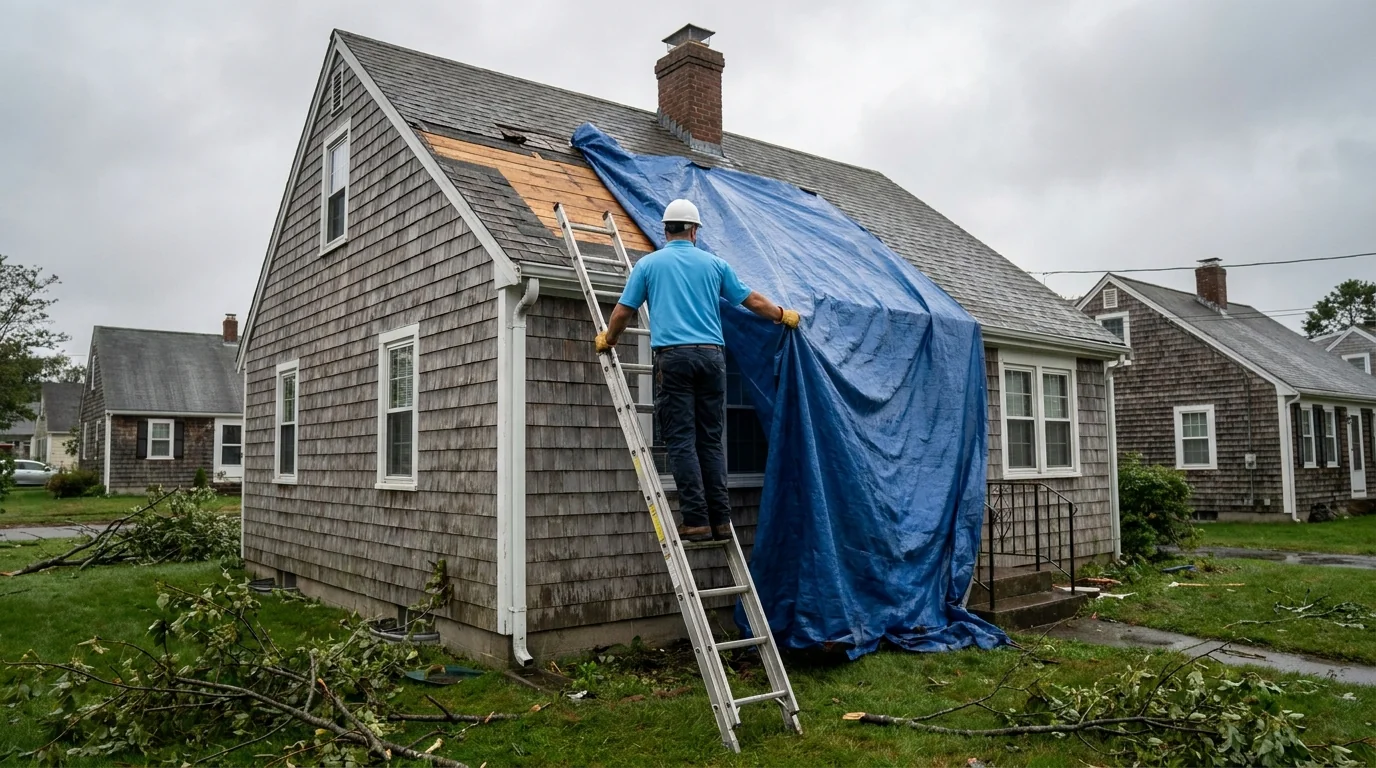
Every storm loss is different, but the sequence matters: stop ongoing intrusion first, document everything second, then dry aggressively before secondary damage sets in. When our crews arrive, the first priority is emergency tarping or board-up for any roof or wall breach, followed by a full moisture mapping of the structure using thermal imaging and pin-type meters. In Bayonne’s older frame homes, that mapping often reveals water migration through balloon-frame wall cavities that would not show up on a standard visual inspection.
Extraction and structural drying follow the IICRC S500 standard — the industry benchmark for water damage response — using commercial-grade desiccant dehumidifiers and high-velocity air movers calibrated to the affected material class. Plaster walls common in pre-war Bayonne homes release moisture more slowly than modern drywall, so drying timelines in these structures typically run longer than a newer build of comparable square footage. We monitor daily with calibrated readings and do not demobilize equipment until the structure reaches documented dry standard. Debris removal, tree limb extraction from roof penetrations, and temporary weatherproofing are handled in parallel so the property is secure throughout the process.
Reaching Bayonne from Kenilworth
The Restoration Group operates around the clock, and Bayonne is reachable from our Kenilworth headquarters via the NJ Turnpike to Route 440 — a corridor that also runs directly past the Bayonne Crossing retail center, where commercial roof losses and overnight sprinkler activations are a recurring call type for us. For residential losses in Bergen Point or Constable Hook, the Route 440 approach puts crews close to the waterfront neighborhoods that carry the highest surge-exposure risk. We are available 24/7, so a call at 2 a.m. after a storm moves through gets the same dispatch response as a call during business hours.
Insurance Coordination After a Bayonne Storm
Storm claims in New Jersey move faster when the documentation is thorough from the first hour. Our team photographs and logs all affected materials, moisture readings, and structural conditions before any demolition begins — a record that supports your adjuster’s scope and reduces the back-and-forth that delays claim settlement. We work directly with most major carriers and can communicate scope with your adjuster throughout the job. For commercial properties along the Route 440 corridor or rental buildings in Midtown Bayonne, we are also experienced coordinating with property management companies and their carrier representatives on multi-unit losses.
Local Note
One pattern we see repeatedly in Bayonne that catches homeowners off guard: the combined sewer infrastructure in many blocks means that a heavy storm event can push sewage-contaminated water back through basement floor drains at the same time roof damage is occurring above. That changes the remediation category — what looks like a straightforward rainwater intrusion may actually involve Category 3 contaminated water under IICRC classification, which requires different PPE protocols, antimicrobial treatment, and in some cases removal of porous materials that would otherwise be salvageable. If your basement flooded during a storm and there is any odor beyond damp concrete, mention it when you call — it affects how we stage the response.
If your Bayonne property took a hit from wind, rain, or surge, call The Restoration Group at (855) 650-7422. We are licensed by the NJ Division of Consumer Affairs, certified as an IICRC Firm (#210213), and available any hour to assess the damage and start the work that keeps a storm loss from becoming a long-term structural problem.
Storm Damage Restoration in Bayonne: Service Coverage
Frequently Asked Questions
How fast can you arrive for storm damage restoration in Bayonne?
Are homes near Constable Hook and the Newark Bay waterfront at higher risk for storm surge damage than other parts of Bayonne?
How does Bayonne's older housing stock affect the timeline for storm damage drying?
My Bayonne basement flooded during a storm and there is an odor — does that change what kind of cleanup is needed?
What documentation do you provide for a storm damage insurance claim in New Jersey?
Can you handle storm damage at commercial properties along the Bayonne Crossing and Route 440 corridor, not just residential homes?
Storm Damage Restoration response in Bayonne
Most Bayonne calls see a technician on-site within 60 minutes from our Fair Lawn headquarters.