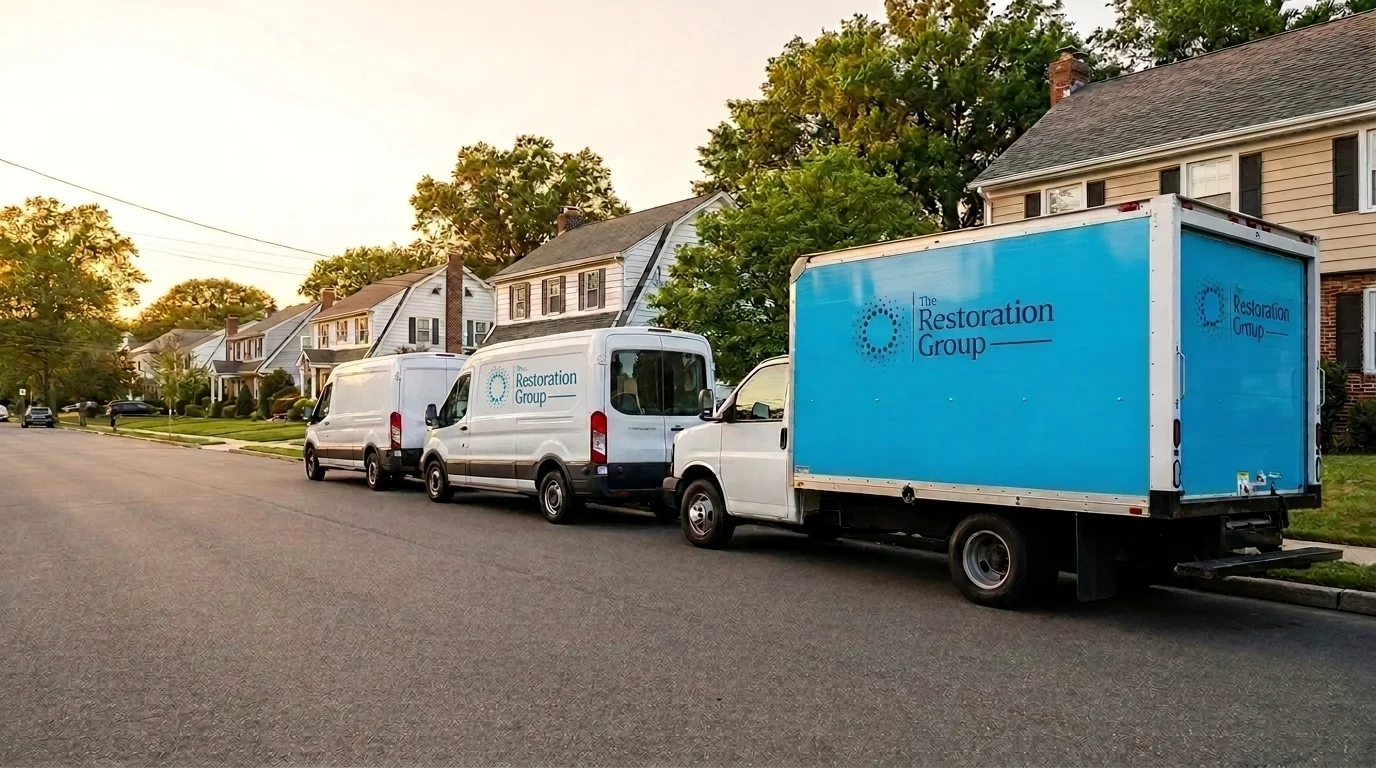
Water Cleanup in East Orange
24/7 water cleanup in East Orange, NJ. IICRC-certified, insurance billing accepted. Call (855) 650-7422.
Our IICRC-certified technicians are dispatched from our Fair Lawn, NJ headquarters and are typically on-site in East Orange within 60 minutes of your call.
When a galvanized supply riser finally gives out in a three-story Brick Church walk-up, water doesn’t stop at one unit — it migrates through plaster ceilings, down brick cavities, and into finished basements before anyone smells the damage. East Orange’s dense stock of early-1900s apartment buildings and two-families creates exactly that kind of cascading, multi-unit water loss, and cleaning it up correctly means understanding how these structures were built, not just where the water went. The Restoration Group responds 24/7 from Kenilworth and is an IICRC Certified Firm (#210213), licensed by the NJ Division of Consumer Affairs.
Why East Orange Properties See Repeated Water Losses
Most of East Orange’s residential building stock went up between roughly 1905 and 1940, with postwar infill filling the gaps. That means galvanized steel risers that have been corroding from the inside for decades, cast-iron drain stacks prone to cracking at the hub joints, and flat or low-slope roofs on brick apartment buildings that pond water after every heavy rain. When a flat roof membrane fails over a six-unit building near the Central Avenue corridor, every floor below is a candidate for ceiling damage.
Below grade, the picture is just as challenging. Basement mechanical rooms and finished cellars across the city flood during heavy rain events — a pattern that became impossible to ignore after Tropical Storm Ida in 2021, when Second River tributaries overwhelmed low-lying streets throughout Essex County. Sewer backups are a separate, recurring problem in lower-elevation blocks: when the combined sewer system surcharges, floor drains in older buildings reverse-flow, leaving standing water that carries contamination well beyond a simple clean-water loss.
The Elmwood and Ampere neighborhoods illustrate both ends of the spectrum — Victorian two-families with original plumbing and unfinished basements that flood seasonally sit a few blocks from postwar garden apartments with updated copper supply lines but aging flat roofs and no secondary drainage. No single drying protocol fits every building type here.
Our Water Cleanup Process in East Orange
The first priority on arrival is category and class assessment. Water from a burst supply line behaves differently than a sewer backup or a roof leak that has been seeping for days — the contamination level determines what personal protective equipment the crew wears, what materials can be dried in place, and what has to be removed. In East Orange’s older plaster-and-lath construction, this matters especially: plaster can read dry at the surface while the wood lath behind it stays saturated, and a moisture meter that only reads the face of the wall will miss it.
Once the category is confirmed, standing water is extracted using truck-mounted and portable extraction units — portable units are essential in walk-ups where elevator access is limited or nonexistent. Structural drying follows with calibrated drywall dehumidifiers and axial air movers positioned to create directed airflow through wall cavities and floor assemblies. Drying logs are documented daily, both for the building owner’s records and for insurance carriers who require proof of drying progression before closing a claim.
In multi-unit buildings, we coordinate with property managers to sequence unit access so drying equipment can run continuously without interruption — a detail that matters when a single water loss has affected three floors and six tenants.
Reaching East Orange from Kenilworth
Kenilworth sits roughly six miles southwest of East Orange via the Garden State Parkway to Route 21 or through Union and Irvington on local routes. Because we operate 24/7, we dispatch on your call regardless of the hour — there is no answering service delay waiting for a morning callback. For addresses near Brick Church station or along the Central Avenue business district, Route 21 northbound is typically the fastest corridor. Addresses in the Presidential Estates section or near East Orange General Hospital are accessible from the Parkway to Freeway Drive without cutting through the densest surface-street traffic.
East Orange Insurance Coordination
Most water losses in East Orange’s apartment stock involve at least two parties: the building owner’s commercial property policy and, in some cases, a tenant’s renter’s insurance. We document the loss photographically from initial arrival through final drying readings, generate moisture mapping reports, and communicate directly with adjusters so the claim file reflects what actually happened rather than a summary written after the fact. For losses that cross unit lines — a common scenario in these older buildings — clear documentation of the water migration path is what prevents disputes over which policy responds to which damage.
Local Note
In East Orange’s pre-war brick apartment buildings, the space between the interior plaster and the exterior brick wythe is often an uninsulated air cavity — and water that enters through a failing parapet or roof edge can travel down that cavity for two or three floors before it ever shows up as a stain on a ceiling. By the time a tenant in the second-floor unit of an Ampere three-flat notices a wet spot, the source may be a deteriorated coping joint on the roof. We probe cavity moisture from the interior using penetrating meters and, when necessary, thermal imaging, because chasing the visible damage without finding the entry point means the problem comes back with the next rain.
If you are dealing with standing water, a soaked ceiling, or a basement backup anywhere in East Orange — ZIP codes 07017, 07018, or 07019 — call (855) 650-7422. We answer around the clock and can begin assessment the same day.
Water Cleanup in East Orange: Service Coverage
Frequently Asked Questions
How fast can you arrive for water cleanup in East Orange?
How quickly can The Restoration Group reach addresses near Brick Church station or the Central Avenue corridor?
East Orange has a lot of older apartment buildings where one pipe burst can affect multiple units. How do you handle a multi-unit water loss?
After Ida-type flooding, is basement water in East Orange considered a clean-water loss or something more hazardous?
Plaster walls are common in East Orange's pre-war housing stock. Does that change how long drying takes?
Will my insurance cover water cleanup in East Orange, and how does The Restoration Group help with the claim?
Water Cleanup response in East Orange
Most East Orange calls see a technician on-site within 60 minutes from our Fair Lawn headquarters.