Mold Remediation in East Orange
24/7 mold remediation in East Orange, NJ. IICRC-certified, insurance billing accepted. Call (855) 650-7422.
Our IICRC-certified technicians are dispatched from our Fair Lawn, NJ headquarters and are typically on-site in East Orange within 60 minutes of your call.
East Orange’s dense stock of early-1900s brick apartment buildings and three-story walk-ups creates a mold environment unlike most of suburban New Jersey. When a flat roof leaks over a Brick Church six-unit or a galvanized riser finally gives out in an Elmwood two-family, moisture soaks into century-old plaster, wood lath, and unreinforced masonry, materials that hold water long after the visible drip stops. By the time a tenant notices the smell, colonies can be well established behind walls or under flooring. The Restoration Group responds 24/7 from Kenilworth to stop the spread before it migrates to adjacent units.
Why East Orange Properties See Repeated Mold Problems
The city’s housing stock is the first factor. Buildings constructed between roughly 1910 and 1940 rely on cast-iron drain stacks and galvanized supply risers that corrode from the inside out. A slow pinhole leak inside a wall cavity can run undetected for months, saturating wood framing and the back of plaster. Unlike modern drywall, which shows water staining quickly, plaster can absorb and redistribute moisture across a wide area before any surface discoloration appears.
The second factor is the ground itself. Low-lying sections of East Orange, particularly near the Second River corridor that runs through the Ampere and Doddtown areas, flood during heavy rain events. Tropical Storm Ida in 2021 pushed water into basement mechanical rooms and finished cellars across ZIP code 07017 and 07018, leaving standing water that sat long enough for mold to begin colonizing within 24 to 48 hours. Sewer backups compound the problem: Category 3 water (sewage-contaminated) accelerates mold growth and requires a more aggressive containment and antimicrobial protocol than a clean-water pipe break.
Flat roofs on postwar infill buildings and commercial properties along the Central Avenue corridor add another layer of risk. Ponding water after a nor’easter finds every seam, and the resulting leak often travels horizontally through roof assemblies before dripping into top-floor units, making the moisture source hard to trace without thermal imaging.
Our Mold Remediation Process in East Orange
Every job starts with a thorough assessment before any material comes out. We use moisture meters, borescopes, and infrared cameras to map the full extent of saturation, critical in older East Orange buildings where water travels unpredictably through plaster, brick cavities, and wood subfloors. We identify the moisture source and confirm it is controlled before remediation begins; pulling mold-affected drywall or plaster while an active leak continues is a waste of everyone’s time and money.
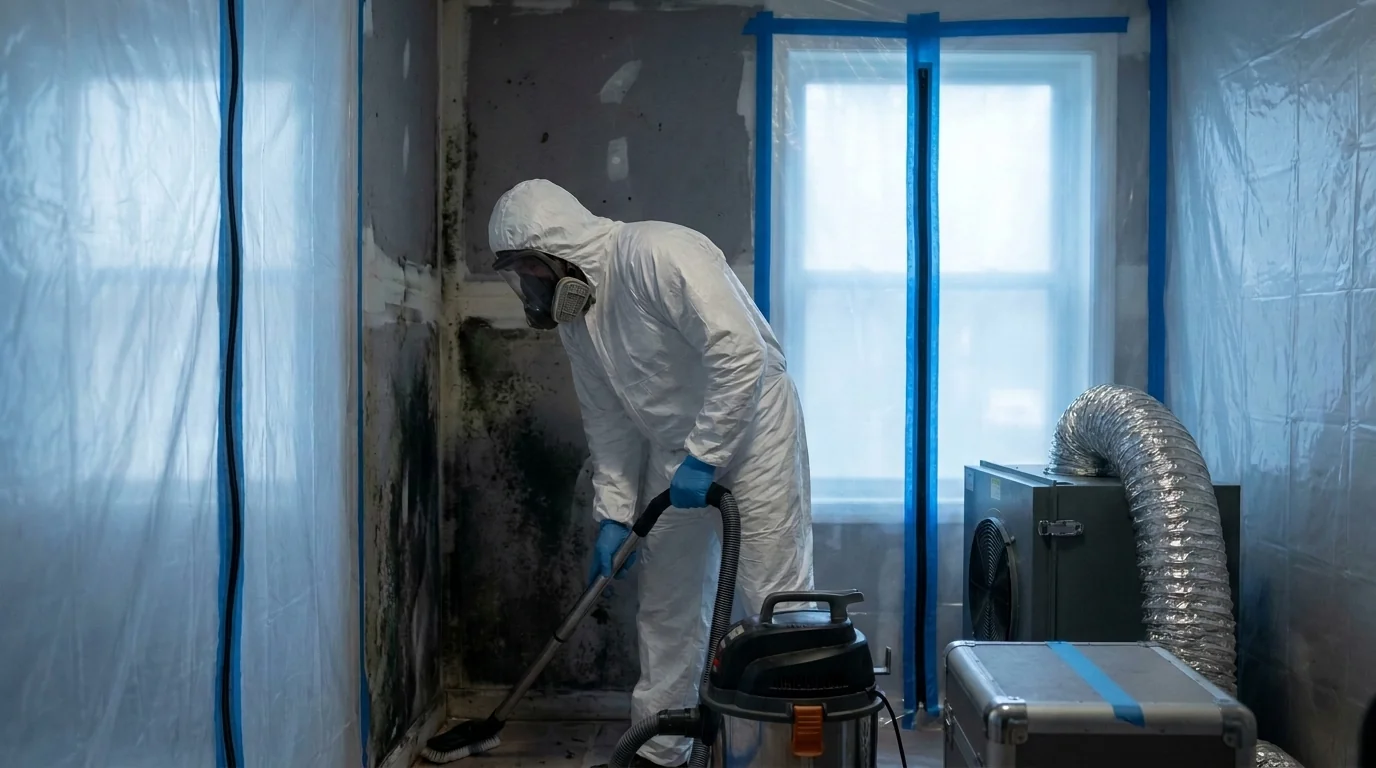
Once the scope is established, we establish negative-air containment using 6-mil poly barriers and HEPA-filtered air scrubbers. This is especially important in multi-unit buildings: spores disturbed during demolition can migrate through shared HVAC chases, stairwells, and gaps in older floor assemblies into neighboring apartments. Containment protects residents who are not part of the affected unit.
Affected materials, plaster, lath, wood framing, insulation, are removed, bagged, and disposed of per New Jersey Department of Environmental Protection guidelines. Remaining structural surfaces are HEPA-vacuumed, treated with an EPA-registered antimicrobial, and dried to documented moisture levels per the IICRC S520 standard before any reconstruction begins. We are an IICRC Certified Firm (#210213), and our documentation package is formatted to support insurance claims and satisfy any post-remediation verification requirements.
Reaching East Orange from Kenilworth
From our Kenilworth base, East Orange is typically accessible via the Garden State Parkway to I-78 East, then north on the Garden State Parkway spur or directly through Union and Irvington. Depending on time of day and traffic on the Springfield Avenue corridor, we can reach Brick Church station-area addresses or Presidential Estates in the city’s northern section without significant delay. Because we operate 24/7, middle-of-the-night calls from property managers dealing with a burst riser or a basement flood get the same response as a weekday morning call, no after-hours surcharge, no answering service handoff.
East Orange Insurance Coordination
Mold claims in multi-unit East Orange buildings often involve more than one policy. A riser leak in a common wall may fall under the building owner’s commercial property policy while a tenant’s contents claim runs through renters insurance. We document the loss with photographs, moisture readings, and written scope notes formatted to the standards most carriers expect, and we work directly with adjusters to reduce the back-and-forth that delays approvals. If your building is managed through an HOA or a property management company, we can coordinate scope reviews with their designated adjuster or third-party consultant.
Local Note
In East Orange’s older brick apartment buildings, particularly the three-story walk-ups common in the Elmwood and Doddtown sections, interior partition walls were often built with a narrow air gap between the brick wythe and the plaster finish. That cavity acts as a hidden channel: water from a roof leak or a top-floor pipe failure can run down inside the wall for two or three floors before it ever appears at baseboard level. When we scope a mold job in one of these buildings and the visible damage seems disproportionately small relative to the reported leak, we probe those cavities before finalizing the remediation plan. Skipping that step is how a “contained” mold job turns into a callback six months later.
If you are dealing with a mold problem in East Orange, whether it is a single-family Victorian near Watsessing Park or a 20-unit brick walk-up off Central Avenue, call The Restoration Group at (855) 650-7422. We will assess the building, explain what we find in plain language, and give you a written scope before any work begins.
Serving East Orange from our Fair Lawn headquarters — ★ 4.8 · 166 Google reviews
“The company was very prepared and professional. They were prompt with coming out to inspect the water damage that occurred and had the team come out the next day. They even wore booties in the house. They cut out all areas of damage, sprayed and use numerous fans and humidifiers in the wet area. I…” - Melanie, October 2026Read our reviews on Google →
Mold Remediation in East Orange: Service Coverage
Frequently Asked Questions
How fast can you arrive for mold remediation in East Orange?
Are the older brick apartment buildings in Elmwood and Doddtown harder to remediate than newer construction?
My East Orange basement flooded during a heavy rain event — how long before mold becomes a serious concern?
Does a mold remediation job in a multi-unit East Orange building require notifying other tenants or the city?
What does the mold remediation process actually look like inside an East Orange apartment — how disruptive is it?
Will my insurance cover mold remediation in an East Orange property, and does the cause of the mold matter?
Mold Remediation response in East Orange
Most East Orange calls see a technician on-site within 60 minutes from our Fair Lawn headquarters.