Mold Inspection and Testing in Wayne
24/7 mold inspection and testing in Wayne, NJ. IICRC-certified, insurance billing accepted. Call (855) 650-7422.
Our IICRC-certified technicians are dispatched from our Fair Lawn, NJ headquarters and are typically on-site in Wayne within 60 minutes of your call.
The stretch of Wayne along the Passaic and Pompton Rivers has flooded so many times — Irene in 2011, Ida in 2021, and the quieter seasonal events in between — that moisture has become a background condition in thousands of homes here, not an occasional emergency. When floodwater retreats from a finished basement in the Hoffman Grove or Mountain View sections, it rarely leaves completely. It soaks into wall cavities, sits beneath vinyl flooring, and within 24 to 48 hours begins the process that eventually shows up as a musty smell, a dark stain on drywall, or an unexplained uptick in allergy symptoms. A professional mold inspection and testing assessment is often the only way to know what’s actually in the air — and what’s hiding behind the walls.
Why Wayne Properties See Elevated Mold Risk
Wayne’s housing stock amplifies the problem. The lake communities — Packanack Lake, Pines Lake, and Lionshead Lake — are largely built on midcentury ranches and split-levels with finished lower levels that sit close to the water table. These homes were designed before modern moisture barriers were standard, and their concrete block foundations wick groundwater steadily. Further inland, the 1950s through 1970s colonials and capes that make up most of the 07470 ZIP code share a common trait: sump-dependent basements with aging plumbing that fails quietly, sometimes for weeks before anyone notices.
The regional climate adds pressure. Northern New Jersey’s humid summers push indoor relative humidity well above the 60% threshold where mold colonization accelerates, and Wayne’s tree canopy — dense around High Mountain Park Preserve and throughout the Preakness valley — keeps shaded exterior walls damp for extended periods. Commercial properties along the Route 23 and Route 46 corridors face their own version of this: roof-drain failures and sprinkler-line condensation in large retail spaces can seed mold growth inside drop ceilings and insulated wall assemblies long before it’s visible.
Our Mold Inspection and Testing Process in Wayne
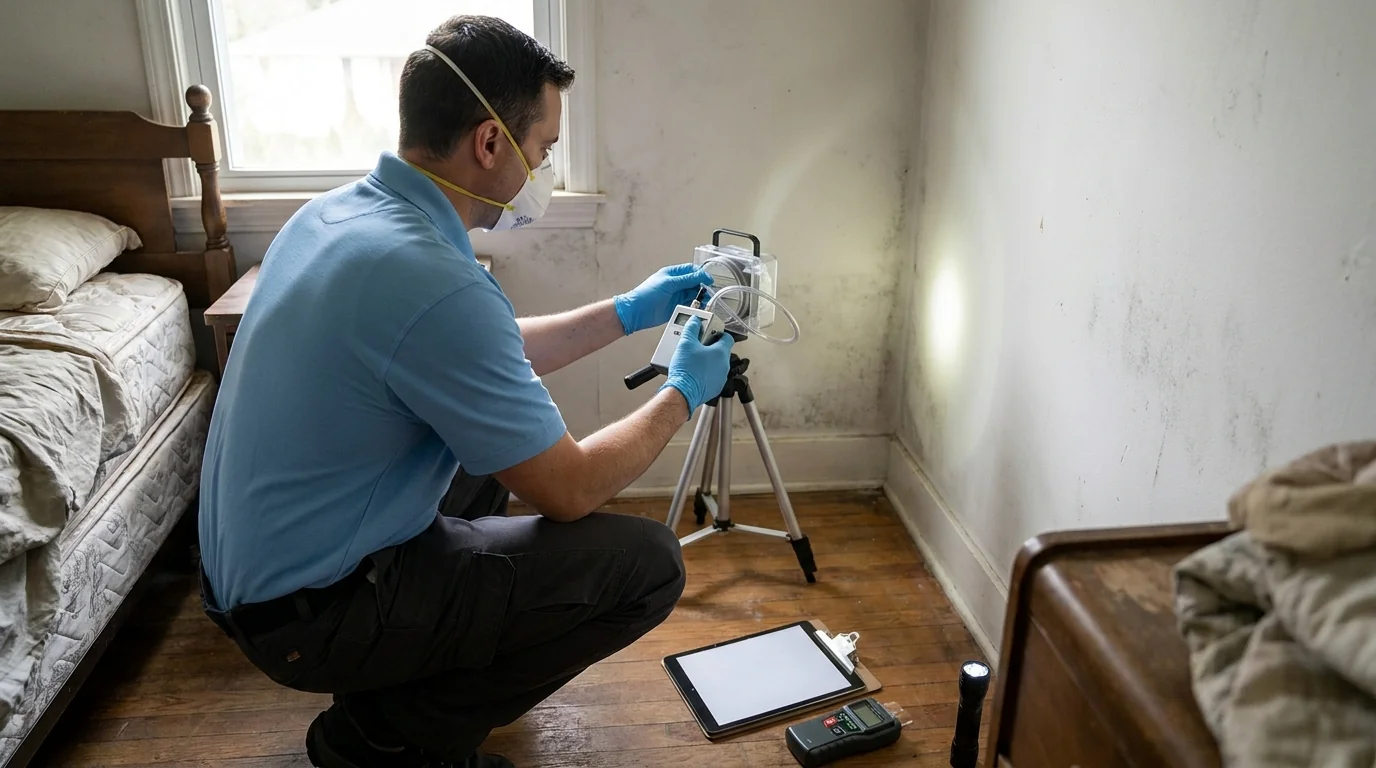
A mold assessment in Wayne isn’t a walk-through with a flashlight. The inspection begins with a visual survey of the areas most likely to harbor hidden growth — basement rim joists, HVAC air handlers, crawl space framing, and any wall surface adjacent to a known water intrusion point. In the older split-levels near Packanack Lake, that often means pulling back carpet at the perimeter of lower-level rooms and checking behind water heaters and laundry units.
From there, air sampling captures what’s actually circulating through the living space. We collect both indoor and outdoor baseline samples so the lab comparison is meaningful — a spore count that looks alarming in isolation may be within normal range relative to outdoor conditions, and vice versa. Surface swab or tape-lift samples are added when visible growth needs species identification. All samples go to an accredited third-party laboratory, and results typically return within two to three business days. The written report identifies species, concentration levels, and the likely moisture source — the last piece being critical for any remediation plan to actually work.
The Restoration Group holds IICRC Firm Certification (#210213), and inspections follow the protocols that certification requires — not a proprietary checklist, but a documented methodology that holds up with insurance adjusters and, when necessary, in legal proceedings.
Reaching Wayne from Kenilworth
From the Kenilworth headquarters, Wayne is accessible via I-78 West to I-287 North, a route that typically runs 30 to 40 minutes under normal traffic conditions. The Route 23 corridor through Wayne Towne Center is often the faster entry point for addresses in the northern and western sections of town, while the Route 46 approach works better for properties closer to Willowbrook Mall and the Pines Lake area. Because Wayne’s river-adjacent neighborhoods can experience road closures during active flood events, the team monitors local traffic and alternate routes before dispatch — particularly for addresses in Hoffman Grove and Mountain View where low-lying roads flood before the rivers crest.
Local Note: What Wayne Inspectors Know That Others Miss
One pattern that comes up repeatedly in Wayne’s lake-community homes: the finished basement walls in many Packanack Lake and Lionshead Lake split-levels were furred out with wood framing directly against the concrete block, with no vapor barrier in between. That cavity — typically an inch and a half wide — is invisible from the finished side and almost never inspected during a standard home purchase. It is, however, exactly the kind of enclosed, damp, dark space where Cladosporium and Penicillium establish quietly over years. When homeowners in these neighborhoods report a persistent musty smell they can’t locate, that wall assembly is the first place we look.
If you’re in Wayne — whether you’re dealing with post-flood uncertainty, a real estate transaction, or symptoms that don’t have an obvious cause — a thorough mold inspection and testing assessment is the clearest way to move from guessing to knowing. Call The Restoration Group at (855) 650-7422 to schedule.
Serving Wayne from our Fair Lawn headquarters — ★ 4.8 · 158 Google reviews
“Teams were very prompt and respectful.. company responded quickly and kept in touch” — Peggy, August 2026Read our reviews on Google →
Mold Inspection and Testing in Wayne: Service Coverage
Frequently Asked Questions
How fast can you arrive for mold inspection and testing in Wayne?
Are homes near Packanack Lake and Lionshead Lake more likely to have hidden mold than other parts of Wayne?
My Hoffman Grove basement flooded during Ida in 2021 and was dried out at the time — do I still need a mold inspection?
How does Wayne's climate affect mold spore counts during the summer months?
Will the mold inspection report satisfy a real estate transaction or insurance claim in the 07470 ZIP code?
What's the difference between a mold inspection and mold testing, and do I need both for a Wayne property?
Mold Inspection and Testing response in Wayne
Most Wayne calls see a technician on-site within 60 minutes from our Fair Lawn headquarters.