Mold Inspection and Testing in Bloomfield
24/7 mold inspection and testing in Bloomfield, NJ. IICRC-certified, insurance billing accepted. Call (855) 650-7422.
Our IICRC-certified technicians are dispatched from our Fair Lawn, NJ headquarters and are typically on-site in Bloomfield within 60 minutes of your call.
When a basement in Watsessing or Brookdale floods — and after Ida in 2021, hundreds did, with sewer backups pushing raw water through floor drains — the visible damage gets addressed first. The mold question comes later, sometimes weeks later, when a musty smell lingers or a family member starts waking up with congestion. By that point, spores have often colonized the back of drywall, the underside of subfloor sheathing, and the paper facing on fiberglass insulation. A proper mold inspection and testing assessment tells you exactly what you’re dealing with, where it is, and whether the air your family is breathing in a 07003 zip code home has crossed into ranges that warrant professional remediation.
Why Bloomfield Properties Are Prone to Hidden Mold
Bloomfield’s housing stock is one of the older and denser in Essex County. The colonials, two-families, and Tudor-style homes built between roughly 1910 and 1940 — common throughout North Center and Brookdale — were constructed before vapor barriers were standard practice. Finished basements in these homes often sit directly against fieldstone or poured-concrete foundations that wick ground moisture year-round. Add to that the original galvanized supply lines and cast-iron waste stacks that are now well past their service life, and slow leaks behind walls become a routine discovery during inspections.
The Second River and Third River (Yantacaw) corridors that thread through Watsessing and Brookdale create localized groundwater pressure that rises after heavy rain. Sump pump failures during summer downpours are among the most common calls in those neighborhoods. Even a pump that fails for six hours overnight can leave enough standing water in a finished basement to start mold colonization within 24 to 48 hours — well before most homeowners realize there was a problem.
On the commercial side, the Broad Street business district and Bloomfield Avenue corridor include older mixed-use buildings with flat or low-slope roofs. Roof membrane failures in those structures often go undetected until a ceiling tile drops or an HVAC unit starts distributing musty air through a retail or restaurant space.
Our Mold Inspection and Testing Process in Bloomfield
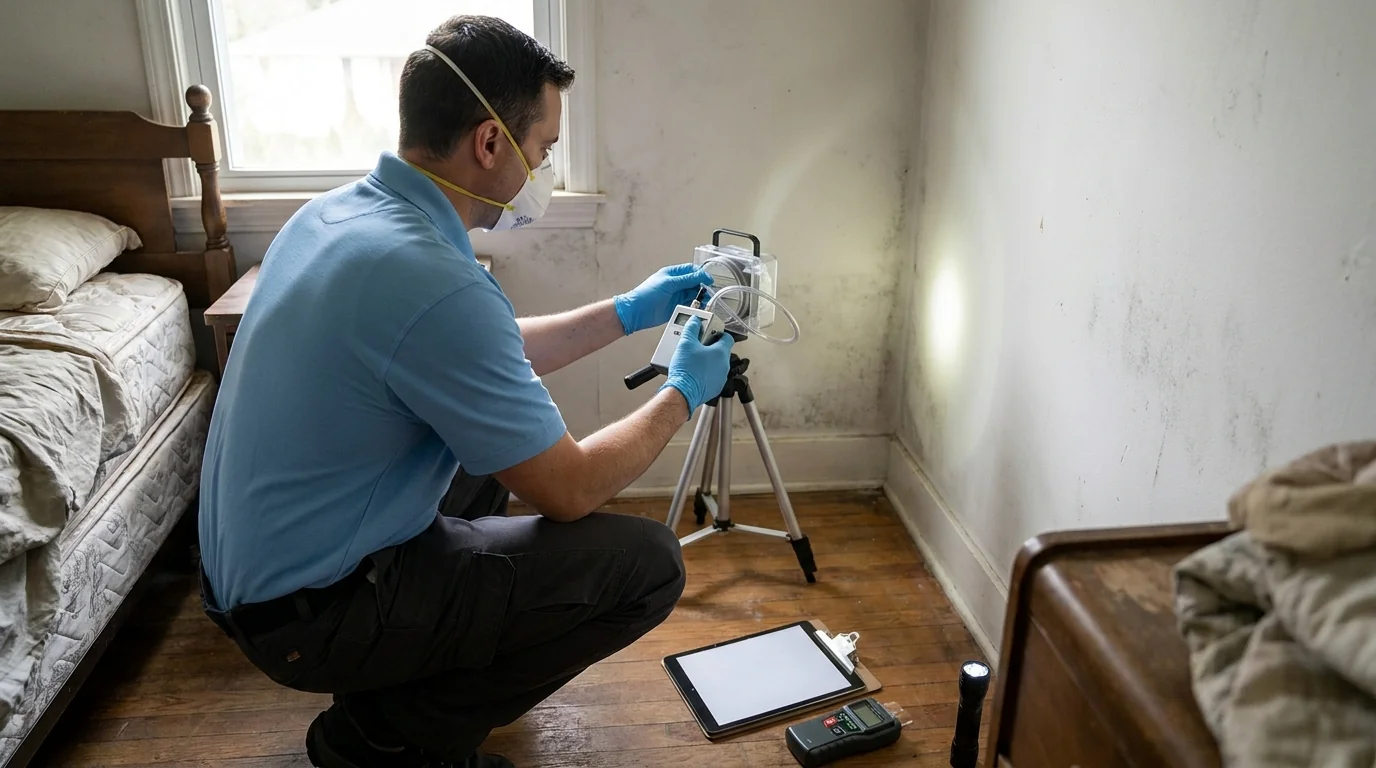
A mold assessment is not a visual walkthrough with a flashlight. The inspection begins with a detailed moisture survey using calibrated thermal imaging and non-invasive moisture meters to map elevated readings behind walls, under flooring, and inside ceiling cavities — without opening walls unnecessarily. In Bloomfield’s older homes, where plaster-over-lath construction is still common, moisture can travel laterally through wall cavities in ways that drywall construction does not, so the survey area typically extends beyond the obvious damage zone.
Air sampling is collected using calibrated spore-trap cassettes at multiple locations — typically one outdoor baseline sample plus two to three interior samples depending on the home’s layout and the number of suspect zones. Swab or tape-lift surface samples are added when visible growth is present or when the moisture map points to a specific cavity. All samples are submitted to an accredited third-party laboratory, and results are typically returned within two to three business days. The written report identifies genus-level mold types, spore concentrations relative to outdoor baseline, and a prioritized scope of findings — the same documentation your insurance adjuster or a prospective buyer’s attorney will ask for.
As an IICRC Certified Firm (#210213), the inspection protocol follows industry standards for mold assessment, which matters when you’re coordinating with a carrier or a real estate transaction.
Reaching Bloomfield from Kenilworth
The Restoration Group operates out of Kenilworth, which puts Bloomfield well within a practical service radius. The most direct route runs north on Route 22 to the Garden State Parkway and into Bloomfield via Broad Street or Bloomfield Avenue — a straightforward drive under normal traffic conditions. Because the team is available around the clock, scheduling an inspection after a late-night sump failure or a morning pipe discovery is not a problem. Call (855) 650-7422 and a coordinator will confirm a same-day or next-available appointment window.
Local Note: What Ida Left Behind in Bloomfield Basements
One pattern that keeps surfacing in Bloomfield inspections — particularly in homes near Watsessing Park and along the lower reaches of the Second River drainage — is mold that was never properly addressed after the September 2021 flooding. Many homeowners dried out the visible water, replaced ruined carpet, and moved on. But sewer-backup water carries a higher biological load than clean water, and organic materials like wood framing, OSB sheathing, and paper-faced insulation that were saturated even briefly can harbor active mold colonies behind a freshly painted or re-drywalled surface. If your Bloomfield home flooded during Ida and has never had a formal air quality or spore-count assessment, that history alone is reason enough to schedule one — especially before listing the property or finishing additional basement space.
If you’re in Bloomfield and have questions about what a mold inspection involves, what the results mean, or how to move forward if growth is confirmed, call (855) 650-7422. The assessment is the first step — and it’s the step that keeps the remediation scope honest.
Mold Inspection and Testing in Bloomfield: Service Coverage
Frequently Asked Questions
How fast can you arrive for mold inspection and testing in Bloomfield?
Are homes near Watsessing Park and the Second River corridor at higher risk for mold after heavy rain?
My Bloomfield home was built in the 1920s and has plaster walls — does that change how a mold inspection is done?
We had sewer backup in our Brookdale basement during the 2021 flooding and never had it formally tested — is mold still a concern three years later?
What does the lab report from a mold inspection actually tell me, and will it satisfy an insurance adjuster or a real estate attorney?
How long does a mold inspection take in a typical Bloomfield two-family or colonial, and when do I get results?
Mold Inspection and Testing response in Bloomfield
Most Bloomfield calls see a technician on-site within 60 minutes from our Fair Lawn headquarters.