Water Cleanup in Union
24/7 water cleanup in Union, NJ. IICRC-certified, insurance billing accepted. Call (855) 650-7422.
Our IICRC-certified technicians are dispatched from our Fair Lawn, NJ headquarters and are typically on-site in Union within 60 minutes of your call.
When a supply line fails behind a finished basement wall in a 1950s split-level off Morris Avenue, the water doesn’t announce itself — it migrates silently through the framing until the carpet squishes underfoot or a seam in the drywall starts to bubble. That scenario plays out regularly across Union Township, where postwar capes and colonials were built with original galvanized supply plumbing that is now well past its service life. The Restoration Group responds 24/7 from our Kenilworth location, putting a crew on-site in Union quickly — before saturation spreads and secondary damage compounds the loss.
Why Union Properties See Water Cleanup Issues
Union Township’s housing stock is the starting point for understanding why water losses here tend to be more involved than they look at first glance. The dense belt of capes, split-levels, and colonials built between the 1940s and 1960s almost universally features finished or semi-finished basements — which means a water event that would be a crawl-space inconvenience elsewhere becomes a multi-material loss: carpet, pad, OSB or plank subfloor, drywall, insulation, and stored belongings all absorbing at different rates simultaneously.
Beyond the plumbing age, Union’s geography adds a second layer of risk. Tributaries of the Elizabeth and Rahway rivers thread through the township, and low-lying areas — particularly around Vauxhall and sections off Morris Avenue — have flooded in heavy summer storms and during events like Tropical Storm Ida. That kind of flood water carries silt and contaminants that plain extraction won’t address; the cleanup protocol has to account for category classification, not just volume removed.
The Route 22 corridor introduces a different profile: commercial sprinkler discharges, roof-membrane failures on flat-topped retail buildings, and overnight losses at restaurants where a dishwasher line fails after close. Kean University’s student housing adds yet another pattern — high-occupancy buildings where a single unit’s overflow migrates to multiple floors before anyone notices.
Our Water Cleanup Process in Union
The first thing a crew does on arrival is classify the water source — clean supply line, gray-water appliance, or black-water intrusion from a backed drain or exterior flood. That classification drives every decision that follows, including what PPE is required, whether contents can be moved in place or must be removed, and how aggressively porous materials need to be treated.
After classification, we map moisture with thermal imaging and calibrated meters. In Union’s older homes, this step matters more than it does in newer construction: plaster-and-lath walls, common in homes built before the mid-1960s in neighborhoods like Battle Hill and Union Center, absorb water differently than paper-faced drywall. The surface can read close to dry while the lath behind it stays saturated — a reading-only approach misses that, and a premature pack-out leads to mold growth inside a wall that looked fine on inspection day.
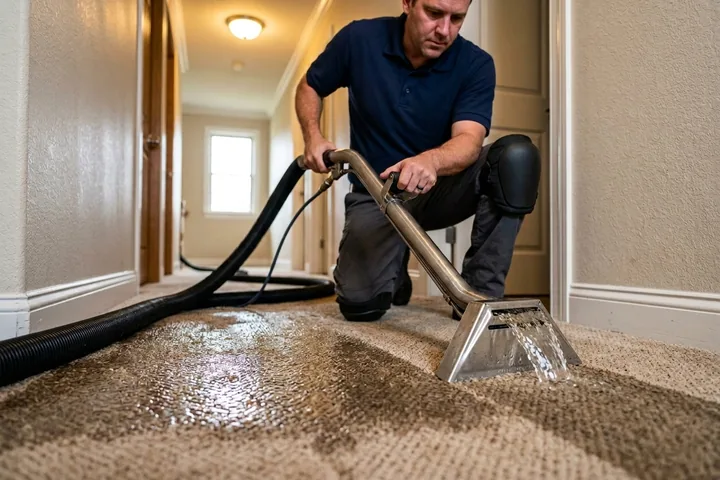
Extraction comes next, followed by the placement of drying equipment calibrated to the actual cubic footage and material types in the affected space. Drying logs are recorded daily and shared with the homeowner and, where applicable, the insurance adjuster. We don’t pull equipment until moisture readings confirm the structure has returned to normal levels — not when a timeline says it should be dry.
Reaching Union from Kenilworth
Our Kenilworth base sits directly adjacent to Union Township’s border, which means dispatch to addresses in Vauxhall, the Union Center business district, or the residential streets around Galloping Hill Golf Course doesn’t involve crossing multiple towns or navigating highway interchanges. For homeowners in ZIP code 07083 or 07088, that proximity matters when water is actively moving through a structure.
We operate 24/7, so a call at 2 a.m. about a burst pipe or a basement filling during a storm reaches a live dispatcher, not a voicemail. Crews stage from Kenilworth with extraction equipment loaded, which reduces the gap between your call and water coming out of the structure.
Local Note
One thing worth knowing about Union’s postwar split-levels: the half-level design means the lower level is often only partially below grade, with exterior walls that are part concrete block and part wood-framed. When water enters through a window well or a failed sump, it hits both materials at once. Concrete block wicks moisture laterally and holds it for a long time; the wood framing above it dries on a different schedule entirely. Drying equipment placed only in the open floor area of that lower level often misses the block-wall saturation entirely. Effective drying in these homes requires equipment positioned against the block, not just in the center of the room — a detail that makes a real difference in final moisture readings and in whether the wall needs to come out.
Insurance Coordination for Union Water Losses
Most residential water losses in Union — burst supply lines, appliance failures, sudden and accidental overflows — fall within standard homeowners’ policy coverage. We document the loss thoroughly from the moment we arrive: photos, moisture readings, affected-material inventories, and drying logs that meet carrier documentation standards. That file goes directly to your adjuster, and we can bill most major carriers directly so you are not managing reimbursement out of pocket while the work is in progress.
For flood losses tied to exterior water intrusion — the kind that affects low spots in Vauxhall during a hard storm — coverage depends on whether the homeowner carries a separate NFIP or private flood policy. We can help you identify what caused the loss and document it clearly, but the coverage question is one to take directly to your agent.
If you’re dealing with standing water in your Union home or business right now, call (855) 650-7422. We’ll dispatch a crew, assess the loss honestly, and start moving water out of your structure — not next week, tonight.
Water Cleanup in Union: Service Coverage
Frequently Asked Questions
How fast can you arrive for water cleanup in Union?
How quickly can The Restoration Group reach a home in Vauxhall or the Union Center area?
Are the older split-levels and capes in Union's 07083 ZIP code harder to dry out after a water loss?
Does exterior flooding from storms — the kind that hits low areas near Vauxhall — get handled differently than an indoor pipe burst?
What equipment do you use for standing water removal, and how long does the drying process typically take?
Will my homeowners' insurance cover a water cleanup loss in Union, and do you handle the billing?
Water Cleanup response in Union
Most Union calls see a technician on-site within 60 minutes from our Fair Lawn headquarters.