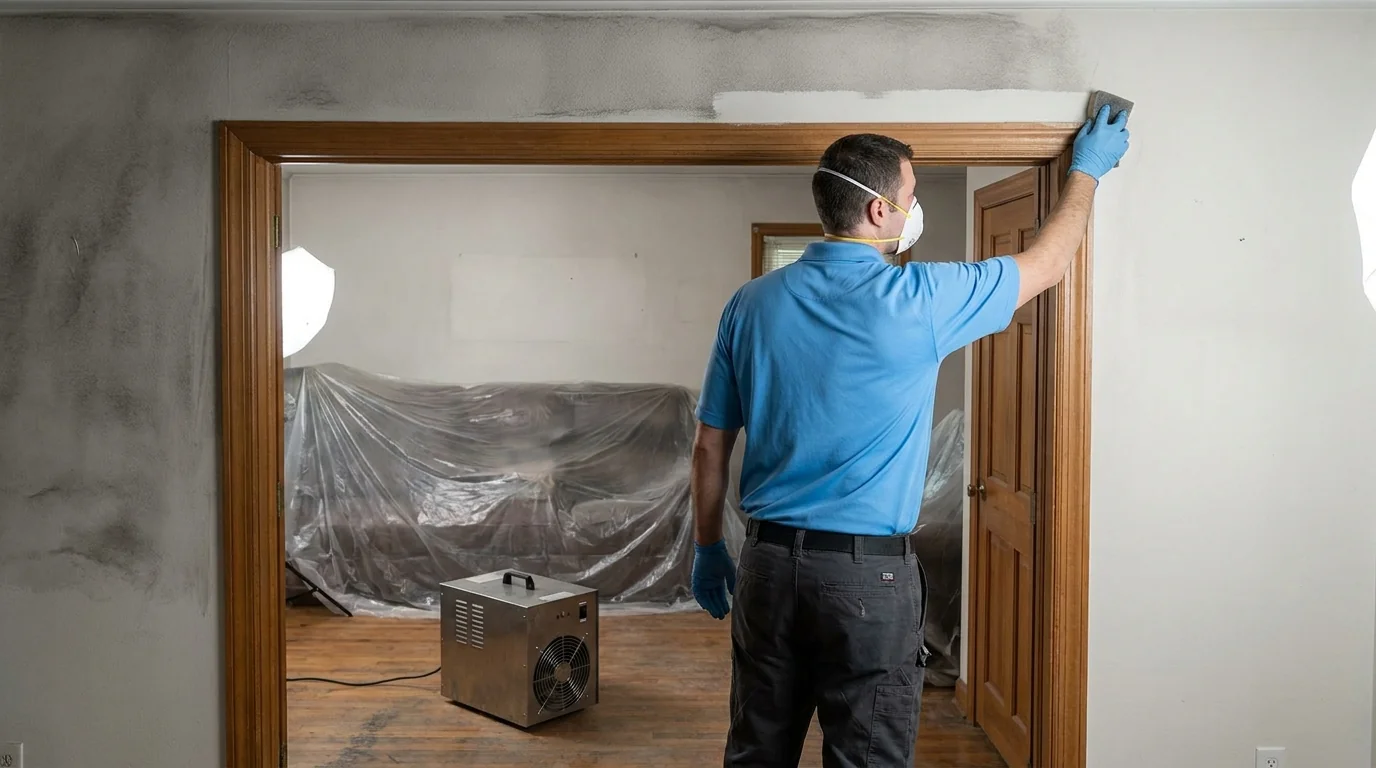
24/7 Emergency Smoke Damage Restoration in Staten Island
24/7 emergency smoke damage restoration in Staten Island, NY. IICRC-certified, insurance billing accepted. Call (855) 650-7422.
Our IICRC-certified technicians are dispatched from our Fair Lawn, NJ headquarters and are typically on-site in Staten Island within 60 minutes of your call.
A kitchen fire in a Port Richmond row house or a basement electrical fire in one of New Dorp’s postwar split-levels leaves more than charred walls, it leaves smoke chemistry embedded in every surface the air touched. Smoke residue travels far beyond the room of origin, seeping into HVAC ductwork, settling into plaster ceilings, and bonding with the porous masonry that defines so much of Staten Island’s older housing stock. The Restoration Group dispatches crews around the clock from its base in Kenilworth, NJ, crossing into Staten Island via the Goethals or Bayonne Bridge to begin documented, systematic smoke damage restoration before secondary damage compounds the loss.
Why Staten Island’s Housing Stock Complicates Smoke Damage
Statten Island’s building inventory spans nearly a century of construction styles, and that variety matters when smoke gets into a structure. Early-1900s frame homes in St. George and Port Richmond were built with true-dimension lumber, horsehair plaster, and minimal vapor barriers, materials that absorb smoke particulates and odor compounds at a different rate than modern drywall. Plaster walls, in particular, hold soot in their pores long after a surface wipe-down looks clean, which means standard dry-sponge or chemical sponge protocols have to be followed by deeper encapsulation or controlled removal to achieve a genuine odor-neutral result.
The dense postwar Cape Cods and split-levels that fill neighborhoods like Great Kills and South Beach introduce a different challenge: finished attics and low-pitch rooflines that trap smoke stratification in tight ceiling cavities. When heat and smoke rise and hit a flat or near-flat ceiling, residue concentrates there. Those ceiling voids are often inaccessible without controlled demolition, and insurance documentation has to reflect that scope before work begins.
Commercial properties along the Hylan Boulevard and Forest Avenue corridors face their own wrinkle: sprinkler-discharge events that follow a contained fire leave both water and smoke residue simultaneously, requiring coordinated drying and soot removal rather than treating the two losses sequentially.
Our Smoke Damage Restoration Process in Staten Island
Every job starts with a structured assessment, not a visual walkthrough, but a room-by-room mapping of smoke migration using thermal imaging and air sampling. Smoke does not stop at the door of the room that burned; it follows pressure differentials through wall cavities, ductwork, and any gap in the building envelope. We document the full extent before touching a surface, because insurance carriers require that scope to authorize the right repair budget.
Once the scope is confirmed, the process moves in a defined sequence:
- HVAC isolation and duct cleaning, forced-air systems are shut down immediately to stop recirculating soot. Ductwork is inspected and cleaned using negative-air equipment before the system is returned to service.
- Dry and wet soot removal, protein-based smoke (common in kitchen fires) and synthetic smoke (electrical or structural fires) require different chemical agents. Mismatching the chemistry smears residue rather than lifting it.
- Structural deodorization, thermal fogging and hydroxyl generation reach into wall cavities and subflooring where spray-and-wipe methods cannot penetrate.
- Content pack-out or on-site cleaning, soft goods, furniture, and personal items are either cleaned on-site or transported to a controlled facility, with a detailed inventory maintained for the insurance claim.
- Reconstruction coordination, when smoke damage requires drywall replacement, ceiling repair, or repainting, we coordinate those trades so the homeowner has a single point of contact through project close.
All drying and decontamination work follows IICRC standards (we hold Certified Firm #210213), and our technicians document each phase with timestamped photos for the claim file.
Reaching Staten Island from Kenilworth
The Restoration Group maintains a borough presence on Staten Island, which means crews are not always crossing from New Jersey, local staging reduces drive time meaningfully. For jobs in ZIP codes like 10301 (St. George, Stapleton) or 10306 (New Dorp, Oakwood), we can typically have a crew on-site faster than a mainland-only operation routing through bridge traffic. We answer calls 24 hours a day, seven days a week, and dispatch is initiated immediately, not queued for a morning callback.
For the South Shore, including Tottenville and Great Kills, the route via the Staten Island Expressway to the Richmond Parkway adds time, but our crew coordinates by phone during transit to give the property owner clear arrival windows and pre-arrival instructions (ventilate if safe, avoid running HVAC, document visible damage with photos).
Staten Island Insurance Coordination
Smoke damage claims on Staten Island follow standard homeowner policy structures, but the borough’s housing age creates scope disputes that are worth anticipating. Older plaster walls, original hardwood floors, and period millwork in homes near Historic Richmond Town or Snug Harbor Cultural Center carry replacement costs that exceed builder-grade materials, and some carriers push back on like-for-like restoration without detailed documentation. Our team produces a written scope with line-item pricing that references current material costs, giving your adjuster a defensible basis for the full claim rather than a depreciated settlement.
We bill carriers directly and work with most major homeowner and commercial property insurers operating in New York.
Local Note
Statten Island’s older homes, particularly the early-twentieth-century frame and brick construction common in the St. George and Port Richmond corridors, frequently have original cast-iron radiator systems with plaster-lathe wall assemblies. When smoke infiltrates these walls, the iron pipes act as a thermal reservoir, re-volatilizing odor compounds for days after the fire is out and the obvious soot has been wiped down. Homeowners in these blocks sometimes report that the smoke smell “comes back” a week after a cleaning service was through. That’s not a cleaning failure, it’s physics. Effective deodorization in these homes requires thermal fogging after the building has been heated to operating temperature, so the volatilized compounds are present in the air column when the deodorizing agent is introduced.
If your home on Staten Island has had a fire and the smell returned after initial cleanup, call (855) 650-7422. A second-opinion assessment costs nothing, and we can tell you quickly whether the residual odor indicates incomplete treatment or an ongoing source that needs to be addressed before reconstruction begins.
Serving Staten Island from our Fair Lawn headquarters — ★ 4.8 · 167 Google reviews
“Prompt, knowledgeable, skillful and honest. Highly recommend. They remediated within 24 hours. Total peace of mind restored. Worth every penny.” - Anne, October 2026Read our reviews on Google →
Smoke Damage Restoration in Staten Island: Service Coverage
Frequently Asked Questions
How fast can you arrive for smoke damage restoration in Staten Island?
How quickly can The Restoration Group reach South Beach or Great Kills after a smoke damage call?
Are the older plaster-wall homes in St. George and Port Richmond harder to fully deodorize after a fire?
My home near Historic Richmond Town has original millwork and hardwood floors. Will insurance cover like-for-like restoration after smoke damage?
What's the difference between protein smoke and synthetic smoke, and why does it matter for cleanup?
A commercial property I manage on Hylan Boulevard had a small fire followed by sprinkler discharge. Do you handle both the smoke and water damage together?
Smoke Damage Restoration response in Staten Island
Most Staten Island calls see a technician on-site within 60 minutes from our Fair Lawn headquarters.
Nearby & Related
- 24/7 Emergency Smoke Damage Restoration in Kenilworth
- Restoration Services in Staten Island
- 24/7 Emergency Fire Damage Restoration in Staten Island
- Mold Remediation in Staten Island
- 24/7 Emergency Smoke Damage Restoration in Bayonne
- 24/7 Emergency Smoke Damage Restoration in Bloomfield
- Contact The Restoration Group