Mold Remediation in Staten Island
24/7 mold remediation in Staten Island, NY. IICRC-certified, insurance billing accepted. Call (855) 650-7422.
Our IICRC-certified technicians are dispatched from our Fair Lawn, NJ headquarters and are typically on-site in Staten Island within 60 minutes of your call.
The East Shore of Staten Island has never fully dried out. Since Hurricane Sandy tore through South Beach and Oakwood Beach in 2012, and again when Ida’s flash flooding crept up low-lying South Shore streets in 2021, many basements and crawlspaces in this borough have cycled through wet-dry-wet conditions enough times that mold isn’t a surprise anymore. It’s a pattern. If you’re smelling something musty in a finished basement off Hylan Boulevard or noticing dark streaking behind drywall in a postwar Cape Cod near Great Kills, that’s not just age, it may be active mold colonization that started with moisture that never fully left.
Why Staten Island Properties See Mold Issues
The borough’s housing stock tells the story. Frame homes built in the early 1900s around St. George and Port Richmond were constructed before vapor barriers were standard, and their wood-framed walls and subfloors absorb and hold moisture in ways newer construction doesn’t. Postwar Cape Cods and split-levels, dense throughout the mid-island ZIP codes like 10306 and 10314, often have finished basements with minimal airflow, exactly the warm, humid, dark environment where mold can establish a foothold within 24 to 48 hours of a water intrusion.
Aging cast-iron drain lines and galvanized supply pipes are common in pre-1970 homes across the borough. When those pipes fail, and they do, quietly, inside walls or under slabs, the leak can go undetected for days. By the time a homeowner notices a stain or a smell, mold may already be colonizing behind the baseboard. The borough’s proximity to the water doesn’t help: relative humidity along the East Shore runs higher than inland areas for much of the year, which means building materials stay closer to the moisture threshold mold needs to grow.
Our Mold Remediation Process in Staten Island
Mold remediation is not the same as mold cleaning. Wiping visible growth with bleach doesn’t address spores embedded in porous materials or airborne contamination that has spread beyond the visible patch. The process we follow is structured around the IICRC S520 standard for mold remediation and begins with a thorough assessment, moisture mapping with thermal imaging and pin meters to find hidden wet zones before any physical work starts.
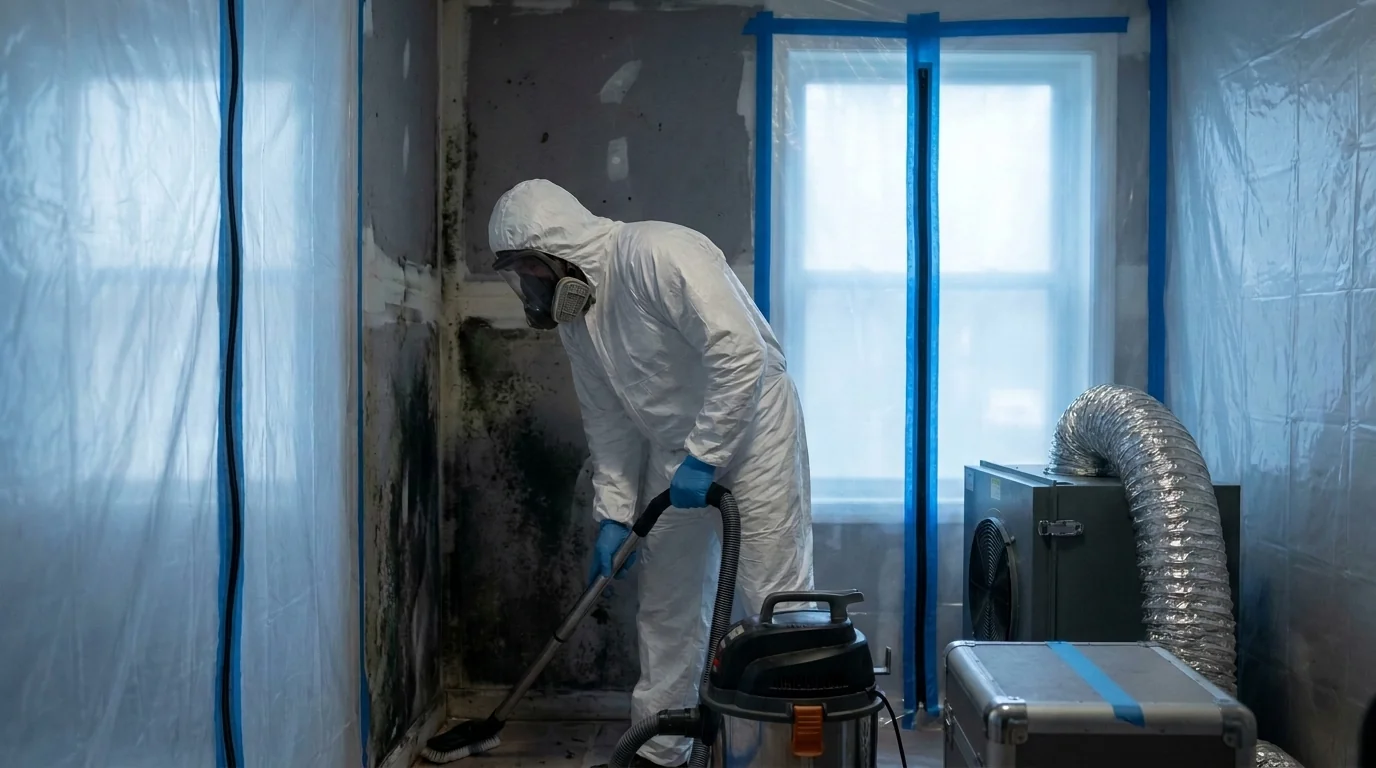
Containment comes first. We seal the affected area with polyethylene barriers and establish negative air pressure using HEPA-filtered air scrubbers so that disturbed spores can’t migrate to unaffected rooms. Contaminated porous materials, drywall, insulation, wood framing that can’t be cleaned to a safe threshold, are removed, bagged, and disposed of properly. Structural surfaces that remain are treated with an EPA-registered antimicrobial agent. Drying equipment stays in place until moisture readings confirm the substrate has returned to normal levels for the material type. We don’t close a job until the numbers support it.
For homes in flood-prone areas like South Beach or Midland Beach, we pay particular attention to crawlspaces and wall cavities at or below grade, those zones often hold residual moisture from prior events even when the visible interior looks dry.
Reaching Staten Island from Our Kenilworth Base
The Restoration Group operates around the clock, and crews can reach Staten Island via the Goethals Bridge or Bayonne Bridge depending on traffic and the specific address. The North Shore, St. George, Port Richmond, Snug Harbor, is accessible quickly from the Bayonne crossing. South Shore addresses near Tottenville or Great Kills typically route through the Goethals. Because we run 24/7, a call at 2 a.m. about a burst pipe that’s been soaking a finished basement gets the same response as a weekday morning call.
Staten Island Insurance Coordination
Most mold claims on Staten Island trace back to a covered water loss, a pipe break, an appliance failure, a roof leak after a nor’easter. Whether the underlying loss is covered depends on your policy language, but the documentation we provide, moisture logs, photos, material inventories, and scope-of-work reports, is formatted to work with insurance adjusters and supports a clean claim submission. We’ve handled commercial claims along the Forest Avenue corridor and residential claims in postwar neighborhoods throughout the borough, and we know what carriers typically ask for.
If your claim involves a prior Sandy or Ida-related loss that was remediated but may not have been fully resolved, we can assess whether residual mold is a new occurrence or a continuation of a prior event, a distinction that matters for coverage.
Local Note
In the postwar split-levels and raised ranches common throughout New Dorp and Great Kills, the space between the first-floor subfloor and the crawlspace is often only 18 to 24 inches, too low for standard equipment staging. Our crews work in confined-space conditions regularly on Staten Island and carry low-profile drying equipment sized for those crawlspaces. It’s a small detail, but it’s the difference between a job that gets done properly and one where the technician can’t reach the worst of the moisture and the mold comes back within a season.
If you’re seeing signs of mold growth, visible discoloration, a persistent earthy or musty odor, or a family member with unexplained respiratory irritation, call (855) 650-7422. We serve all of Staten Island, and our team is available any hour to assess what’s happening and explain what remediation would actually involve for your specific property.
Serving Staten Island from our Fair Lawn headquarters — ★ 4.8 · 167 Google reviews
“Prompt, knowledgeable, skillful and honest. Highly recommend. They remediated within 24 hours. Total peace of mind restored. Worth every penny.” - Anne, October 2026Read our reviews on Google →
Mold Remediation in Staten Island: Service Coverage
Frequently Asked Questions
How fast can you arrive for mold remediation in Staten Island?
Are homes near South Beach and Midland Beach more prone to recurring mold after flooding?
How does the older housing stock in St. George and Port Richmond affect mold remediation?
Does mold remediation in Staten Island require a post-remediation air clearance test?
What ZIP codes on Staten Island do you serve, and how quickly can you respond?
What's the difference between mold removal and mold remediation, and why does it matter for a Staten Island basement?
Will my homeowners insurance cover mold remediation in Staten Island?
Mold Remediation response in Staten Island
Most Staten Island calls see a technician on-site within 60 minutes from our Fair Lawn headquarters.