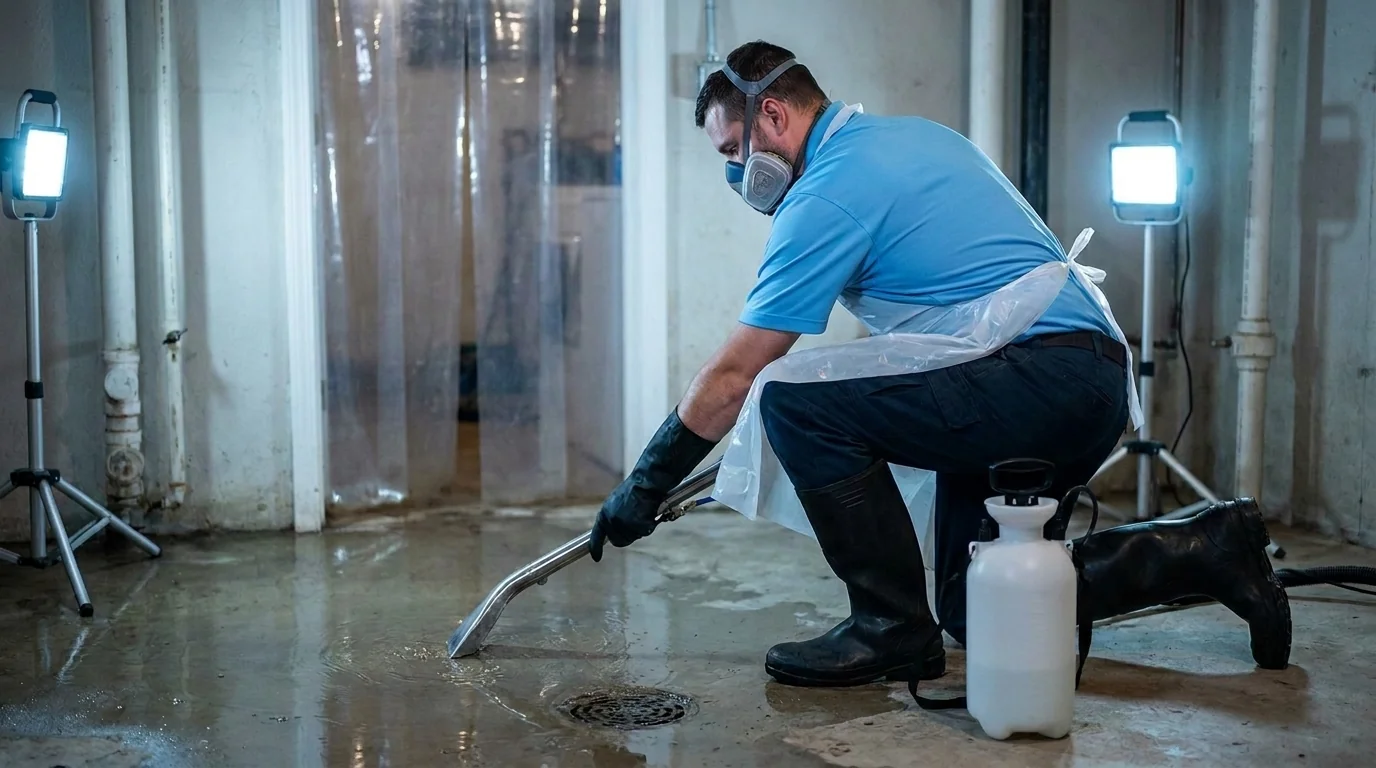
24/7 Emergency Sewage Cleanup and Sanitization in Staten Island
24/7 emergency sewage cleanup and sanitization in Staten Island, NY. IICRC-certified, insurance billing accepted. Call (855) 650-7422.
Our IICRC-certified technicians are dispatched from our Fair Lawn, NJ headquarters and are typically on-site in Staten Island within 60 minutes of your call.
When a sewer line backs up into a basement on the East Shore, in neighborhoods like South Beach or Great Kills, where post-Sandy infrastructure repairs left some lateral lines still running through saturated, settled soil, the damage isn’t just water. Raw sewage carries bacteria, viruses, and pathogens that soak into concrete block walls and subfloor framing within hours. The Restoration Group operates 24/7 and keeps crews based on Staten Island, so when that call comes in at 2 a.m., the response isn’t coming from across the state.
Why Staten Island Properties See Sewage Backup More Often Than You’d Expect
The borough’s housing stock tells part of the story. A large share of homes in ZIP codes like 10304 and 10306 were built between the 1940s and 1970s, Cape Cods and split-levels with cast-iron drain stacks that are now 50 to 80 years old. Cast iron corrodes from the inside out, and the first sign of trouble is often a slow drain that suddenly becomes a full backup. In older sections of Port Richmond and New Dorp, clay tile sewer laterals are still common; tree root intrusion into those lines is one of the most frequent causes of sewage overflow we encounter on the North and Mid-Island.
The East Shore adds a separate layer of risk. The flooding that Hurricane Sandy brought to Oakwood Beach and Midland Beach in 2012, and the inland flash flooding Ida pushed through low-lying South Shore streets in 2021, overloaded the municipal combined sewer system repeatedly. When storm surge or heavy rain overwhelms capacity, sewage can back-flow through floor drains and basement toilets even in homes with no plumbing defect at all. That’s a Category 3 contamination event regardless of how it started, and it requires the same full sanitization protocol as a direct pipe failure.
Our Sewage Cleanup and Sanitization Process in Staten Island
Every sewage job starts with containment. Technicians establish a work perimeter, don PPE, and assess the source before anything else moves. If the line is still active, we coordinate with the property owner and, when necessary, with NYC DEP to confirm the lateral is cleared before extraction begins.
From there, the process follows a defined sequence:
- Extraction and removal: Standing sewage is removed with truck-mounted extraction units. Porous materials, drywall, insulation, carpet, subfloor sections, that absorbed Category 3 water are bagged and removed per NYC sanitation guidelines. There is no drying porous material that has been saturated with raw sewage; it comes out.
- Antimicrobial treatment: All affected structural surfaces are treated with EPA-registered disinfectants. In basements with concrete block or poured concrete walls, we apply multiple passes because those materials are more porous than they appear.
- Drying and dehumidification: After contaminated materials are removed and surfaces are treated, drying equipment is staged to bring structural moisture levels down to pre-loss readings. In Staten Island’s humid summers, ambient moisture slows drying times, we account for that in equipment placement and monitoring schedules.
- Post-treatment verification: We document moisture readings and surface conditions before closing out, providing records that support your insurance claim.
Reaching Staten Island from Our Base
The Restoration Group maintains a crew presence on Staten Island, which means response doesn’t depend on crossing the Goethals or Bayonne Bridge during peak traffic. For a sewage emergency in St. George near the Staten Island Ferry Terminal, or a commercial property along the Hylan Boulevard corridor, crews can mobilize directly from the borough. We’re available 24/7, including overnight and weekend calls when sewage backups most often go unnoticed until significant damage has already spread.
Insurance Coordination for Sewage Claims in Staten Island
Sewage backup coverage is one of the most commonly misunderstood elements of a standard homeowner’s policy. In New York, basic HO-3 policies typically exclude sewer backup unless a specific rider was added, and many Staten Island homeowners, particularly in older homes that predate the widespread marketing of that endorsement, don’t have it. We document every loss thoroughly: photographs, moisture logs, material inventories, and scope of work. That documentation supports your adjuster’s review whether the claim is covered under a backup rider, a flood policy through NFIP, or a combination. We bill carriers directly when coverage is confirmed.
Local Note
In the postwar Cape Cods and split-levels common throughout New Dorp and Great Kills, the subfloor framing often sits directly on a concrete slab or over a shallow crawlspace with minimal clearance. When sewage reaches those crawlspaces, the confined space limits equipment access and extends drying time considerably, sometimes by a full day or more compared to a full basement. Our crews carry low-profile drying equipment specifically for these configurations, and we inspect crawlspace access points before quoting scope so there are no surprises mid-job.
If sewage has backed up into your Staten Island home or commercial property, call (855) 650-7422 now. The longer contaminated water sits against framing, insulation, and concrete, the deeper it penetrates, and the more material has to come out. Our team is on call around the clock and can be on-site the same day.
Serving Staten Island from our Fair Lawn headquarters — ★ 4.8 · 167 Google reviews
“Prompt, knowledgeable, skillful and honest. Highly recommend. They remediated within 24 hours. Total peace of mind restored. Worth every penny.” - Anne, October 2026Read our reviews on Google →
Sewage Cleanup and Sanitization in Staten Island: Service Coverage
Frequently Asked Questions
How fast can you arrive for sewage cleanup and sanitization in Staten Island?
Are homes in South Beach and the East Shore at higher risk for sewage backups during heavy rain?
How quickly can The Restoration Group reach a sewage backup in St. George or Port Richmond?
Does NYC DEP need to be involved before sewage cleanup can start in Staten Island?
What materials typically have to be removed versus dried after a sewage backup in a Staten Island basement?
Does a standard homeowner's policy in New York cover sewage backup cleanup, and how does The Restoration Group help with the claim?
Will my homeowners insurance cover sewage cleanup and sanitization in Staten Island?
Sewage Cleanup and Sanitization response in Staten Island
Most Staten Island calls see a technician on-site within 60 minutes from our Fair Lawn headquarters.
Nearby & Related
- 24/7 Emergency Sewage Cleanup and Sanitization in Kenilworth
- Restoration Services in Staten Island
- 24/7 Emergency Fire Damage Restoration in Staten Island
- Mold Remediation in Staten Island
- 24/7 Emergency Sewage Cleanup and Sanitization in Bayonne
- 24/7 Emergency Sewage Cleanup and Sanitization in Bloomfield
- Contact The Restoration Group