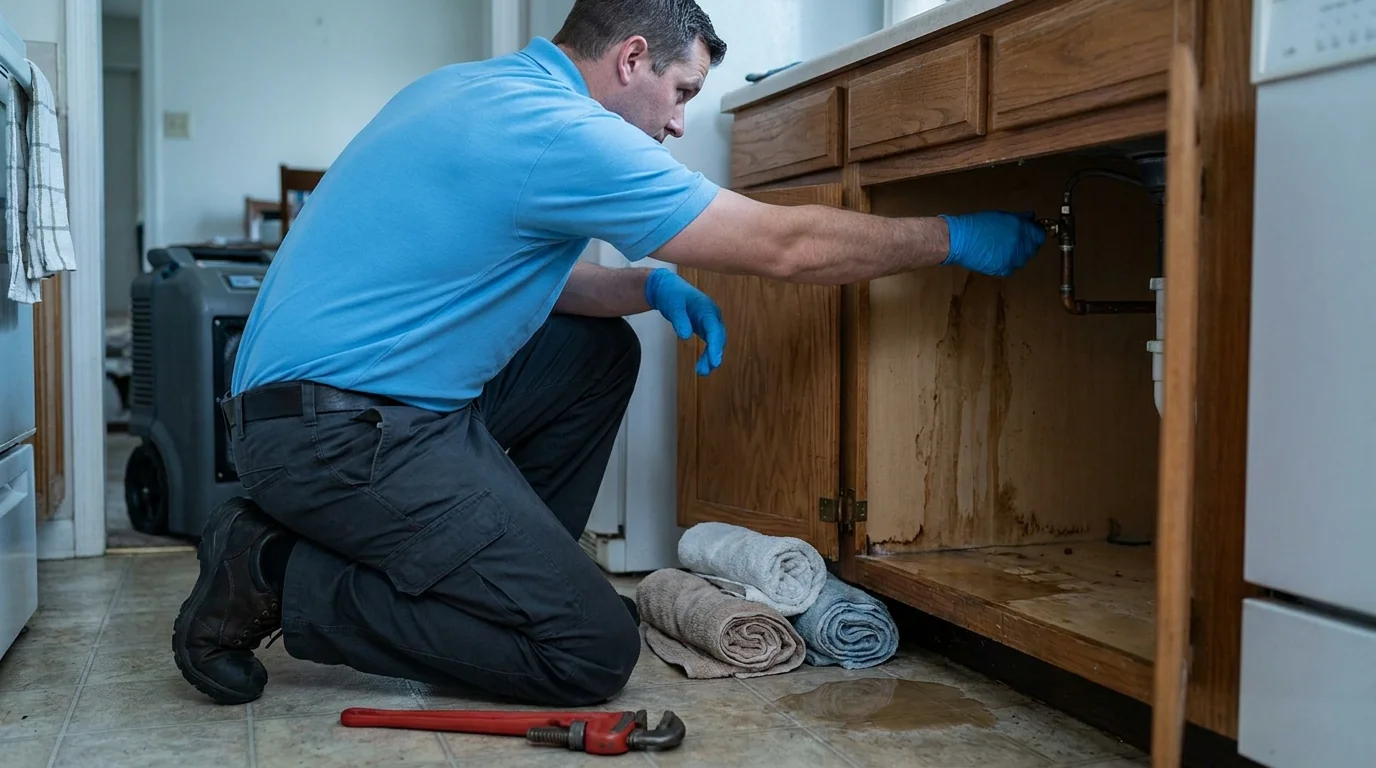
24/7 Emergency Burst Pipe Cleanup and Repair in Staten Island
24/7 emergency burst pipe cleanup and repair in Staten Island, NY. IICRC-certified, insurance billing accepted. Call (855) 650-7422.
Our IICRC-certified technicians are dispatched from our Fair Lawn, NJ headquarters and are typically on-site in Staten Island within 60 minutes of your call.
Cast-iron supply lines installed decades ago in Staten Island’s postwar Cape Cods and split-levels don’t announce their failure, they simply let go, often in the dead of winter when temperature swings between the harbor and the South Shore push aging metal past its limit. When a pipe bursts behind a finished wall in Great Kills or beneath the slab of a New Dorp two-family, the water moves fast and quietly, soaking subfloor, insulation, and framing before anyone notices the drop in pressure. The Restoration Group has a crew base on Staten Island and responds around the clock to stop the loss, extract the water, and get the repair documented before secondary damage sets in.
Why Staten Island Properties See More Burst Pipe Losses
The borough’s housing stock tells the story. Blocks of frame homes built between the 1920s and 1950s, concentrated in Port Richmond and St. George, still carry original galvanized or cast-iron supply lines that have spent a century contracting and expanding with the seasons. Those pipes corrode from the inside out, so the first visible sign of a problem is often a wet ceiling rather than a slow drip. Newer townhome developments on the West Shore fare better on pipe age but introduce a different risk: shared water mains and HOA-managed shutoffs that can delay isolation when a line breaks inside a unit.
Freezing is a real factor here. Staten Island sits at the outer edge of New York Harbor, and the East Shore corridor, already sensitized by Hurricane Sandy in 2012 and the inland flash flooding Ida brought in 2021, has homes where crawlspace insulation was compromised by prior flood events and never fully restored. An under-insulated crawlspace is a reliable path to a frozen and ruptured supply line the first time January temperatures drop into the single digits.
Our Burst Pipe Cleanup and Repair Process
The first priority on arrival is water isolation. Our technicians locate the main shutoff, or coordinate with building management if it’s a shared system, and stop the flow before any extraction begins. From there the process follows a documented sequence:
Extraction and moisture mapping. Truck-mounted extractors pull standing water from finished and unfinished spaces. Thermal imaging cameras identify water that has migrated behind drywall or under hardwood flooring, which is common in the older balloon-frame construction found throughout Port Richmond and South Beach. Every affected area is logged with moisture readings before drying equipment is placed.
Structural drying. Industrial desiccant dehumidifiers and high-velocity air movers run continuously. Drying timelines are monitored against IICRC S500 standards, typically three to five days for Category 1 losses in conditioned space, longer if plaster walls or dense subfloor assemblies are involved.
Pipe repair coordination. We work alongside licensed plumbers to complete the break repair and pressure-test the line before any wall or ceiling is closed. Restoration closes out only after the repaired system holds pressure and moisture readings return to baseline.
Documentation for insurance. Every step, moisture logs, thermal images, equipment placement records, and scope of work, is packaged for your carrier. We bill most major insurers directly.
Getting to Staten Island from Our Crew Base
Because The Restoration Group maintains a crew base on the island, dispatching to any ZIP code, from 10301 near the ferry terminal to 10312 on the South Shore, doesn’t require crossing the Goethals or Bayonne Bridge under emergency conditions. That matters at 2 a.m. when a pipe lets go in a finished basement in Tottenville. Call (855) 650-7422 and a dispatcher will confirm the nearest available crew; we’re available 24/7.
For commercial losses along the Hylan Boulevard or Forest Avenue retail corridors, where a sprinkler-line failure or water-main break can affect multiple tenant spaces simultaneously, we can stage multiple extraction units and coordinate with building management to prioritize occupied areas.
Local Note: Plaster Walls and Drying Time in Older Staten Island Homes
In the pre-1950 frame homes concentrated around St. George and Port Richmond, interior walls are often original lime plaster over wood lath rather than modern drywall. Plaster absorbs water more slowly than gypsum board, which means the surface can feel dry to the touch while the substrate behind it still holds significant moisture. Our technicians account for this by extending monitoring cycles and placing dehumidifiers closer to wall cavities in these homes. Rushing the drying phase to save a day on equipment rental is how plaster-wall losses turn into mold remediation jobs three weeks later, a pattern we see enough on this island that it’s built into our standard scope for pre-1960 structures.
If a burst pipe has left standing water anywhere in your Staten Island home or commercial property, the clock on secondary damage is already running. Call (855) 650-7422, our crew is on the island and available around the clock to extract, dry, and document the loss before it compounds.
Serving Staten Island from our Fair Lawn headquarters — ★ 4.8 · 167 Google reviews
“Prompt, knowledgeable, skillful and honest. Highly recommend. They remediated within 24 hours. Total peace of mind restored. Worth every penny.” - Anne, October 2026Read our reviews on Google →
Burst Pipe Cleanup and Repair in Staten Island: Service Coverage
Frequently Asked Questions
How fast can you arrive for burst pipe cleanup and repair in Staten Island?
How quickly can your crew reach South Beach or the East Shore after a pipe burst?
My Tottenville townhome has a shared water main managed by the HOA — does that complicate the shutoff and repair process?
Are older homes in Port Richmond or St. George at higher risk for burst pipes than newer construction?
What does the drying process look like inside a finished basement in a Staten Island split-level?
Will my homeowner's insurance cover a burst pipe loss in Staten Island, and does The Restoration Group handle the billing?
Burst Pipe Cleanup and Repair response in Staten Island
Most Staten Island calls see a technician on-site within 60 minutes from our Fair Lawn headquarters.
Nearby & Related
- 24/7 Emergency Burst Pipe Cleanup and Repair in Kenilworth
- Restoration Services in Staten Island
- 24/7 Emergency Fire Damage Restoration in Staten Island
- Mold Remediation in Staten Island
- 24/7 Emergency Burst Pipe Cleanup and Repair in Bayonne
- 24/7 Emergency Burst Pipe Cleanup and Repair in Bloomfield
- Contact The Restoration Group