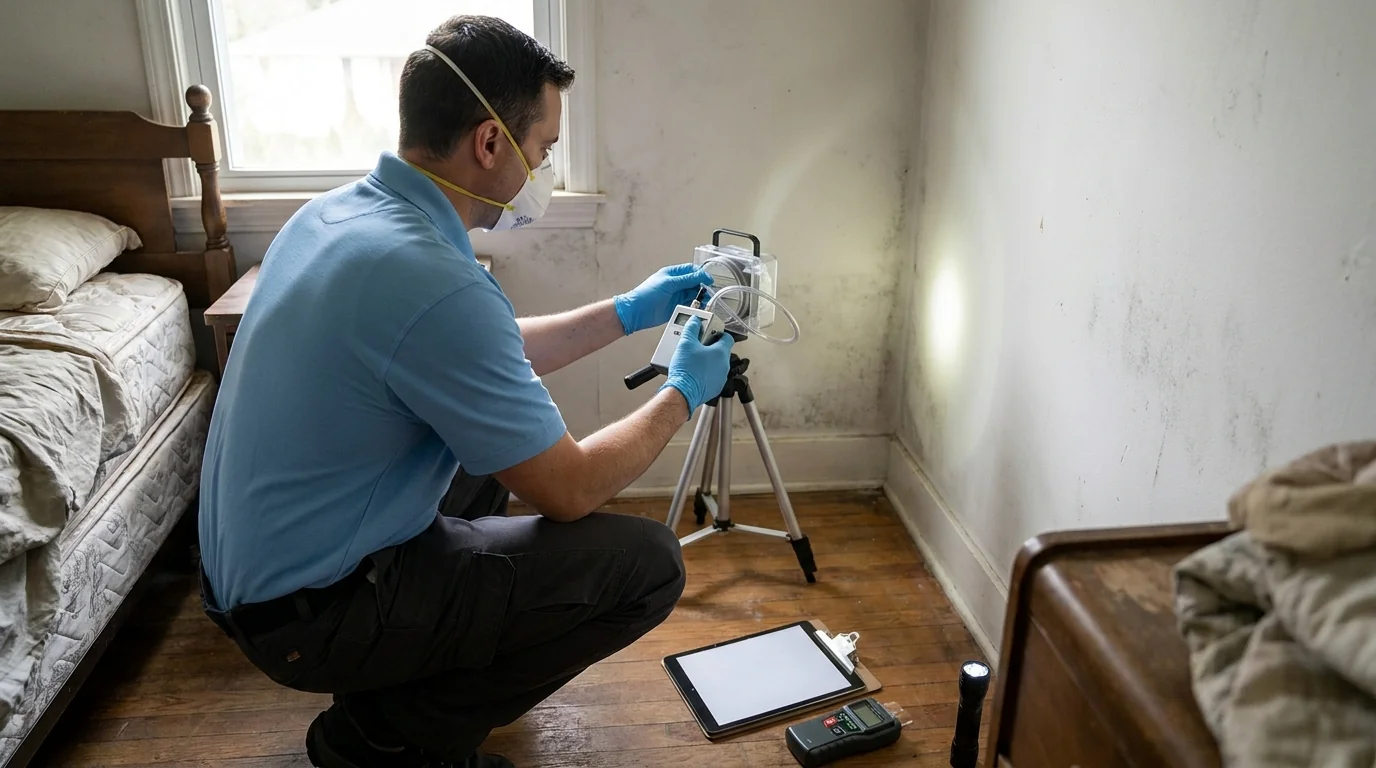
Mold Inspection and Testing in Roselle
24/7 mold inspection and testing in Roselle, NJ. IICRC-certified, insurance billing accepted. Call (855) 650-7422.
Our IICRC-certified technicians are dispatched from our Fair Lawn, NJ headquarters and are typically on-site in Roselle within 60 minutes of your call.
When the Elizabeth River backs up during a heavy storm — the way it did across East Roselle during Ida in 2021 — basements don’t just flood. They stay damp inside walls and under slabs for days, and in Roselle’s dense stock of early-1900s colonials and postwar capes, that hidden moisture is exactly the condition mold needs to colonize within 24 to 72 hours. A mold inspection and testing visit from The Restoration Group gives you a documented, evidence-based picture of what’s actually growing, where it started, and whether the air your family is breathing meets safe indoor standards — before a remediation contractor touches a single wall.
Why Roselle Properties Are Especially Vulnerable to Hidden Mold
Roselle’s housing stock is one of the more challenging environments for mold assessment in Union County. The majority of homes in the 07203 ZIP code were built between 1910 and 1955, which means original galvanized supply lines and cast-iron waste stacks that are now failing on schedule — slow drips behind plaster walls, weeping joints under kitchen floors, and chronic condensation in uninsulated crawl spaces beneath older capes near the Warinanco Park corridor. Those materials don’t announce themselves. A pinhole leak behind a bathroom tile can feed a mold colony for months before a stain appears.
The Elizabeth River floodplain along the eastern edge of town compounds the problem. Low-lying blocks near Warinanco Park absorb groundwater during prolonged rain events, and sump pumps in finished basements — common across the neighborhood — can’t always keep pace with a fast-moving summer storm. When a sump overloads, the water that enters isn’t clean; it carries organic sediment that accelerates mold growth on framing, drywall, and carpet padding. The Chestnut Street business corridor adds a commercial dimension: flat or low-slope roofs on retail buildings along that stretch are prone to overnight ponding, and a slow roof leak can saturate drop-ceiling tiles and insulation for weeks before anyone notices.
Our Mold Inspection and Testing Process in Roselle
A thorough mold assessment is a two-part process: a physical inspection to locate moisture sources and visible growth, followed by laboratory-analyzed sampling to identify species and quantify spore concentrations. Here’s how that unfolds on a Roselle property:
Step 1 — Moisture mapping. Using thermal imaging cameras and calibrated moisture meters, the inspector traces water intrusion pathways through walls, floors, and ceilings. In Roselle’s older homes, this often means checking behind plaster walls in finished basements and around original cast-iron cleanouts where condensation collects.
Step 2 — Visual assessment. The inspector documents all visible microbial growth, staining, and water damage with photographs. Finished basements and crawl spaces receive particular attention given local flood history.
Step 3 — Air sampling. Non-viable spore-trap cassettes are collected at multiple indoor locations and compared against an outdoor baseline. This tells us not just whether mold is present, but whether spore counts indoors are elevated relative to the outside environment — the key metric for indoor air quality concerns.
Step 4 — Surface sampling (when indicated). If visible growth is present, tape-lift or swab samples are collected for species identification. Knowing whether you’re dealing with Cladosporium, Aspergillus, or Stachybotrys affects the scope and protocol of any remediation that follows.
Step 5 — Written report. Lab results are compiled into a clear written report suitable for your insurance carrier, a prospective buyer’s attorney, or a remediation contractor. The report identifies affected areas, probable moisture sources, and recommended next steps.
The Restoration Group is an IICRC Certified Firm (#210213) and a licensed NJ Home Improvement Contractor, which means the documentation we produce meets the standards insurance adjusters and remediation contractors expect.
Reaching Roselle from Kenilworth
The Restoration Group is based in Kenilworth, directly adjacent to Roselle’s western border. That proximity matters for an inspection service available around the clock — there’s no long drive down the Turnpike to reach a home near Fifth Avenue or a commercial property along Chestnut Street. We can typically be on-site the same day you call, and for urgent situations — a flooded basement still drying out, a real estate closing with a mold contingency — we schedule promptly to keep your timeline moving.
Local Note: What Roselle’s Plaster Walls Mean for Mold Testing
One pattern that shows up repeatedly in Roselle’s pre-1950 housing is mold that forms between the plaster finish coat and the wood lath behind it — a cavity that a standard visual inspection can miss entirely. Plaster absorbs and holds moisture differently than modern drywall; it can feel dry to the touch on the surface while the lath behind it remains damp for weeks after a flood event. When our inspectors work in older homes near the Chestnut Street district or along the blocks closest to Warinanco Park, we specifically probe suspect walls with a pin-type moisture meter rather than relying on surface readings alone. That extra step has caught active mold growth behind walls that looked perfectly fine from the front.
If you’ve had water in your basement, a slow plumbing leak, or you’re purchasing an older Roselle property and want a clean bill of health before closing, call The Restoration Group at (855) 650-7422. We’ll document what’s there — and what isn’t — so you can move forward with confidence.
Serving Roselle from our Fair Lawn headquarters — ★ 4.8 · 158 Google reviews
“Very professional staff and also helped accommodate working around some other contractors that were simultaneously working in my house. Highly recommend!” — Gautam, July 2026Read our reviews on Google →
Mold Inspection and Testing in Roselle: Service Coverage
Frequently Asked Questions
How fast can you arrive for mold inspection and testing in Roselle?
My East Roselle basement flooded during a storm last summer and I dried it out myself — do I still need a mold inspection?
Are the older homes near Warinanco Park more likely to have mold problems than newer construction in Roselle?
I'm buying a home on Chestnut Street — can a mold inspection be completed quickly enough to meet a real estate closing deadline?
What's the difference between a mold inspection and mold testing — do I need both?
Will my homeowner's insurance cover a mold inspection in Roselle if the mold resulted from a covered water loss like a sump-pump failure?
Mold Inspection and Testing response in Roselle
Most Roselle calls see a technician on-site within 60 minutes from our Fair Lawn headquarters.