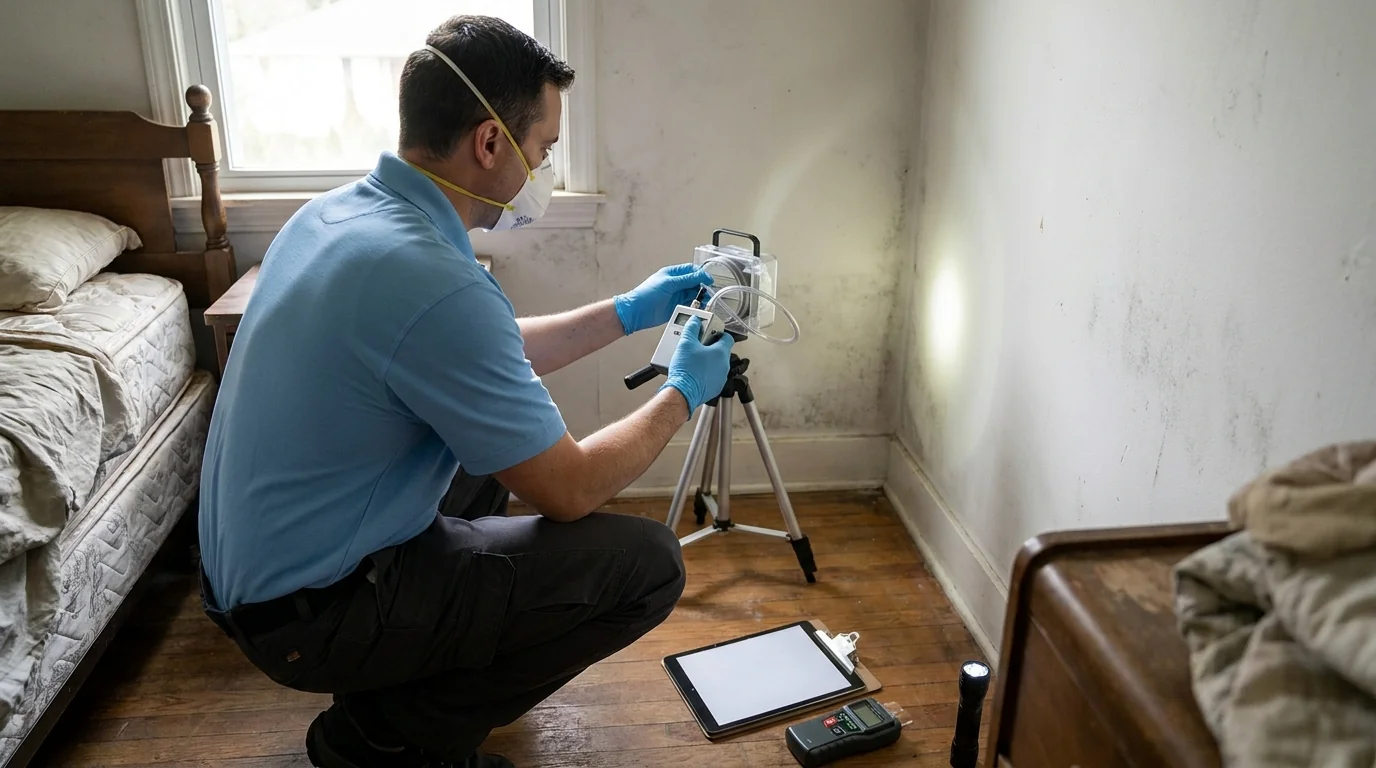
Mold Inspection and Testing in New Brunswick
24/7 mold inspection and testing in New Brunswick, NJ. IICRC-certified, insurance billing accepted. Call (855) 650-7422.
Our IICRC-certified technicians are dispatched from our Fair Lawn, NJ headquarters and are typically on-site in New Brunswick within 60 minutes of your call.
New Brunswick’s dense stock of early-1900s rowhouses and multifamily buildings — especially the blocks radiating out from Rutgers Village and the Fifth Ward — creates conditions where mold can establish itself quietly behind plaster walls, inside balloon-frame cavities, and under original hardwood floors long before a tenant or owner notices a musty odor. A proper mold inspection here isn’t a generic checklist; it’s a targeted investigation that accounts for the city’s aging infrastructure, its history of Raritan River flooding, and the near-constant moisture events driven by failing cast-iron drains and corroded supply lines in buildings that have been subdivided and re-plumbed across multiple decades.
Why New Brunswick Properties Are Prone to Hidden Mold
The same building density that makes New Brunswick’s neighborhoods walkable and vibrant also concentrates moisture problems. Pre-1950 construction along the George Street corridor and in Robeson Village typically features brick-and-mortar exterior walls with minimal vapor barriers — when those walls absorb ground moisture or a slow roof leak goes unaddressed for a season, interior cavities stay damp long enough for mold spores to colonize within 24 to 72 hours. Student rentals near Rutgers University compound the risk: high occupancy, deferred maintenance reports, and frequent turnover mean water intrusion events often go unreported until visible growth appears on a ceiling or a landlord schedules a turnover inspection.
The Raritan River’s flood history adds another layer. When Ida pushed water into low-lying riverfront areas near Boyd Park in 2021, dozens of ground-floor units and finished basements took on water. Even properties that dried out visually may still carry elevated spore counts inside wall assemblies and under subfloors — conditions that standard visual inspection alone won’t catch.
Downtown New Brunswick’s commercial corridor presents a different exposure profile: restaurant kitchens, office HVAC systems, and sprinkler-related losses in high-rise buildings can seed mold growth inside ductwork and above drop ceilings, where it circulates through the air supply before anyone sees a stain.
Our Mold Inspection and Testing Process in New Brunswick
Every inspection begins with a structured visual assessment of the building envelope, plumbing chases, HVAC components, and any areas with a documented or suspected moisture history. For New Brunswick properties, that typically means paying close attention to basement slab edges (common entry points in the city’s older rowhouses), bathroom and kitchen wet walls shared between units, and any areas that show evidence of past flood exposure.
Where visual indicators suggest active or past growth, we collect air samples and surface samples using calibrated equipment. Air samples establish a baseline spore count for each interior zone and compare it against an outdoor control sample — a meaningful benchmark given that New Brunswick’s urban tree canopy and proximity to the Raritan River corridor can elevate ambient outdoor spore levels seasonally. Surface samples (tape lifts or swabs) identify the specific mold genus and species present, which matters for remediation planning and for any health-related disclosures required in a real estate transaction or insurance claim.
All samples are sent to an accredited third-party laboratory. The written report we deliver identifies affected areas, documents moisture readings, maps probable moisture pathways, and outlines remediation scope — a format that works directly with insurance adjusters and, when required, with NJ Department of Community Affairs inspection records for rental properties.
The Restoration Group holds IICRC Firm Certification (#210213) and is licensed as a NJ Home Improvement Contractor through the NJ Division of Consumer Affairs, so the inspection documentation we produce carries the credentials that lenders, insurers, and municipal inspectors expect.
Reaching New Brunswick from Kenilworth
From our Kenilworth headquarters, New Brunswick is a straightforward run down the Garden State Parkway to the New Jersey Turnpike or directly via Route 1/9 south — typically 25 to 35 minutes under normal traffic conditions. We operate 24/7, so whether a property manager in the Downtown corridor discovers a ceiling collapse on a Sunday morning or a landlord in the 08901 ZIP code needs a same-day inspection before a tenant move-in, we can schedule and dispatch without waiting for a business-hours window.
For properties near Robert Wood Johnson University Hospital or the institutional buildings along College Avenue, parking and access logistics can add time — we ask for building contact information in advance so we’re not waiting at a locked service entrance.
Local Note
One pattern that comes up repeatedly in New Brunswick’s older multifamily stock: buildings that were converted from single-family rowhouses to two- or three-unit rentals often have sealed-off original chimneys that now function as unventilated vertical shafts connecting every floor. When a ground-floor unit has a moisture event, humid air migrates upward through these chases and condenses inside upper-floor walls — producing mold growth two stories above the original water source. Inspectors who don’t probe these pathways will miss the secondary colonies entirely. It’s a construction quirk specific to this era and housing type, and it’s one reason we treat New Brunswick multifamily inspections as multi-zone investigations rather than single-unit assessments.
If you’re dealing with a suspected mold problem anywhere in New Brunswick — whether it’s a Rutgers Village rental, a rowhouse in the Fifth Ward, or a commercial space off George Street — call (855) 650-7422. We’ll schedule an inspection, collect the samples, and give you a clear, documented picture of what’s actually in the air and walls of your property.
Serving New Brunswick from our Fair Lawn headquarters — ★ 4.8 · 158 Google reviews
“Teams were very prompt and respectful.. company responded quickly and kept in touch” — Peggy, August 2026Read our reviews on Google →
Mold Inspection and Testing in New Brunswick: Service Coverage
Frequently Asked Questions
How fast can you arrive for mold inspection and testing in New Brunswick?
Are properties near the Raritan River in New Brunswick at higher risk for mold after flooding?
How does New Brunswick's older housing stock affect what a mold inspection covers?
Does a mold inspection in New Brunswick include documentation for NJ rental property compliance or insurance claims?
What's the difference between air sampling and surface sampling, and which does my New Brunswick property need?
Can a mold inspection in a Downtown New Brunswick commercial space test the HVAC system as well as the occupied areas?
Mold Inspection and Testing response in New Brunswick
Most New Brunswick calls see a technician on-site within 60 minutes from our Fair Lawn headquarters.