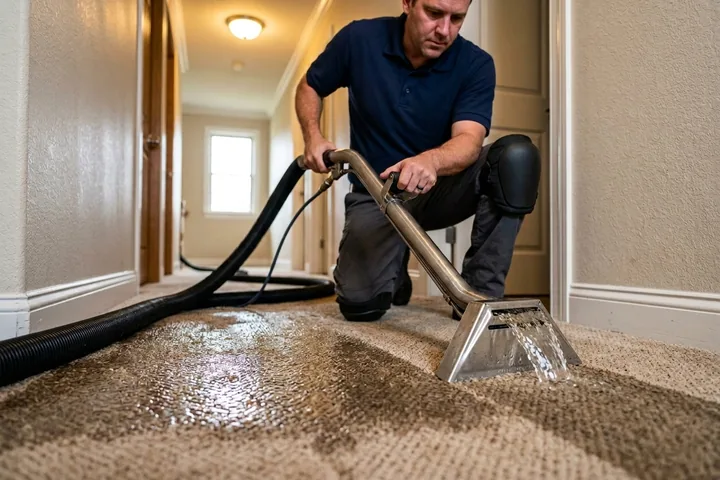
Water Cleanup in Manhattan
24/7 water cleanup in Manhattan, NY. IICRC-certified, insurance billing accepted. Call (855) 650-7422.
Our IICRC-certified technicians are dispatched from our Fair Lawn, NJ headquarters and are typically on-site in Manhattan within 60 minutes of your call.
When a radiator valve fails on the 18th floor of a pre-war co-op on the Upper West Side, the water doesn’t stop at the unit — it migrates through original plaster ceilings, travels along steam pipe chases, and shows up two floors below before anyone smells the damage. Manhattan water losses are vertical by nature, and cleaning them up requires a crew that understands the borough’s building stock, its management culture, and the difference between a fast extraction and a genuinely dry structure. The Restoration Group responds 24/7 to water cleanup calls across Manhattan, from Harlem to the Financial District.
Why Manhattan Properties See Water Cleanup Emergencies
The borough’s plumbing infrastructure spans more than a century. Pre-war buildings — many of them constructed before World War II with cast-iron risers and steam heating systems — develop failures at joints, valves, and supply lines that modern PEX plumbing simply doesn’t share. When those systems fail, water doesn’t follow a straight path. It pools inside hollow-core plaster walls, soaks into original hardwood subfloors, and wicks into masonry that was never designed to be dried with mechanical equipment.
More recent events have layered on top of that aging infrastructure. Hurricane Sandy’s storm surge inundated the Financial District and the Lower East Side, exposing how quickly below-grade spaces — parking garages, mechanical rooms, lobby levels — can fill when the drainage system is overwhelmed. Tropical Storm Ida overwhelmed street drains from Harlem down through Chelsea, turning basement apartments into catch basins in under an hour. Climate-driven rainfall events are no longer rare in Manhattan; they’re a recurring risk for any property with below-grade square footage or street-level retail.
Our Water Cleanup Process in Manhattan
Water cleanup in a Manhattan high-rise or brownstone isn’t the same job it is in a single-family suburban home. The process has to account for vertical water migration, building management protocols, and occupied adjacent units.
We start with thermal imaging and calibrated moisture readings across every affected surface — walls, ceilings, subfloors, and baseboards — before any extraction begins. That baseline map tells us where water has traveled beyond the visible wet zone, which in a plaster-and-lath building is almost always farther than it looks. Extraction follows using truck-mount and portable units suited to the building’s access constraints; many Manhattan buildings require freight elevator coordination and after-hours staging agreements with the resident manager.
Drying equipment — commercial-grade desiccant dehumidifiers and high-velocity air movers — is placed according to the moisture map, not by formula. We maintain unit-by-unit drying logs throughout the process, which building management and insurance adjusters both require. No equipment comes out until readings confirm the structure has returned to pre-loss moisture levels across all monitored points.
Reaching Manhattan from Kenilworth
The Restoration Group is based in Kenilworth, NJ, with direct access to the Lincoln Tunnel and the George Washington Bridge. Midtown addresses — including the corridors around the Empire State Building and Grand Central Terminal — are reachable around the clock. Lower Manhattan, including ZIP codes 10038 (Financial District) and 10002 (Lower East Side), is accessible via the Holland Tunnel or the lower level of the GWB depending on traffic conditions. We dispatch 24/7, so the call you make at 2 a.m. after a pipe bursts gets the same response as a daytime emergency.
Manhattan Insurance and Building Management Coordination
Most Manhattan water losses involve more than one party: the unit owner, the co-op board or condo association, a managing agent, and at least one insurance carrier — sometimes two if the building’s master policy overlaps with the unit owner’s HO-6. We document losses in a format that satisfies all of them: photo logs organized by unit and floor, moisture readings tied to specific structural components, and certificates of insurance that meet the building’s vendor requirements before we set foot in the freight elevator.
For commercial losses — retail spaces in Chelsea, restaurant interiors in Midtown, office suites anywhere in the borough — we prioritize overnight mitigation schedules where every closed hour represents real revenue loss. The drying timeline doesn’t change, but the sequencing of work can be structured around business hours when the building and the carrier agree.
Local Note
In Manhattan’s pre-war co-ops and brownstones, original plaster walls behave very differently from modern drywall when they’ve been saturated. Plaster is dense and slow to release moisture — surface readings can drop to acceptable levels within a day or two while the lath behind the plaster and the masonry behind the lath remain significantly elevated. A crew that pulls equipment based on surface readings alone will leave a building that looks dry but isn’t. We extend monitoring in plaster-wall buildings as a matter of course, because the alternative is a mold call three weeks later.
If you’re dealing with standing water, soaked ceilings, or a loss that’s already spread to adjacent units, call The Restoration Group at (855) 650-7422. We’re available around the clock, we carry the documentation your building management will ask for, and we know how Manhattan buildings actually work.
Water Cleanup in Manhattan: Service Coverage
Frequently Asked Questions
How fast can you arrive for water cleanup in Manhattan?
How quickly can The Restoration Group reach a water emergency in Midtown or the Upper East Side?
My Manhattan co-op board requires vendor insurance certificates before anyone enters the building — can you provide those?
Water from a burst pipe upstairs has come through my ceiling — how do I know how far it's actually spread in a pre-war Manhattan building?
Does a water loss in a Financial District or Lower East Side basement unit require different cleanup steps than an upper-floor loss?
How long does water cleanup typically take in a Manhattan high-rise unit?
Water Cleanup response in Manhattan
Most Manhattan calls see a technician on-site within 60 minutes from our Fair Lawn headquarters.