Water Cleanup in Jersey City
24/7 water cleanup in Jersey City, NJ. IICRC-certified, insurance billing accepted. Call (855) 650-7422.
Our IICRC-certified technicians are dispatched from our Fair Lawn, NJ headquarters and are typically on-site in Jersey City within 60 minutes of your call.
Jersey City sits at the intersection of two water damage realities that rarely share a zip code anywhere else in New Jersey. Along the Exchange Place waterfront and through Newport’s high-rise towers, a single supply-line failure can push water through stacked units before a building super even gets the call. A few miles inland, the 1890s brownstones and frame rowhouses of the Heights and Bergen-Lafayette carry the chronic risk of cellar flooding and combined-sewer backups that worsen every time a nor’easter stalls over Hudson County. When water is moving through your building, The Restoration Group responds 24/7 — call (855) 650-7422.
Why Jersey City Properties Face Distinct Water Damage Risks
Jersey City’s geography works against it. Much of the city sits on low-lying ground that was exposed during Hurricane Sandy’s surge and flooded again during Ida, when basements citywide took on water faster than sump pumps could cycle. The Hudson River waterfront looks resilient from the outside, but the soil beneath older blocks retains moisture long after a storm passes, keeping foundation walls under hydrostatic pressure for days.
The building stock compounds the problem. Rowhouses in Bergen-Lafayette and Greenville were built when combined sewer systems were standard — storm water and sanitary waste share the same pipe. A heavy rain event can reverse flow and push contaminated water into basements through floor drains, which is a different cleanup problem than a clean-water pipe burst. Waterfront towers at Newport and Exchange Place face a separate dynamic: riser failures or HVAC condensate overflows on an upper floor migrate through concrete slab assemblies and show up as ceiling stains two or three units below the source, making moisture mapping essential before any drying begins.
Our Water Cleanup Process in Jersey City
The first thing we do on arrival is identify the water category. Clean supply-line water, gray water from an appliance, and sewage-contaminated water each require a different extraction and treatment protocol — and in Jersey City, combined-sewer backups mean we encounter category 3 contamination more often than in newer suburban developments.
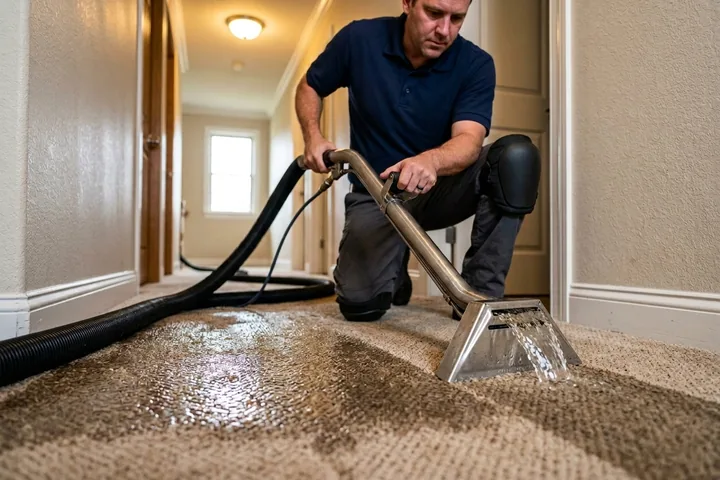
Once the source is confirmed and stopped, we extract standing water using truck-mounted and portable units, then deploy thermal imaging and calibrated moisture meters to map where water has migrated inside wall cavities, under flooring, and into subfloor assemblies. In older plaster-and-lath construction — common throughout the Heights and Journal Square — water wicks into the lath and reads dry at the plaster surface well before the structure is actually dry. We set drying equipment based on what the meters show, not what the walls look like.
Drying timelines are monitored daily, and we document every reading. That documentation matters in Jersey City’s dense multifamily environment, where a landlord or condo board may need to show an insurer or building association exactly which units were affected and when they reached drying goals.
Jersey City Insurance and HOA Coordination
Multifamily ownership in Jersey City means water damage almost always involves more than one party — a unit owner, a building owner or management company, a condo association, and frequently two separate insurance policies. We produce moisture logs, photo documentation, and scope-of-loss reports formatted to support both the unit owner’s claim and the building’s master policy, so adjusters are working from the same set of facts.
For high-rise buildings along the waterfront, building management typically needs unit-by-unit moisture documentation before they will authorize repairs in common areas or adjacent units. We build that documentation into every job from day one rather than assembling it after the fact.
Reaching Jersey City from Kenilworth
From our Kenilworth headquarters, the most direct route into Jersey City runs through the NJ Turnpike and the 1&9 corridor, putting us into neighborhoods like Journal Square and Bergen-Lafayette without navigating the most congested waterfront approaches. For calls in Downtown Jersey City and the Newport area near ZIP code 07310, we route via Route 139 or the Holland Tunnel approach depending on time of day. Because we operate 24/7, overnight and early-morning calls avoid the peak congestion that can slow daytime response through the Hudson County interchange.
Local Note
In Jersey City’s older rowhouse blocks — particularly in the Heights and Bergen-Lafayette — basement floors are often original poured concrete that has settled and cracked over a century of freeze-thaw cycles. Water doesn’t pool evenly; it follows the low points in the slab and can sit under stored belongings or behind finished walls without being visible from the center of the room. When we set up for extraction in these basements, we probe the perimeter and corners first, because that’s where standing water hides longest and where mold colonization starts if drying equipment is placed only in the open center of the space.
If water is moving through your property right now, don’t wait to see how far it spreads. Call The Restoration Group at (855) 650-7422 — we’re available around the clock and ready to respond anywhere in Jersey City, from the waterfront towers at Exchange Place to the rowhouse blocks of Greenville.
Water Cleanup in Jersey City: Service Coverage
Frequently Asked Questions
How fast can you arrive for water cleanup in Jersey City?
How quickly can The Restoration Group reach a water emergency in Downtown Jersey City or the Newport area?
Our Jersey City condo building had a riser failure that affected multiple units — can you document each unit separately for the association's insurer?
Is the water in my Bergen-Lafayette basement from a sewer backup or a groundwater intrusion — and does it matter for cleanup?
What does water cleanup actually involve once the standing water is removed?
Does Jersey City's combined sewer system affect how often homes in areas like Greenville need water cleanup after storms?
Will my homeowners insurance cover water cleanup in Jersey City?
Water Cleanup response in Jersey City
Most Jersey City calls see a technician on-site within 60 minutes from our Fair Lawn headquarters.