Mold Inspection and Testing in Highland Park
24/7 mold inspection and testing in Highland Park, NJ. IICRC-certified, insurance billing accepted. Call (855) 650-7422.
Our IICRC-certified technicians are dispatched from our Fair Lawn, NJ headquarters and are typically on-site in Highland Park within 60 minutes of your call.
The stretch of Highland Park along the Raritan River has a mold problem that most homeowners don’t discover until it’s already behind the drywall. When Hurricane Ida pushed the Raritan over its banks in 2021, low-lying sections near Donaldson Park and River Road sat under water long enough for mold colonies to establish inside wall cavities within 48 to 72 hours — often in homes where the visible flood line had already dried and the owners assumed the worst was over. A professional mold inspection and testing service doesn’t just look at surfaces; it finds what the eye misses in the borough’s older building stock before a small colony becomes a remediation project.
Why Highland Park Properties See Elevated Mold Risk
Highland Park’s housing inventory is one of the densest concentrations of pre-war construction in Middlesex County. The 1910s-through-1940s colonials, bungalows, and two-family homes that line the streets of Livingston Manor and the Triangle neighborhood were built with materials and ventilation standards that simply weren’t designed for today’s understanding of moisture control. Original cast-iron drain lines corrode and weep at joints inside finished basement walls. Galvanized supply pipes develop pinhole leaks that feed moisture into plaster and wood framing for months before anyone notices a stain.
The geography compounds the problem. The borough sits in a natural bowl bordered by the Raritan to the south, and the water table in lower-lying sections rises seasonally. Basement slab moisture migration is common even in homes that have never flooded, and it creates the persistent relative humidity — often above 60% — that mold spores need to germinate on wood joists, paper-faced insulation, and the back side of drywall.
The Raritan Avenue corridor adds a commercial layer to this picture. Restaurants and retail spaces along the business district run commercial dishwashers, ice machines, and HVAC systems that generate condensation and occasional sprinkler discharges. Proximity to Rutgers University across the river means a significant share of Highland Park’s housing stock turns over as student rentals and multi-unit properties — buildings where a slow leak under a bathroom fixture may go unreported for an entire lease cycle.
Our Mold Inspection and Testing Process in Highland Park
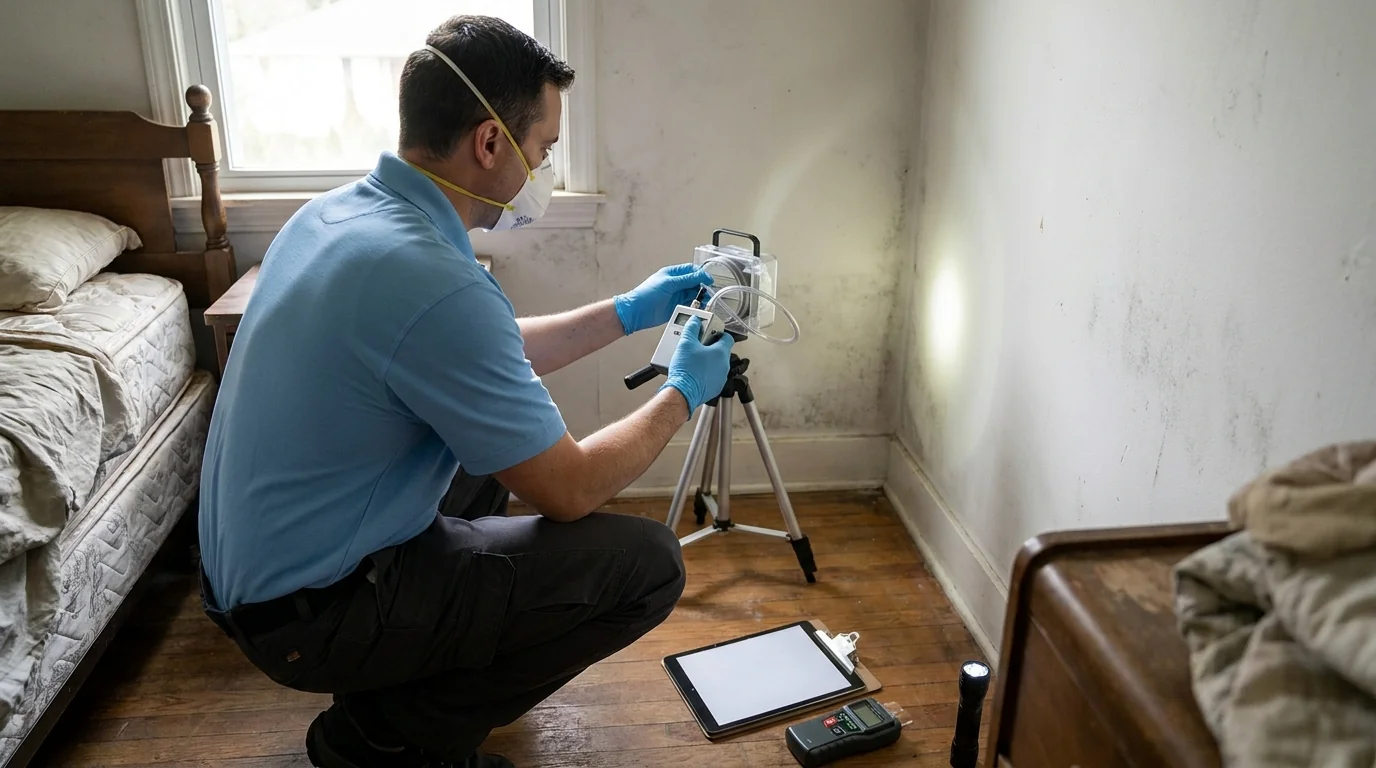
A mold assessment in an 08904 ZIP code property follows a different checklist than one in a newer suburb. We begin with a moisture mapping pass using a calibrated pin-type and pinless moisture meter on every wall surface in areas of concern — not just the obvious ones. In Highland Park’s plaster-walled homes, moisture readings can be deceptively low at the surface while the substrate behind the lath is saturated. Thermal imaging helps identify cold spots where condensation is accumulating inside wall cavities.
Air sampling is collected in a minimum of two interior zones plus one outdoor baseline. The outdoor sample matters here because Highland Park’s tree canopy and proximity to the Raritan floodplain mean ambient outdoor spore counts can be elevated seasonally — a fact that affects how lab results are interpreted. Spore trap cassettes are sent to an accredited third-party laboratory, and results typically return within 24 to 48 hours.
Surface sampling — tape lifts or swabs — is added when visual evidence suggests active growth. We document every sample location with photographs and GPS coordinates so the lab report ties directly to a specific room, wall, or structural member. The written assessment you receive identifies the species present, the probable moisture source, and a recommended scope of work if remediation is warranted. Because we are an IICRC Certified Firm (#210213), the inspection report is structured to satisfy most insurance carriers and NJ-licensed remediation contractors.
Reaching Highland Park from Our Kenilworth Office
Our Kenilworth headquarters puts Highland Park well within a short drive via Route 1 or the Garden State Parkway to Route 27. Because this is a 24/7 operation, an inspection call placed at any hour — including the middle of the night after a basement backup — can be scheduled for the earliest practical access window. For properties near the Landing Lane Bridge or North Highland Park, the approach from the Edison side of the river is often faster during peak traffic on Route 1.
Local Note
One pattern we see consistently in Highland Park’s older two-family homes: the original balloon-frame construction allows air — and mold spores — to travel vertically between floors inside the wall cavity with almost no resistance. A mold source in a first-floor bathroom can seed the second-floor bedroom wall without any visible connection between the two spaces. When we inspect a two-family in Livingston Manor or the Meadow neighborhood and find elevated spore counts on an upper floor with no apparent water history there, we always trace the wall cavity down to the unit below before closing the assessment.
Highland Park Insurance Coordination
Mold claims in Highland Park frequently originate from Ida-related losses that were initially documented as flood damage. If your carrier previously paid a flood or water claim on the property, a current mold inspection report can support a supplemental claim for hidden secondary damage — particularly in finished basements where drying documentation from 2021 may be incomplete. We photograph affected materials, note moisture readings, and provide a written assessment formatted for direct submission to adjusters. NJ-licensed as a Home Improvement Contractor through the Division of Consumer Affairs, we can coordinate with your remediation contractor and your carrier without adding an unnecessary layer of back-and-forth.
If you’ve noticed a musty odor in a Highland Park property, seen discoloration along a basement wall, or recently dealt with a plumbing failure in an older home near the Raritan Avenue corridor, the next step is a professional assessment — not a wait-and-see approach. Call (855) 650-7422 to schedule mold inspection and testing in Highland Park.
Serving Highland Park from our Fair Lawn headquarters — ★ 4.8 · 158 Google reviews
“Great customer service. I was kept well informed throughout the entire process. I received nothing but respect and sympathy from everyone I dealt with.” — Ryan, July 2026Read our reviews on Google →
Mold Inspection and Testing in Highland Park: Service Coverage
Frequently Asked Questions
How fast can you arrive for mold inspection and testing in Highland Park?
Are homes in Highland Park's Livingston Manor and Triangle neighborhoods at higher risk for hidden mold after the 2021 Ida flooding?
How does Highland Park's pre-war housing stock affect the mold inspection process?
What does mold air testing actually measure, and why does the outdoor baseline sample matter in Highland Park?
Can a mold inspection report support a supplemental insurance claim on a Highland Park property that had flood damage in 2021?
How long does a mold inspection take for a typical Highland Park bungalow or two-family home?
Mold Inspection and Testing response in Highland Park
Most Highland Park calls see a technician on-site within 60 minutes from our Fair Lawn headquarters.