Water Damage Restoration in Fort Lee
24/7 water damage restoration in Fort Lee, NJ. IICRC-certified, insurance billing accepted. Call (855) 650-7422.
Our IICRC-certified technicians are dispatched from our Fair Lawn, NJ headquarters and are typically on-site in Fort Lee within 60 minutes of your call.
When a supply line fails on the 22nd floor of a high-rise along the Palisades, water doesn’t stop at the unit where it started — it travels through concrete decks, saturates drywall on the floors below, and can reach a dozen units before anyone shuts off the riser. That’s the reality of water damage in Fort Lee, where dense condominium towers dominate the skyline above the Hudson and a single plumbing failure becomes a multi-unit emergency within minutes. The Restoration Group responds 24/7, dispatching IICRC Certified Firm (#210213) technicians to extract standing water, dry structural assemblies, and document everything your insurance adjuster needs.
Why Fort Lee Properties Face Elevated Water Damage Risk
Fort Lee’s building stock creates conditions that amplify water losses in ways you won’t find in most Bergen County towns. Along the Palisades ridge, towers built in the 1960s and 1970s — many in Central Fort Lee and near the Hudson Lights mixed-use corridor — rely on aging galvanized and copper supply lines that have cycled through decades of pressure fluctuations. When one of those lines lets go, the stacked-unit layout means water migrates vertically and laterally through shared assemblies before anyone notices a stain on the ceiling.
The geography adds another layer. Fort Lee sits atop steep Palisades cliffs, and heavy rainfall drains fast and hard toward lower-grade streets and basement-level parking structures. Storm Ida in 2021 demonstrated how quickly that runoff overwhelms foundation drainage across Bergen County — Fort Lee was no exception. In Coytesville and The Hill, where prewar multifamily homes and older two- and three-family houses sit closer to grade, groundwater intrusion and window-well flooding are recurring problems every time a nor’easter stalls over the region.
Our Water Damage Restoration Process in Fort Lee
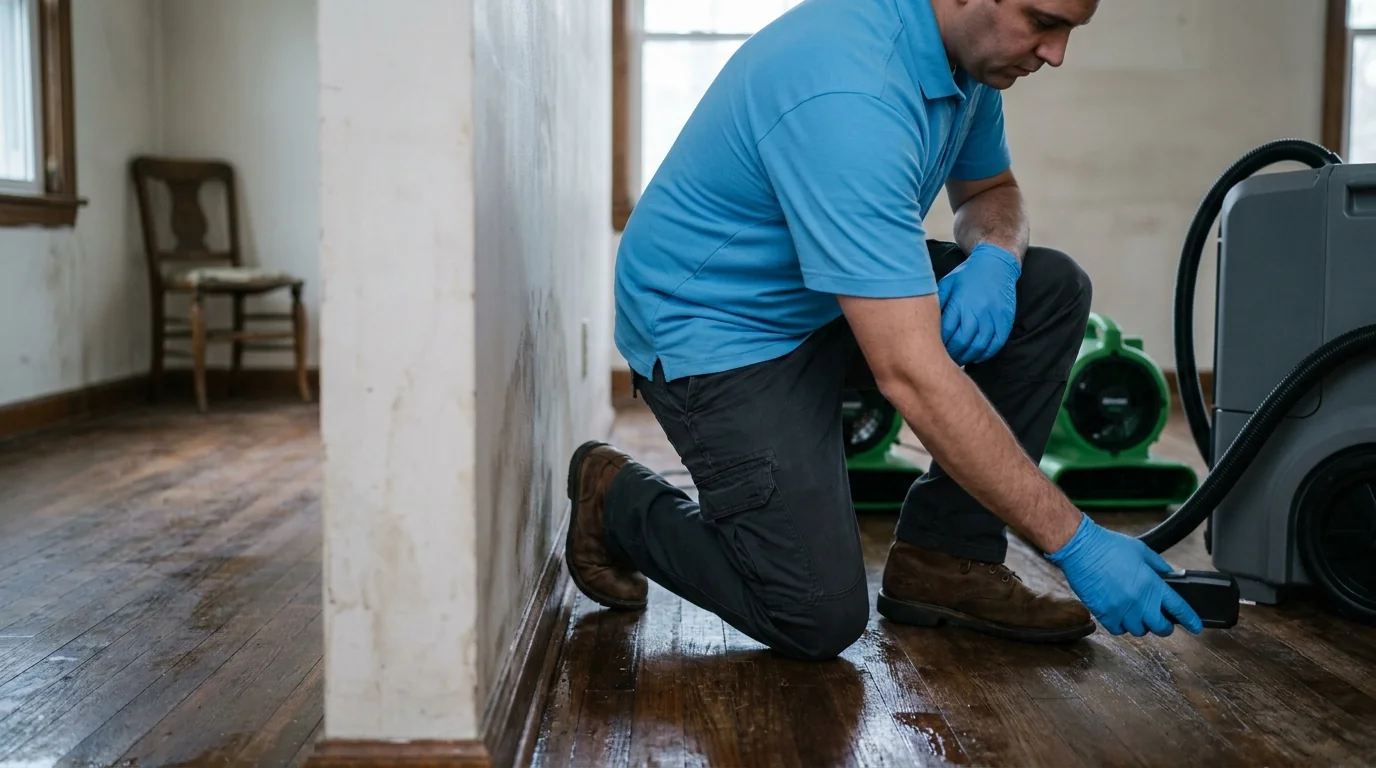
Every job starts with a moisture survey — thermal imaging and calibrated meters to map exactly where water has traveled, not just where it’s visible. In high-rise units, that often means checking the unit below and the shared corridor walls before we set a single piece of equipment. We extract standing water with truck-mounted and portable units, then place commercial-grade desiccant dehumidifiers and axial air movers in a calculated drying configuration sized to the space.
Structural drying in Fort Lee high-rises requires coordination with building management. We communicate directly with property managers to access mechanical rooms, confirm riser shutoffs, and meet HOA or condo board documentation requirements before demolition of any shared wall or ceiling assembly. Drying logs are recorded daily and handed off to your adjuster in the format most carriers request — moisture readings, equipment placement maps, and timestamped photos of affected materials.
For single-family and multifamily homes in Coytesville or along the streets climbing toward Fort Lee Historic Park, the process is similar but the building materials differ. Older plaster-on-lath walls common in pre-1950 construction absorb water more deeply than modern drywall and release it more slowly — drying timelines typically run longer, and we adjust chamber configurations accordingly rather than pulling equipment prematurely.
Reaching Fort Lee from Kenilworth
The Restoration Group is based in Kenilworth, NJ, and Fort Lee is reachable via the New Jersey Turnpike to Route 1/9 north and across to Route 46 east, or via I-95 directly to the George Washington Bridge approach roads. Because Fort Lee sits at the eastern terminus of I-95 and the lower level of the GWB, inbound traffic from our direction avoids the Manhattan-bound congestion that backs up the upper level. We dispatch around the clock — if water is moving in your unit right now, call (855) 650-7422 and we’ll have a crew en route.
Fort Lee Insurance & HOA Coordination
Water losses in Fort Lee’s condo towers almost always involve at least two insurance policies: the unit owner’s HO-6 policy and the building’s master policy. Determining which policy covers which portion of the damage — and where the unit owner’s responsibility ends at the “bare walls” line — is something we work through with adjusters regularly. We photograph and document affected materials before any demolition, preserve samples when requested, and provide line-item scopes in Xactimate format that most major carriers accept without revision.
If your building’s HOA requires a licensed contractor for any work touching common elements, we carry our NJ Licensed Home Improvement Contractor credential through the NJ Division of Consumer Affairs and can provide documentation to property management on request.
Local Note
One thing worth knowing if you’re in a Fort Lee high-rise in ZIP code 07024: many towers built before 1980 have HVAC fan-coil units recessed into the floor at the base of exterior windows. When those drain pans overflow — from a clogged condensate line or a window left open during a storm — water migrates under the flooring finish and into the concrete subfloor assembly without ever appearing as a visible puddle. We’ve found active moisture in subfloor channels two rooms away from the fan-coil unit. If you’re seeing a musty smell or a soft spot underfoot and can’t identify a source, that’s one of the first places we check in buildings of that era.
Water damage in Fort Lee moves fast and hides in places that aren’t obvious. Call (855) 650-7422 any time — day or night — and The Restoration Group will send a certified crew to assess the loss, stop the spread, and start the drying process before the damage compounds further.
Serving Fort Lee from our Fair Lawn headquarters — ★ 4.8 · 158 Google reviews
“Great customer service. I was kept well informed throughout the entire process. I received nothing but respect and sympathy from everyone I dealt with.” — Ryan, July 2026Read our reviews on Google →
Water Damage Restoration in Fort Lee: Service Coverage
Frequently Asked Questions
How fast can you arrive for water damage restoration in Fort Lee?
How does a water loss in a Fort Lee high-rise get handled differently than a single-family home loss?
Can you respond to water emergencies near the Hudson Lights complex or Central Fort Lee at night?
My Fort Lee condo's HOA says any contractor touching common walls needs to be licensed in New Jersey — does that apply to you?
How long does structural drying typically take in Fort Lee's older prewar buildings?
Which insurance policy covers water damage in a Fort Lee condo — my HO-6 or the building's master policy?
Water Damage Restoration response in Fort Lee
Most Fort Lee calls see a technician on-site within 60 minutes from our Fair Lawn headquarters.