Odor Removal and Deodorization in Fort Lee
24/7 odor removal and deodorization in Fort Lee, NJ. IICRC-certified, insurance billing accepted. Call (855) 650-7422.
Our IICRC-certified technicians are dispatched from our Fair Lawn, NJ headquarters and are typically on-site in Fort Lee within 60 minutes of your call.
Fort Lee’s dense stack of high-rise condominiums along the Palisades creates an odor problem that flat-grade suburbs rarely face: a single cooking fire, a sewage backup, or a cigarette-saturated unit on the 14th floor can push smoke, mold, and organic odors through shared HVAC risers and into neighboring units before the source apartment’s door ever opens. If you’re dealing with a persistent smell in a 07024 address — whether it’s a prewar two-family in Coytesville or a glass-tower condo overlooking the George Washington Bridge — the source and the solution are rarely as simple as opening a window.
Why Fort Lee Properties Experience Stubborn Odors
The building stock here spans nearly a century of construction styles, and each era traps odors differently. Older wood-frame homes in Coytesville and The Hill have plaster walls, original hardwood subfloors, and minimal vapor barriers — materials that absorb smoke and moisture deeply and release them slowly over weeks. In contrast, the newer high-rise towers along the Palisades run centralized HVAC systems that can distribute a localized odor — pet dander, fire residue, mold off-gassing — across multiple floors through shared air-handling units.
Fort Lee’s position atop the Palisades cliffs also matters. The steep-grade terrain channels stormwater fast and hard, and when that water enters a crawl space or basement in a hillside home near Palisades Interstate Park, it doesn’t drain quietly — it sits, warms, and begins producing microbial off-gassing within 24 to 48 hours. That musty, earthy smell is not just unpleasant; it signals active biological activity that surface sprays won’t reach.
Our Odor Removal and Deodorization Process in Fort Lee
Effective deodorization is not a single product — it’s a sequenced protocol matched to the odor source, the affected materials, and the building type. The process typically moves through four stages:
1. Source identification and containment. We locate the origin — charred framing, wet insulation, a decomposing organic source — before any treatment begins. Masking an odor without removing its source is a temporary fix that fails within days.
2. Physical removal of contaminated material. Smoke-saturated drywall, fire-damaged insulation, and waterlogged subfloor all off-gas continuously. Where materials are beyond cleaning, controlled removal stops the odor at its root.
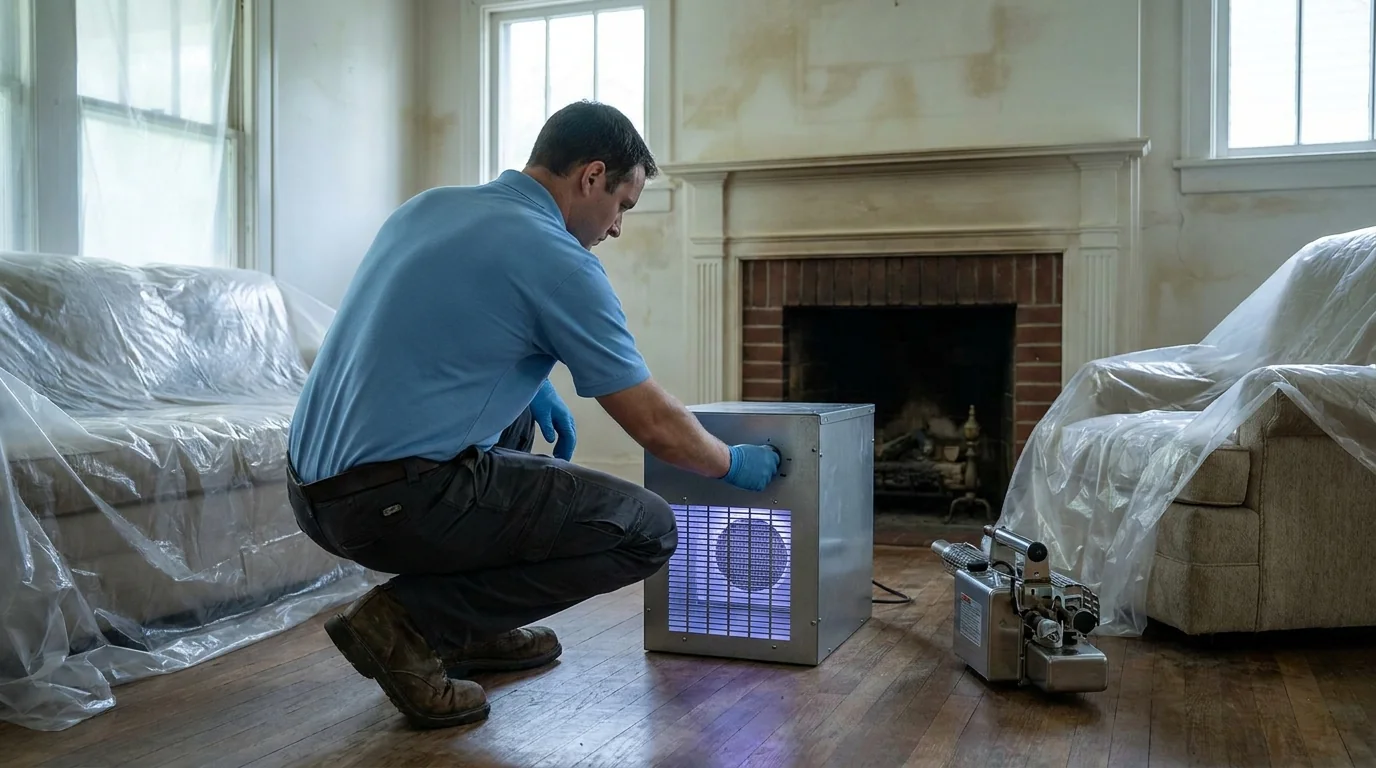
3. Treatment matched to the odor type. For smoke and fire residue, thermal fogging penetrates porous surfaces — wood framing, ceiling tiles, carpet backing — the same way smoke did, neutralizing odor compounds on contact. Hydroxyl deodorization is safe to run in occupied spaces and works well in Fort Lee high-rises where complete unit evacuation isn’t always practical. Ozone treatment is reserved for unoccupied spaces where a high-concentration, time-limited treatment is appropriate.
4. Verification. We don’t close a job based on smell alone. Air quality readings confirm that volatile organic compound levels have returned to acceptable baselines before equipment is removed.
As an IICRC Certified Firm (#210213), our technicians follow documented drying and deodorization protocols — not improvised approaches.
Fort Lee High-Rise and HOA Coordination
Working inside Fort Lee’s condominium towers introduces logistical layers that single-family jobs don’t have. Building management at Hudson Lights and comparable complexes typically requires proof of insurance, advance notice for freight elevator use, and written scope-of-work documentation before any contractor accesses common areas or mechanical rooms. We carry those documents and coordinate directly with building managers so the process doesn’t stall at the lobby.
For odor events that cross unit lines — smoke migration through shared walls, mold off-gassing from a unit above — HOA boards often need a written assessment to determine liability and direct remediation responsibility. We can provide that documentation as part of the service.
Reaching Fort Lee from Kenilworth
From our Kenilworth base, the most direct route to Fort Lee runs north on the Garden State Parkway to I-95 East, crossing into Bergen County and reaching the Route 4 / Fort Lee corridor in under an hour under normal conditions. We’re available around the clock, so whether the call comes in during the morning bridge traffic rush or late on a weeknight, a crew can be dispatched and on-site to assess the situation.
Local Note
One pattern we’ve seen repeatedly in Fort Lee’s older multifamily buildings on The Hill: when a unit has been smoked in for years and the tenant turns over, the odor has often penetrated not just the painted drywall surface but the joint compound beneath it — and in some cases, the gypsum core itself. A single coat of odor-blocking primer won’t hold. The correct fix is mechanical abrasion or full panel replacement in the heaviest areas, followed by thermal fogging of the framing cavity, before any repainting begins. Skipping that step is why some units still smell like cigarettes three months after a renovation.
If you’re managing a property in Fort Lee and dealing with a smell that keeps coming back, call The Restoration Group at (855) 650-7422. We’ll identify the source, explain what it will take to eliminate it permanently, and coordinate with your building management or insurance carrier from start to finish.
Serving Fort Lee from our Fair Lawn headquarters — ★ 4.8 · 158 Google reviews
“Great customer service. I was kept well informed throughout the entire process. I received nothing but respect and sympathy from everyone I dealt with.” — Ryan, July 2026Read our reviews on Google →
Odor Removal and Deodorization in Fort Lee: Service Coverage
Frequently Asked Questions
How fast can you arrive for odor removal and deodorization in Fort Lee?
Can smoke odor from one unit spread to neighboring units in Fort Lee high-rises?
Are older homes in Coytesville and The Hill harder to deodorize than newer construction?
Does Fort Lee's building management process slow down odor remediation in high-rises?
What's the difference between ozone treatment and hydroxyl deodorization, and which is used in occupied Fort Lee units?
Will my insurance cover professional odor removal for a fire or water loss at my Fort Lee address?
Odor Removal and Deodorization response in Fort Lee
Most Fort Lee calls see a technician on-site within 60 minutes from our Fair Lawn headquarters.