Flood Damage Restoration in Fort Lee
24/7 flood damage restoration in Fort Lee, NJ. IICRC-certified, insurance billing accepted. Call (855) 650-7422.
Our IICRC-certified technicians are dispatched from our Fair Lawn, NJ headquarters and are typically on-site in Fort Lee within 60 minutes of your call.
When a water line fails inside one of Fort Lee’s high-rise towers along the Palisades, the damage rarely stays in one unit. Gravity and shared plumbing chases carry the loss downward through stacked floors, soaking drywall, saturating concrete subfloors, and triggering secondary claims in units the original tenant never met. The Restoration Group responds 24/7 to flood damage across Fort Lee’s 07024 ZIP code — from the dense residential corridors near the George Washington Bridge to the older multifamily homes tucked into Coytesville and The Hill.
Why Fort Lee Properties See Flood Damage Differently
Fort Lee’s geography sets up conditions that amplify water losses in ways most inland towns don’t face. The borough sits atop the Palisades cliffs, and when storms roll in off the Hudson — as they did with Tropical Storm Ida in 2021, which drove widespread flooding across Bergen County — steep-grade runoff overwhelms surface drainage fast. Water that can’t move laterally pushes into basement-level parking garages, mechanical rooms, and ground-floor commercial spaces along the Main Street corridor and the Hudson Lights mixed-use complex.
At the same time, the residential mix creates two very different restoration challenges. The high-rise condominium and apartment towers that define Fort Lee’s skyline use pressurized supply lines that, when they fail, can discharge hundreds of gallons before a shutoff is reached. Older prewar wood-frame and multifamily buildings in Coytesville and The Hill absorb water more slowly but hold it longer — original plaster walls and balloon-frame cavities trap moisture in places a moisture meter won’t catch on the first pass, making thorough mapping critical before drying equipment is even staged.
Our Flood Damage Restoration Process in Fort Lee
Every job begins with a detailed moisture survey using thermal imaging and calibrated pin and pinless meters. In high-rise buildings, that means tracing the loss vertically — checking the unit above the origin point, the unit of origin, and every floor below until readings return to ambient. We document affected materials with photographs and written scope notes formatted for insurance carriers before a single piece of equipment is placed.
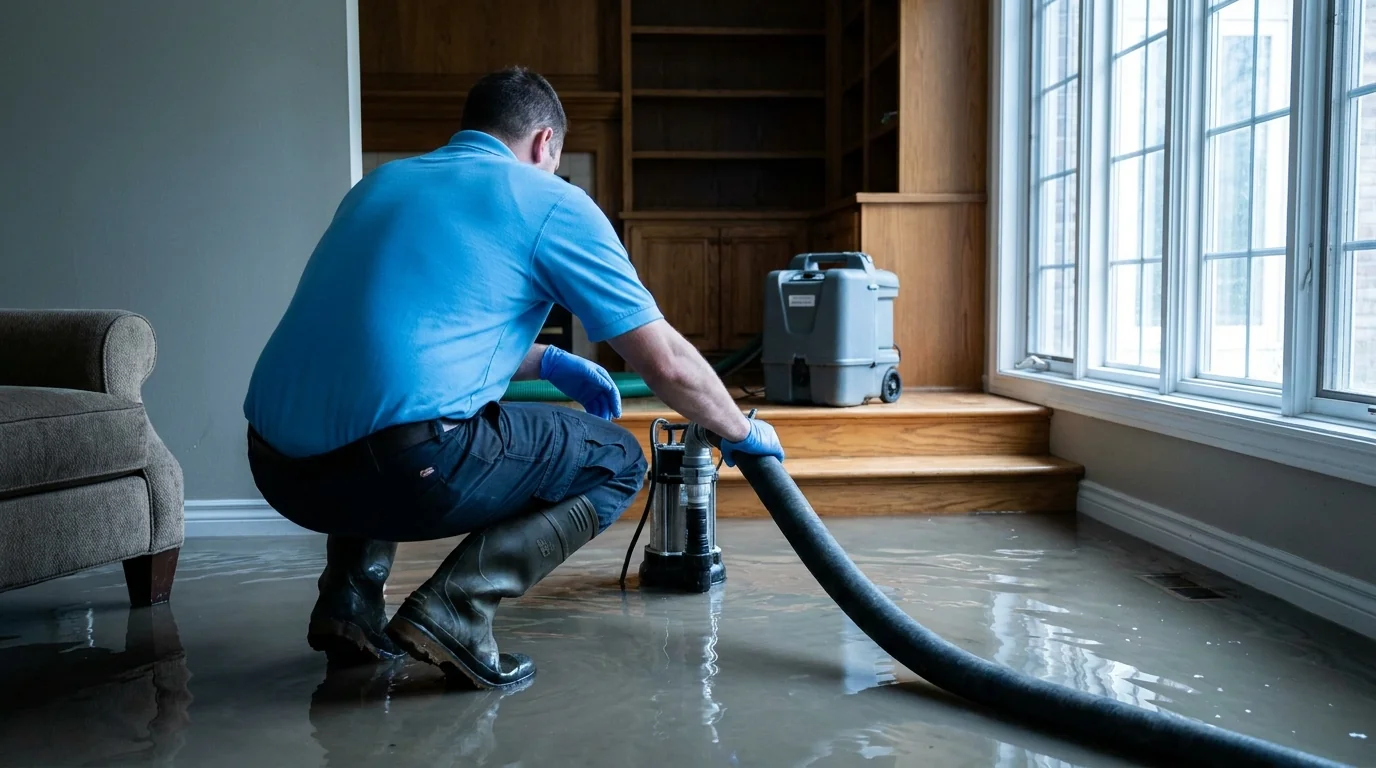
Extraction comes next. Standing water is removed with truck-mounted and portable extraction units; in condo buildings where elevator access limits equipment size, we use compact high-efficiency extractors that still move significant volume. Structural drying follows using commercial-grade desiccant and refrigerant dehumidifiers paired with high-velocity air movers, positioned to create the airflow patterns the IICRC S500 standard requires for the material types and moisture load present. We monitor and log readings daily until all affected assemblies reach documented dry standard — not until they feel dry.
Demolition of unsalvageable material — wet insulation, saturated drywall below the flood line, swollen cabinetry — is performed selectively to preserve as much of the structure as possible while eliminating any substrate that would otherwise support microbial growth.
Reaching Fort Lee from Kenilworth
The Restoration Group is based in Kenilworth, NJ, and dispatches crews around the clock. The most direct routing to Fort Lee runs via I-78 East to the New Jersey Turnpike or Route 1/9 North, connecting to Route 46 East into Bergen County. Depending on traffic on the approach to the George Washington Bridge interchange — a real variable during peak commute hours — crews can also route through Ridgefield or Leonia to reach Coytesville and the northern residential neighborhoods without sitting in bridge-approach congestion. We call ahead on active losses to confirm building access, parking, and whether a property manager or doorman needs to be notified before the crew arrives.
Fort Lee Insurance and HOA Coordination
High-rise condo losses in Fort Lee almost always involve at least two insurance policies: the unit owner’s HO-6 policy and the building’s master policy. The line between what each covers — and who is responsible for the origin of the loss — can delay mitigation if it isn’t addressed immediately. We document the loss scope in a format that speaks to both adjusters, photograph the point of origin, and provide a written moisture log that establishes the timeline and affected square footage. For HOA-managed buildings, we coordinate directly with property management on access, common-area work authorization, and any building-specific requirements for contractor insurance certificates before work begins.
Local Note
In Fort Lee’s older prewar buildings in Coytesville and on The Hill, original horsehair plaster over wood lath behaves very differently from modern 5/8” drywall when flooded. Plaster is dense and slow to release absorbed moisture — surface readings can look acceptable within a few days while the wood lath and stud cavities behind it remain well above safe drying thresholds. We extend monitoring cycles on these buildings and use cavity drying equipment to move air through wall assemblies rather than relying on surface evaporation alone. Calling the job dry too early in a prewar Fort Lee home is how mold problems start two weeks later.
If your Fort Lee property has taken on water — whether it’s a high-rise unit off the Palisades, a ground-floor commercial space near Hudson Lights, or a single-family home in Coytesville — call The Restoration Group at (855) 650-7422. We’re available 24/7, we work directly with your insurance carrier, and we don’t consider the job finished until the numbers say it is.
Serving Fort Lee from our Fair Lawn headquarters — ★ 4.8 · 158 Google reviews
“Great customer service. I was kept well informed throughout the entire process. I received nothing but respect and sympathy from everyone I dealt with.” — Ryan, July 2026Read our reviews on Google →
Flood Damage Restoration in Fort Lee: Service Coverage
Frequently Asked Questions
How fast can you arrive for flood damage restoration in Fort Lee?
How does a flood loss in a Fort Lee high-rise condo get handled differently than a single-family home loss?
Can storm runoff from the Palisades cliffs cause flood damage even without a direct pipe failure?
Does Fort Lee's condo HOA structure affect how quickly restoration work can start?
What does the drying process actually look like inside a flooded Fort Lee apartment, and how long does it take?
How does The Restoration Group handle insurance documentation for flood losses in the 07024 area?
Flood Damage Restoration response in Fort Lee
Most Fort Lee calls see a technician on-site within 60 minutes from our Fair Lawn headquarters.