Mold Inspection and Testing in Edison
24/7 mold inspection and testing in Edison, NJ. IICRC-certified, insurance billing accepted. Call (855) 650-7422.
Our IICRC-certified technicians are dispatched from our Fair Lawn, NJ headquarters and are typically on-site in Edison within 60 minutes of your call.
Basement moisture readings that spike after a Raritan River flood event or a slow supply-line leak behind a finished wall don’t always announce themselves with visible staining — sometimes the first sign is a musty odor in a Clara Barton split-level or a recurring headache in a North Edison colonial that nobody can explain. Mold can begin colonizing porous materials within 24 to 48 hours of a moisture intrusion, and in Edison’s mix of postwar housing stock and aging infrastructure, the conditions for hidden growth are common enough that a professional inspection is often the only way to know what you’re actually dealing with.
Why Edison Properties Are Prone to Hidden Mold Growth
Edison is a township built in waves — postwar capes and split-levels in neighborhoods like Stelton and Oak Tree, colonials from the 1970s and 1980s in North Edison, and large multifamily complexes scattered throughout the 08820 and 08837 ZIP codes. Many of these homes were finished with original cast-iron drain lines and galvanized supply plumbing that is now decades past its expected service life. When those pipes fail inside a finished basement ceiling or behind a tiled bathroom wall, the leak can persist for weeks before anyone notices.
The township’s southern edge along the Raritan River adds another layer of risk. Low-lying streets near Mill Brook tributaries experienced significant flooding during Hurricane Ida in 2021, and homes that took on water — even a few inches — often developed mold problems in wall cavities and subfloor assemblies that weren’t fully dried out. Flood water carries organic material that accelerates mold colonization, and fiberglass batt insulation in basement rim joists holds moisture long after the visible water is gone.
The Route 1 corridor adds a commercial dimension. Retail and restaurant tenants along that stretch, as well as warehouse and logistics operations near Menlo Park Mall, deal with sprinkler-discharge events and roof-leak losses that can saturate large square footages overnight. Commercial mold issues in those settings often require air quality documentation before a tenant can reopen.
What a Mold Inspection and Testing Visit Actually Involves
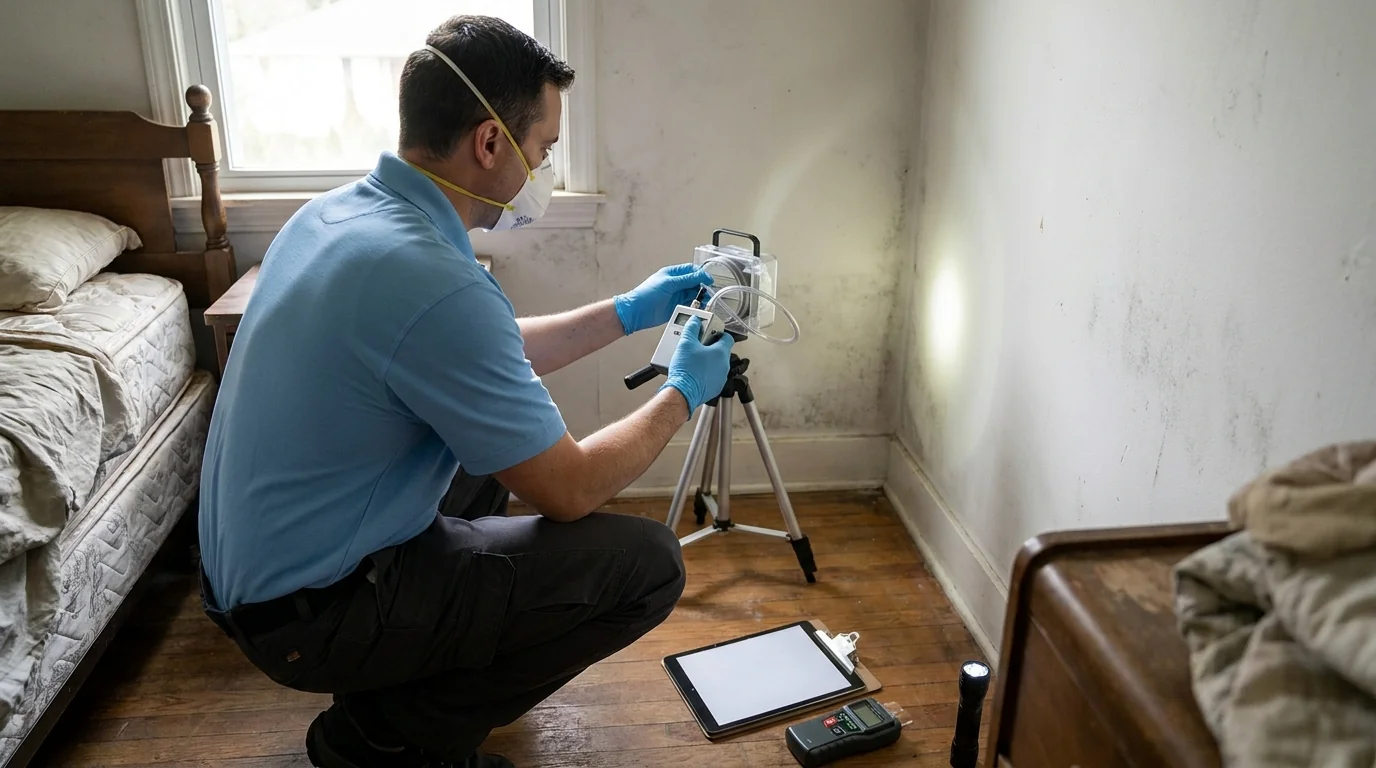
A mold inspection is not a visual walk-through with a flashlight. The process starts with a structured interview about the property’s moisture history — past leaks, flooding, HVAC issues, any previous remediation — followed by a room-by-room survey using a calibrated moisture meter and thermal imaging camera to locate elevated readings behind surfaces that look dry.
Where moisture anomalies are found, or where visible staining or odor suggests active growth, surface samples (tape-lift or swab) and air cassette samples are collected. Air samples capture the spore count and species composition in the living space and compare it against an outdoor baseline sample taken the same day. That comparison is what tells you whether elevated indoor spore levels are a building problem or just a reflection of outdoor seasonal conditions — an important distinction in central New Jersey, where outdoor mold counts run high from late summer through fall.
All samples are sent to an accredited third-party laboratory. The written report identifies species, spore concentrations, and affected areas, and it serves as the documentation baseline if remediation is needed and an insurance claim is filed.
Reaching Edison from Our Kenilworth Location
The Restoration Group operates out of Kenilworth, which puts Edison roughly 20 to 25 minutes away via the Garden State Parkway south to the Route 1 interchange, or through Woodbridge on Route 9. Because we’re available around the clock, a call about a suspected mold issue — whether it follows an overnight pipe failure in a Stelton basement or a post-storm inspection request in a North Edison neighborhood — gets a same-day scheduling response. Inspections are booked for a specific arrival window, not a vague half-day range.
Local Note: What Edison’s Postwar Basements Tend to Hide
One pattern that comes up repeatedly in Edison’s older neighborhoods is mold growth inside the hollow cores of concrete block foundation walls. Many of the capes and ranches built in the 1950s and 1960s used concrete masonry unit construction for their basement walls, and those hollow cavities can trap condensation and organic debris for years without any visible surface growth. Standard moisture meters read the surface, not the cavity. During inspections in these homes, thermal imaging during temperature differential conditions — early morning in summer, or after the heat kicks on in fall — is often the only way to detect the temperature anomaly that signals moisture inside the block. It’s a detail that matters specifically in Edison’s older housing stock and one that changes how we approach the inspection protocol.
If you’re seeing signs of moisture intrusion or unexplained air quality changes in your Edison home or commercial property, a documented inspection is the right first step. Call The Restoration Group at (855) 650-7422 to schedule mold inspection and testing — we’ll give you a clear picture of what’s present, where it is, and what it means for your property.
Mold Inspection and Testing in Edison: Service Coverage
Frequently Asked Questions
How fast can you arrive for mold inspection and testing in Edison?
Are homes in the Stelton and Clara Barton neighborhoods of Edison at higher risk for mold after a basement flood?
My Edison home was in a low-lying area that flooded during Ida in 2021. Is it too late to test for mold from that event?
How does outdoor mold season in central New Jersey affect the interpretation of air quality test results in Edison?
What does a mold inspection report include, and will it satisfy an insurance adjuster or a real estate transaction in Edison?
Do commercial tenants along the Route 1 corridor in Edison need a different type of mold assessment than a residential homeowner?
Mold Inspection and Testing response in Edison
Most Edison calls see a technician on-site within 60 minutes from our Fair Lawn headquarters.