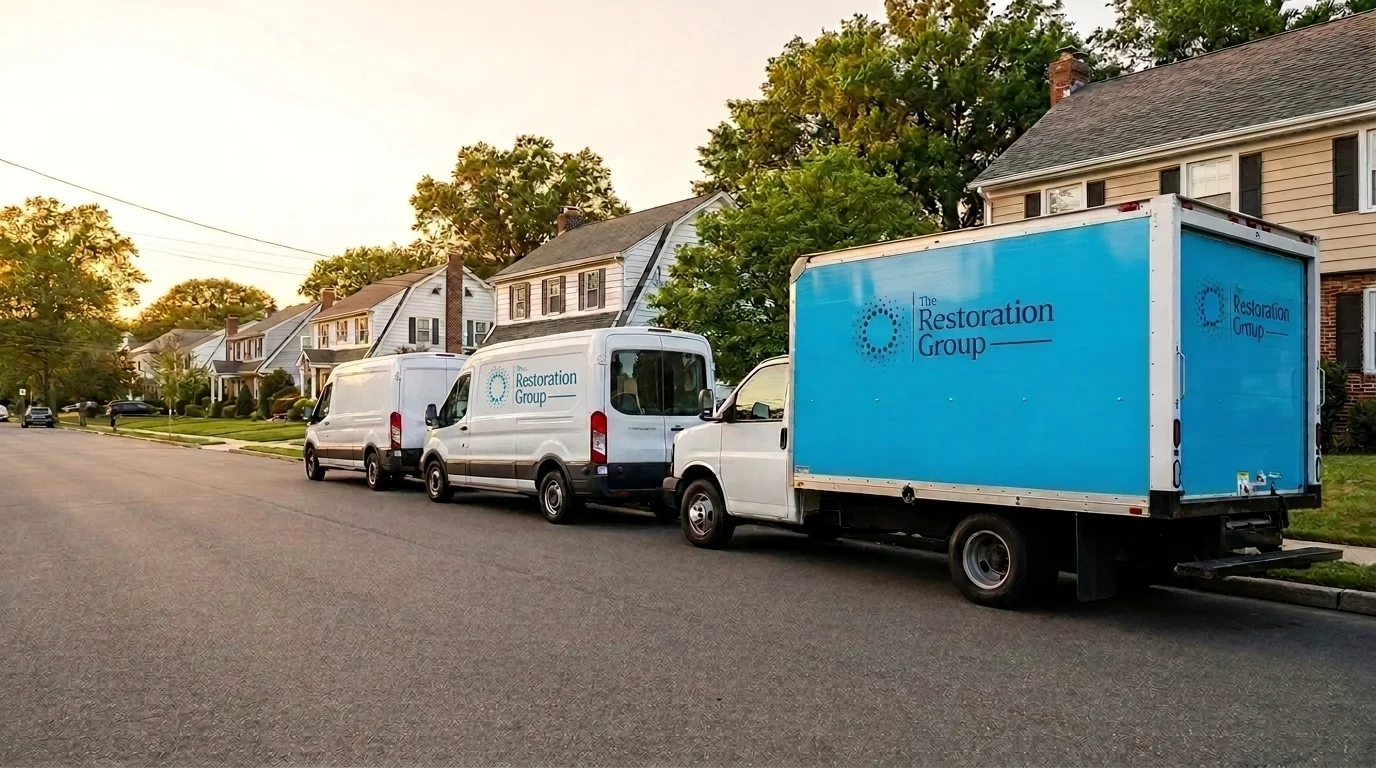
Water Cleanup in Cranford
24/7 water cleanup in Cranford, NJ. IICRC-certified, insurance billing accepted. Call (855) 650-7422.
Our IICRC-certified technicians are dispatched from our Fair Lawn, NJ headquarters and are typically on-site in Cranford within 60 minutes of your call.
The Rahway River doesn’t just define Cranford’s character — it defines the water damage calendar here. Residents near Riverside Drive and throughout the 07016 ZIP code have watched the river crest after Floyd, Irene, and Ida, and many have learned that the window between standing water in the basement and the start of mold colonization is shorter than most people expect. The Restoration Group, based in neighboring Kenilworth, responds around the clock to water cleanup calls across Cranford — because in this town, a heavy rain at 2 a.m. is a genuine emergency, not a morning problem.
Why Cranford Properties See Repeated Water Damage
Cranford earned the nickname “Venice of New Jersey” honestly. The Rahway River winds through the center of town, and the neighborhoods closest to Rahway River Parkway and the Cranford Canoe Club area are the first to feel a surge when upstream rain overwhelms the watershed. But river flooding is only half the story. Away from the riverbanks — in areas like Sunny Acres and Lincoln Park East — the problem is storm sewer capacity. When a fast-moving storm drops two or more inches in a short window, the municipal system backs up and water enters basements through floor drains and sump pits rather than through any failure of the home itself.
The housing stock compounds the risk. Most of Cranford’s residential blocks were built between roughly 1910 and the late 1940s — full-basement colonials and capes with original clay-tile drain lines, stone or brick foundation walls, and in many cases, plaster-over-lath interior walls rather than modern drywall. That construction era means water finds paths that newer homes simply don’t have, and it means extraction and drying require a different approach than a 1990s subdivision would.
Our Water Cleanup Process in Cranford
When we arrive, the first priority is safety and source control — confirming utilities are isolated if there’s any risk of electrical contact with standing water. From there, the process follows a documented sequence calibrated to the conditions we consistently find in Cranford homes.
Water extraction comes first. Truck-mounted and portable extractors pull standing water from basement floors, finished lower levels, and saturated carpet. In homes with stone or poured-concrete foundations, we pay close attention to the perimeter — water wicks laterally along the footing before it becomes visible at the center of the floor.
Moisture mapping follows immediately. Thermal imaging cameras and calibrated moisture meters let us read what’s happening inside walls and under flooring without unnecessary demolition. In Cranford’s older plaster walls, surface readings can appear dry while the wood lath behind them holds significant moisture — a condition that leads to mold if the drying phase is cut short.
Structural drying uses industrial air movers and refrigerant or desiccant dehumidifiers positioned according to the IICRC S500 standard for water damage restoration. We log temperature, humidity, and moisture readings at each visit so there’s a documented drying record — which matters when you’re filing with the National Flood Insurance Program or a private carrier.
Affected material removal, when necessary, is performed selectively. Saturated insulation and irreparably damaged drywall or flooring come out; salvageable structural materials are dried in place wherever the moisture readings support it.
Reaching Cranford from Kenilworth
Our Kenilworth headquarters sits one town over from Cranford — a short run up North Michigan Avenue or across via Kenilworth Boulevard to the Cranford border. That proximity matters when a basement is actively filling. We’re available 24/7, and the short distance means a crew can be mobilizing while you’re still on the phone. Downtown Cranford addresses, the Nomahegan Park corridor, and neighborhoods throughout the 07016 ZIP are all within a quick response radius.
Cranford Insurance and NFIP Coordination
Cranford’s flood history means a meaningful share of homeowners carry National Flood Insurance Program policies in addition to standard homeowners coverage — and NFIP claims have specific documentation requirements that differ from a typical carrier claim. We photograph affected areas systematically, log water levels and affected square footage, and produce the kind of written drying records that adjusters need to process a claim without unnecessary back-and-forth. If your loss involves both NFIP and a homeowners policy — a common situation when river flooding combines with a sump failure — we can communicate with both carriers from the same documentation package.
Local Note
Cranford’s older full basements often have a detail worth knowing before any pump-out: the original floor drain in a 1920s or 1930s home typically connects to the storm sewer, not the sanitary line. After a river flood event, that drain can act as a two-way valve — water that appeared to drain may re-enter if the street-level storm system is still under pressure. We check drain flow direction and downstream conditions before assuming a basement is clear, and we advise homeowners not to run laundry or dishwashers until the municipal system has normalized. It’s a small step that prevents a second round of water cleanup on a floor that looked finished.
If water has reached your Cranford home — whether from the Rahway River, a backed-up sewer, or a burst pipe on a January night — call The Restoration Group at (855) 650-7422. We document the loss, start drying immediately, and stay on the job until the moisture readings confirm the structure is genuinely dry.
Water Cleanup in Cranford: Service Coverage
Frequently Asked Questions
How fast can you arrive for water cleanup in Cranford?
Are homes near Riverside Drive in Cranford at higher risk for repeat flooding, and does that affect how you approach cleanup?
How quickly can The Restoration Group reach a water emergency in Cranford's 07016 ZIP code?
Cranford has a lot of pre-WWII homes with plaster walls — does that change how long the drying process takes?
We have an NFIP flood policy — how does your documentation process support that type of claim in Cranford?
After a storm, Sunny Acres and Lincoln Park East seem to flood from storm drains rather than the river — is the cleanup process different for that type of water intrusion?
Will my homeowners insurance cover water cleanup in Cranford?
Water Cleanup response in Cranford
Most Cranford calls see a technician on-site within 60 minutes from our Fair Lawn headquarters.