24/7 Emergency Storm Damage Restoration in Clifton
24/7 emergency storm damage restoration in Clifton, NJ. IICRC-certified, insurance billing accepted. Call (855) 650-7422.
Our IICRC-certified technicians are dispatched from our Fair Lawn, NJ headquarters and are typically on-site in Clifton within 60 minutes of your call.
When a fast-moving nor’easter or a remnant tropical system stalls over Passaic County, Clifton absorbs the hit in ways that neighboring towns don’t. The Passaic River and Weasel Brook converge near the city’s eastern and southern edges, and when either one overruns its banks, as both did during Irene in 2011 and Ida in 2021, low-lying streets in Lakeview and Delawanna flood before county emergency alerts even go out. If your home or building took on storm damage overnight, The Restoration Group is reachable around the clock at (855) 650-7422.
Why Clifton Properties See Disproportionate Storm Damage
Clifton’s housing stock tells a big part of the story. The majority of single-family homes in ZIP codes 07011 through 07014 were built between 1945 and 1965, capes, colonials, and split-levels with finished basements that sit only a foot or two above the water table in the flood-prone eastern sections. Those basements were never designed to handle the kind of hydraulic pressure that a 6-inch rainfall event generates against foundation walls. Original cast-iron drain lines and aging supply plumbing compound the problem: a storm that shakes a house can loosen a corroded joint and turn a flooding event into a combined storm-and-pipe-burst loss.
Botany Village’s older brick multi-family buildings face a different set of vulnerabilities. Parapet walls and flat or low-slope roofs that have gone years between inspections can fail suddenly under the weight of saturated debris or wind-driven rain, sending water into multiple units simultaneously. On the Route 3 commercial corridor and around Styertowne, retail and mixed-use buildings with large roof spans and commercial sprinkler systems see storm-triggered sprinkler discharges and overnight roof-leak events that require a faster commercial response than a typical residential crew can provide.
Our Storm Damage Restoration Process in Clifton
Every storm loss is different, but the sequence we follow is consistent and calibrated to what we actually find in Clifton properties.
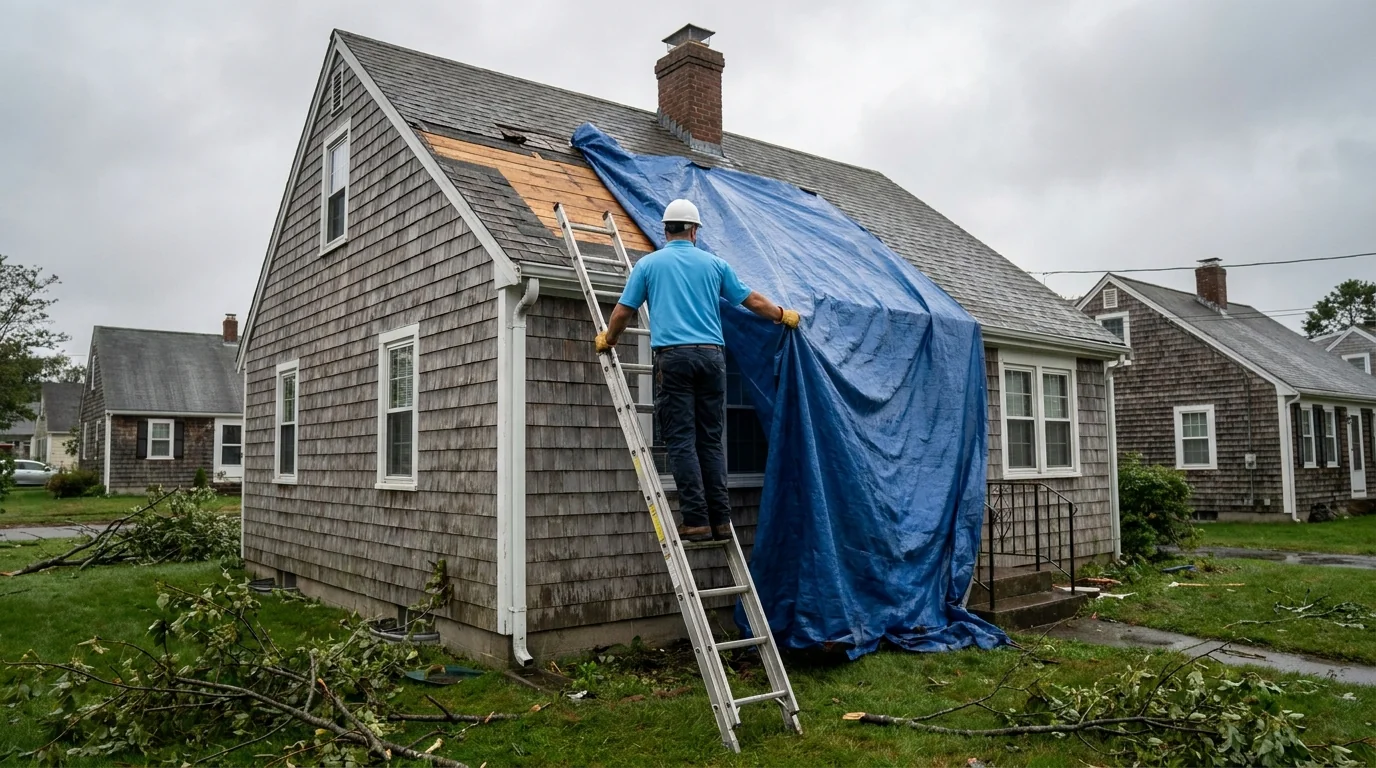
1. Emergency stabilization. The first priority is stopping active intrusion, tarping breached roofs, boarding compromised windows, and pumping standing water before it wicks further into structural cavities. In split-level homes, water that enters at grade can travel down into a finished lower level within minutes.
2. Moisture mapping. We use thermal imaging cameras and calibrated moisture meters to trace water migration behind walls and under flooring. In Clifton’s postwar homes, original hardwood subfloors and plaster-over-lath wall assemblies hold water in ways that modern drywall doesn’t, and a visual inspection alone will miss saturated cavities that will grow mold within 24 to 48 hours.
3. Structural drying. Industrial desiccant dehumidifiers and high-velocity air movers are positioned according to the IICRC S500 standard for water damage restoration. Drying timelines in finished basements with concrete block walls typically run longer than above-grade spaces, we monitor daily and adjust equipment placement based on psychrometric readings, not a fixed-day schedule.
4. Debris removal and damage documentation. Wind-driven tree limbs, displaced roofing materials, and saturated insulation are removed and photographed systematically. That documentation package is what your insurance adjuster needs to process the claim accurately.
5. Reconstruction. Once the structure is dry and the adjuster has signed off, our crews handle framing, drywall, insulation, and finish work so you’re dealing with one contractor from first call to final walkthrough.
Reaching Clifton from Kenilworth
Our crews stage out of Kenilworth, which puts us roughly 20 minutes from most of Clifton under normal traffic conditions via Route 22 East to Route 21 North. The Route 21 corridor runs directly through the Delawanna and Lakeview sections that see the heaviest flood activity, so we’re not navigating around the affected area, we’re driving into it from the south. For calls originating near Botany Village or Athenia, we typically come in via Bloomfield Avenue or Clifton Avenue depending on which lanes are passable after a major storm event. Because we operate 24/7, we can dispatch immediately when a storm clears enough for crews to work safely, we don’t wait for business hours to open a job.
Clifton Insurance Coordination
Storm damage claims in Clifton tend to involve a mix of wind, flood, and water-intrusion coverage that sits across two or three separate policy sections, and sometimes two separate carriers if a homeowner carries a standalone NFIP flood policy in addition to standard homeowners coverage. We photograph and document every affected material before anything is removed, itemize equipment placement and drying logs, and provide a scope of loss formatted to align with Xactimate line items, which is the estimating platform most adjusters use. That paperwork reduces the back-and-forth that delays claim settlements.
Local Note
One thing that catches out-of-area contractors in Clifton’s Lakeview and Delawanna sections: the combination of clay-heavy soil and shallow water tables means that even after floodwaters recede from the street, hydrostatic pressure against basement walls can persist for days. We’ve seen freshly pumped basements re-flood from groundwater seeping through block mortar joints 36 hours after a storm, before any additional rain. If your basement took on water during a Passaic River event, don’t assume it’s dry because the pump ran dry, have the walls checked before you bring equipment or stored contents back in.
Storm damage doesn’t follow a schedule, and neither do we. If your property in Clifton took a hit, call (855) 650-7422 now, we’ll assess the damage, stabilize the structure, and walk you through the insurance process from the first conversation.
Serving Clifton from our Fair Lawn headquarters — ★ 4.8 · 167 Google reviews
“Great workers, so nice and efficient! And Ottavio is the best” - Emma, October 2026Read our reviews on Google →
Storm Damage Restoration in Clifton: Service Coverage
Frequently Asked Questions
How fast can you arrive for storm damage restoration in Clifton?
Are homes in Clifton's Lakeview and Delawanna sections at higher risk during storm events, and does that affect how quickly you can respond?
Clifton has a lot of postwar split-levels and capes with finished basements — does that change how you approach storm water extraction?
My home is in the 07011 ZIP code near Botany Village and has an older flat roof. What storm damage issues should I expect after a major wind event?
How does storm damage documentation work when a Clifton homeowner has both a standard homeowners policy and a separate NFIP flood policy?
How long does storm damage drying typically take in a Clifton home with a concrete block basement foundation?
Will my homeowners insurance cover storm damage restoration in Clifton?
Storm Damage Restoration response in Clifton
Most Clifton calls see a technician on-site within 60 minutes from our Fair Lawn headquarters.