Water Cleanup in Clark
24/7 water cleanup in Clark, NJ. IICRC-certified, insurance billing accepted. Call (855) 650-7422.
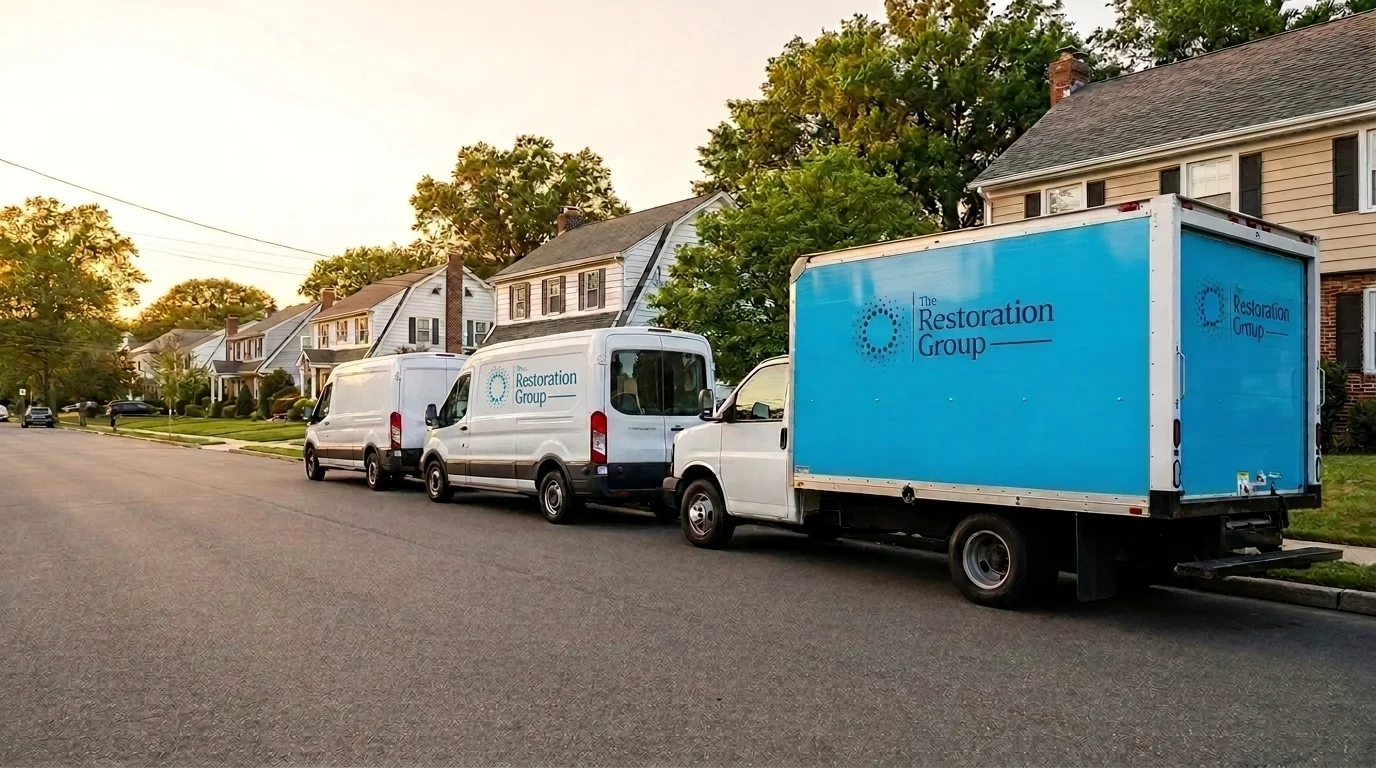
Our IICRC-certified technicians are dispatched from our Fair Lawn, NJ headquarters and are typically on-site in Clark within 60 minutes of your call.
When the Rahway River or Robinson’s Branch backs up after a hard rain, the ranches and split-levels near Lake Avenue and Valley Road don’t get a warning — water just appears at the base of the basement stairs. Clark’s compact postwar housing stock was built for a different era of storm intensity, and the finished basements that make these homes livable are exactly where water damage does its worst work. The Restoration Group responds 24/7 to water cleanup calls across Clark, NJ 07066, from sump-pump failures on quiet cul-de-sacs to commercial losses along the Raritan Road strip.
Why Clark Properties See Water Cleanup Issues
Clark was largely built out between the late 1940s and the mid-1960s, which means the majority of its housing stock carries aging cast-iron drain lines and original copper supply plumbing. Cast iron corrodes from the inside out — pinhole failures and joint separations are common, and they often go unnoticed until a finished basement ceiling shows a stain or standing water appears on the carpet. Copper supply lines from this era are prone to pinhole leaks at solder joints, especially where water pressure fluctuates.
The geography compounds the risk. Robinson’s Branch threads through low ground near Lake Avenue before joining the Rahway River along Clark’s northern and western edges. During heavy events — Ida in 2021 being the sharpest recent example — both waterways have exceeded their banks and pushed water backward through municipal sewer connections, sending sewage-contaminated water into basements off Valley Road. That’s a different cleanup problem than a burst pipe: it requires Category 3 water protocols, not just extraction and drying.
Sump pumps are the routine failure point. Clark’s soil drains slowly after saturation, and a pump that loses power during a summer thunderstorm can let a foot of groundwater into a finished basement within hours.
Our Water Cleanup Process in Clark
Every call starts with a moisture assessment before any equipment moves. In Clark’s older homes, water behind plaster or inside block foundation walls can read dry at the surface while the substrate stays saturated — a standard pin meter reading at the drywall face misses it. We use thermal imaging and penetrating moisture meters to map the actual wet boundary, not just the visible one.
From there, the process follows a structured sequence:
- Standing water extraction using truck-mounted and portable units, including water trapped under floating floors and inside wall cavities
- Material evaluation — determining what can be dried in place versus what needs to come out (wet insulation, for example, holds moisture too long to dry efficiently and typically gets removed)
- Drying system placement — calibrated dehumidifiers and air movers positioned based on the moisture map, not a generic room-count formula
- Daily monitoring — moisture readings logged each visit so drying progress is documented, not assumed
- Final clearance readings before equipment is pulled
For losses that involve sewage backup — a real pattern in the Valley Road area after heavy rain — we follow Category 3 containment and disposal protocols before any drying work begins.
Reaching Clark from Kenilworth
The Restoration Group is based in Kenilworth, which sits directly adjacent to Clark’s northern border. Central Avenue and Raritan Road connect the two municipalities in minutes, meaning crews can reach the Westfield Avenue corridor, the Brant Lake neighborhood, and addresses near Arthur L. Johnson High School without navigating across county lines or through congested interchange traffic. Because we operate 24/7, a call at 2 a.m. after a sump failure gets the same dispatch as a call at noon.
Clark Insurance Coordination
Most standard homeowner policies in New Jersey cover sudden and accidental water discharge — a burst pipe, an appliance failure, an ice-maker line that lets go overnight. Flood damage from rising surface water is a separate coverage under the National Flood Insurance Program, and Clark properties near Robinson’s Branch may carry both. We document losses with photographs, moisture logs, and itemized scope notes formatted for carrier review, and we bill most major insurers directly. If your policy has a flood rider or a separate endorsement, we can work with your adjuster to sort the coverage categories correctly.
Local Note
Clark’s split-level homes present a specific drying challenge that doesn’t come up as often in towns with slab-on-grade construction. The intermediate floor level — typically a few steps below the main living area, often housing the laundry room, a bathroom, and direct garage access — sits partially below grade. When water enters at that level, it wicks laterally into the framing that connects to the upper floor deck. Drying that assembly requires equipment placed both below and above the wet zone simultaneously, and it takes longer than a straightforward basement flood because the framing is enclosed on multiple sides. If you have a split-level in Clark and you’ve had water at the intermediate level, ask specifically about the floor-deck assembly when you call — it’s the part that gets missed.
If standing water is in your home right now, call The Restoration Group at (855) 650-7422. We’re available around the clock and can begin water cleanup in Clark the same day you call.
Water Cleanup in Clark: Service Coverage
Frequently Asked Questions
How fast can you arrive for water cleanup in Clark?
How quickly can The Restoration Group reach the Lake Avenue and Valley Road area of Clark after a water emergency?
My Clark basement flooded after a heavy rain and smells like sewage — is that a different cleanup than a normal water loss?
Are Clark's postwar split-levels and ranches harder to dry out than newer construction?
Does my homeowner's insurance cover the kind of basement flooding that's common in Clark's 07066 ZIP code?
How do you know when a water-damaged area in a Clark home is actually dry and safe to close up?
Water Cleanup response in Clark
Most Clark calls see a technician on-site within 60 minutes from our Fair Lawn headquarters.