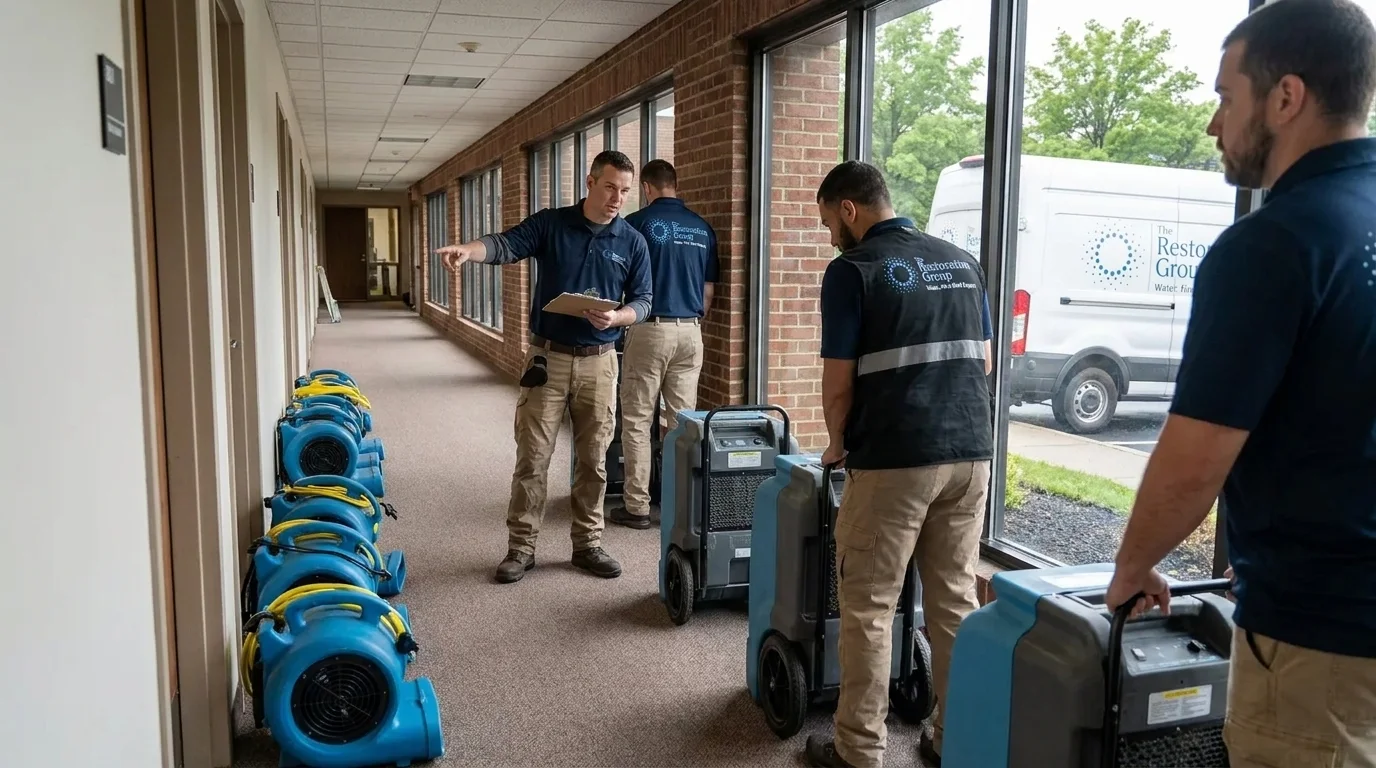
Large Loss and Catastrophic Response in Kenilworth
24/7 large loss and catastrophic response in Kenilworth and surrounding areas. IICRC-certified, insurance billing accepted. Call (855) 650-7422.
A single-family water loss and a 40-unit apartment fire are not the same problem scaled up. Large loss and catastrophic response applies when damage spans multiple units, multiple structures, or crosses into six and seven figures of reconstruction cost, and when the building has to keep functioning (or get tenants back in) while the work happens. That means multiple drying crews running in parallel, a general contractor on standby for structural repairs, and documentation built from day one to survive scrutiny from a large loss adjuster or third-party administrator.
What large loss and catastrophic response actually involves
A catastrophic loss rarely has one cause or one affected area. A burst main in a mixed-use building can hit a ground-floor retail space, the units above it, and shared mechanical rooms all at once. A commercial fire can leave smoke damage in sections of a structure the flames never reached. Large loss response treats the property as a single project with multiple fronts: structural stabilization, water or fire mitigation, content handling, and reconstruction scheduling, all tracked against one scope of work instead of several disconnected ones.
The work typically runs longer than a standard residential claim, sometimes weeks instead of days, and it requires equipment deployed at a different scale: trailer-mounted desiccant dehumidifiers instead of a handful of box fans, generator power when utilities are compromised, and enough extraction and air-moving equipment to cover tens of thousands of square feet without pulling resources off other active jobs.
Our process
- Rapid mobilization and site assessment. Crews are deployed to assess the full footprint of the damage, not just the most visible area, before any equipment goes in. Because The Restoration Group operates 24/7, that initial assessment can start the moment the loss is reported.
- Scope documentation for the carrier or TPA. Detailed photos, moisture readings, and line-item estimates are compiled in a format large loss adjusters expect, so the claim moves without repeated requests for missing information.
- Structural stabilization. Board-up, temporary power, roof tarping, and shoring happen before mitigation equipment is set, protecting the building envelope and preventing secondary damage while the larger plan is finalized.
- Multi-zone mitigation. Extraction, drying, or soot and smoke removal runs across every affected area simultaneously, with moisture logs and air quality checks tracked by zone so progress is verifiable, not estimated.
- Reconstruction handoff. Once the structure is dry and stable, reconstruction scope, permitting, and phased rebuild work are coordinated so the property owner isn’t managing multiple separate contractors for one loss.
What separates a good large loss response from a bad one
The most common failure on catastrophic losses isn’t a missed repair, it’s a documentation gap. When moisture readings, photos, and equipment logs aren’t tracked by zone from day one, adjusters have no way to verify drying progress, and payment stalls while the building sits wet. A good large loss response treats documentation as part of the mitigation work, not paperwork that happens afterward.
The second common mistake is understaffing. A crew sized for a single-family water loss cannot dry a commercial building or multi-unit property on the same timeline, and delayed drying on a large footprint means a much higher risk of secondary mold growth across multiple units before remediation even starts. Scaling crew size and equipment to the actual square footage, not the first 24 hours of visible damage, is what keeps a catastrophic loss from turning into a second, mold-driven claim.
What does large loss and catastrophic response cost?
Catastrophic losses vary enormously depending on the number of structures, units, and trades involved, so costs are better understood as ranges than fixed prices. These are typical industry figures, not a quote: every loss gets a written scope from The Restoration Group before work begins, and much of the mitigation and stabilization cost is typically covered by commercial or multi-family property insurance, with coverage details depending on the specific policy and cause of loss.
| Scenario | Typical range |
|---|---|
| Multi-unit residential water loss, per building | $50,000 - $250,000 |
| Commercial structure fire, single building | $250,000 - $1,500,000 |
| Large commercial water loss with business interruption | $150,000 - $800,000 |
| Multi-building flood event | $500,000 - $5,000,000+ |
| Phased reconstruction after mitigation, per unit | $15,000 - $60,000 |
Seasonal and regional considerations
Union County’s mix of older multi-family buildings, aging commercial strips, and industrial properties means catastrophic losses here often involve shared mechanical systems, common walls, and plumbing stacks that affect multiple units from a single failure point. Winter freeze events can turn a single pipe failure into a multi-floor loss overnight, while summer thunderstorms and the occasional remnant tropical system bring the flood-driven catastrophic losses that hit basements, parking structures, and ground-floor commercial space hardest.
Service area
The Restoration Group is based in Kenilworth, NJ and responds to large loss and catastrophic events throughout Union County and the surrounding region, including commercial, multi-family, and mixed-use properties.
A catastrophic loss doesn’t wait for business hours, and neither should the response. Call (855) 650-7422 to mobilize a large loss team and start building the scope of work your adjuster needs to move the claim forward.
Frequently Asked Questions
Does property insurance cover large loss and catastrophic damage?
What makes a loss \"large loss\" instead of a standard claim?
How is a multi-building or multi-unit loss managed differently than a single-family claim?
How quickly can a large loss team mobilize?
What role do large loss adjusters play in the restoration process?
Looking for the best large loss and catastrophic response company in Fair Lawn?
The Restoration Group provides large loss and catastrophic response in Fair Lawn, NJ and the surrounding area, and has served local property owners since 2021. Customers rate us 4.8 out of 5 stars across 166 Google reviews. We answer calls 24/7 — call (844) 808-8838 for immediate help.
Need Large Loss and Catastrophic Response now?
We respond 24/7 across Fair Lawn and surrounding NJ cities.
Related Coverage
- Our Restoration Services
- Contact The Restoration Group
- Restoration Services in Avenel
- Restoration Services in Bayonne
- Restoration Services in Bloomfield
- Restoration Services in Bridgewater
- Restoration Services in Brooklyn
- Restoration Services in Carteret
- Restoration Services in Chatham
- Restoration Services in Clark
- Restoration Services in Clifton
- Restoration Services in Colonia
- Restoration Services in Cranford
- Restoration Services in East Brunswick