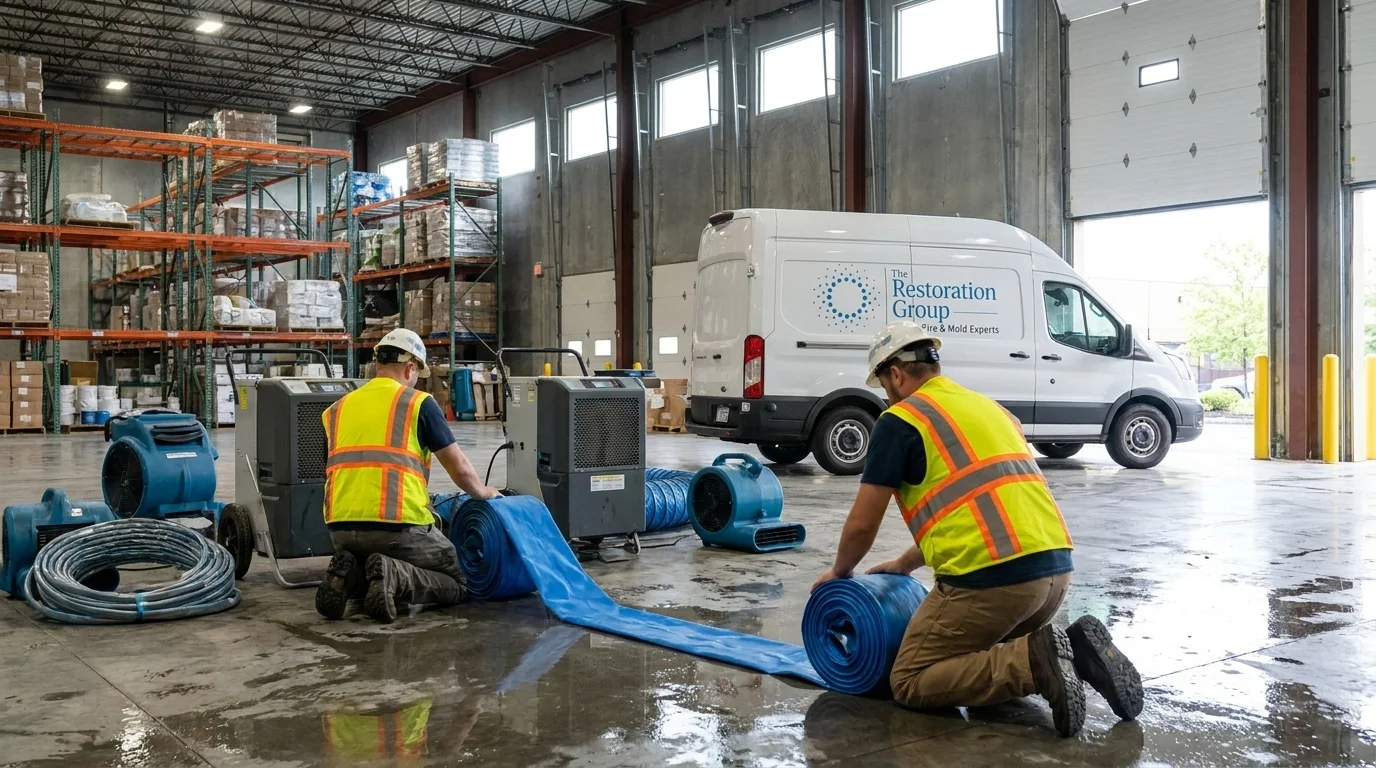
Industrial Restoration in Kenilworth
24/7 industrial restoration in Kenilworth and surrounding areas. IICRC-certified, insurance billing accepted. Call (855) 650-7422.
Water pooling under a conveyor line or smoke settling into HVAC ductwork doesn’t wait for a convenient time. A pinhole leak in overhead piping or a fire in a loading dock transformer can shut down a production line within hours, and every hour of downtime compounds the loss. Industrial restoration deals with the scale, equipment, and documentation requirements that separate a warehouse or manufacturing floor from a residential job: larger volumes of water or soot, specialized machinery at risk, and business interruption on the clock. We answer 24/7 and bring equipment sized for facility-scale losses, not single-room drying.
What industrial restoration actually involves
Industrial restoration covers water, fire, and storm losses inside warehouses, manufacturing plants, distribution centers, and processing facilities. The work scales with the building: instead of a handful of air movers, a flooded 40,000 square foot warehouse floor may need desiccant dehumidification units, trench drains cleared of debris, and submersible pumps running continuously. Fire losses on a production floor involve soot characterization across different surfaces, from painted steel beams to electrical panels, and often require coordination with facility engineers before any equipment is powered back on. Timelines vary widely: a contained water intrusion in a storage area might dry in a few days, while a plant-wide loss involving concrete slab saturation or machinery corrosion can run several weeks.
Our process
- Facility assessment and access coordination. We walk the affected areas with facility management or safety staff, identify electrical hazards, confirm lockout/tagout status on equipment, and scope which zones can stay operational during drying.
- Large-volume extraction or soot removal. Truck-mounted extraction units and submersible pumps handle standing water in loading docks, pits, and trenches; for fire losses, we use HEPA vacuuming and dry-chemical sponging matched to the soot type before wet cleaning begins.
- Structural drying sized to the space. High-ceiling warehouses and open manufacturing floors need calculated airflow and dehumidification capacity, not residential-scale equipment. We monitor moisture in concrete slabs, steel supports, and subfloor voids with daily readings until drying goals are met.
- Corrosion and equipment protection. Metal shelving, conveyor components, and electrical panels are treated with corrosion inhibitors where water or smoke exposure puts them at risk, since rust can set in within hours on bare metal.
- Documentation for claims and downtime records. We photograph affected inventory, structural materials, and equipment, and provide a written scope that supports both the property claim and any business interruption filing.
What separates a good industrial restoration response from a bad one
The most common mistake is undersizing the drying equipment for the space, which leaves hidden moisture in slab seams, wall cavities, or beneath heavy machinery long after the visible water is gone. Another is overlooking machinery and electrical components entirely because the visible damage is to flooring or inventory; corrosion on bearings, motors, or control panels often shows up weeks later if it isn’t addressed during the initial response. Adjusters reviewing industrial claims look for moisture mapping data, equipment-specific treatment notes, and a clear timeline connecting the loss event to the drying or soot removal work performed. A thorough response documents all of it in writing before the crew leaves the site, not after the fact.
What does industrial restoration cost?
Costs vary significantly based on square footage, the category of water or type of fire damage, and whether specialized equipment or inventory is involved. The ranges below reflect typical industry figures for industrial-scale losses, not a quote: The Restoration Group provides a written scope specific to your facility before any work begins, since every loss is different. Commercial property insurance often covers industrial water and fire damage along with applicable business interruption coverage, but policy terms vary and should be confirmed with your carrier.
| Scenario | Typical range |
|---|---|
| Small warehouse water intrusion, under 5,000 sq ft | $5,000 - $15,000 |
| Mid-size manufacturing floor, Category 2 water | $15,000 - $45,000 |
| Large distribution center, structural drying | $40,000 - $120,000 |
| Industrial fire damage, single production line | $25,000 - $75,000 |
| Plant-wide smoke and soot remediation | $75,000 - $250,000+ |
Seasonal & regional considerations
New Jersey’s winter freeze-thaw cycles put loading dock seals, overhead sprinkler lines, and unheated storage sections at the highest risk for pipe bursts, particularly in older industrial buildings with exposed piping runs. Summer humidity adds load to any warehouse drying project, since large open spaces with high ceilings don’t exchange air the way smaller rooms do, and dehumidification has to be sized accordingly. Facilities near the industrial corridors along the Turnpike and rail lines in Union County also deal with periodic heavy rain events that can overwhelm site drainage faster than in surrounding residential areas.
Service area
The Restoration Group is based in Kenilworth and responds to industrial and manufacturing facilities throughout Union County and the surrounding industrial corridor, including warehouses, plants, and distribution centers in neighboring towns along the Turnpike and rail access points.
If water, fire, or smoke is affecting your facility right now, call (855) 650-7422 to get an industrial restoration team scoping the damage and protecting your equipment before the loss spreads further.
Frequently Asked Questions
Does commercial insurance cover industrial water or fire damage?
Can you work in sections of our facility without shutting down the entire operation?
How is drying a warehouse different from drying a home?
Will a water or fire loss cause corrosion on our machinery and equipment?
What documentation do you provide for a business interruption claim?
Looking for the best industrial restoration company in Fair Lawn?
The Restoration Group provides industrial restoration in Fair Lawn, NJ and the surrounding area, and has served local property owners since 2021. Customers rate us 4.8 out of 5 stars across 166 Google reviews. We answer calls 24/7 — call (844) 808-8838 for immediate help.
Need Industrial Restoration now?
We respond 24/7 across Fair Lawn and surrounding NJ cities.
Related Coverage
- Our Restoration Services
- Contact The Restoration Group
- Restoration Services in Avenel
- Restoration Services in Bayonne
- Restoration Services in Bloomfield
- Restoration Services in Bridgewater
- Restoration Services in Brooklyn
- Restoration Services in Carteret
- Restoration Services in Chatham
- Restoration Services in Clark
- Restoration Services in Clifton
- Restoration Services in Colonia
- Restoration Services in Cranford
- Restoration Services in East Brunswick