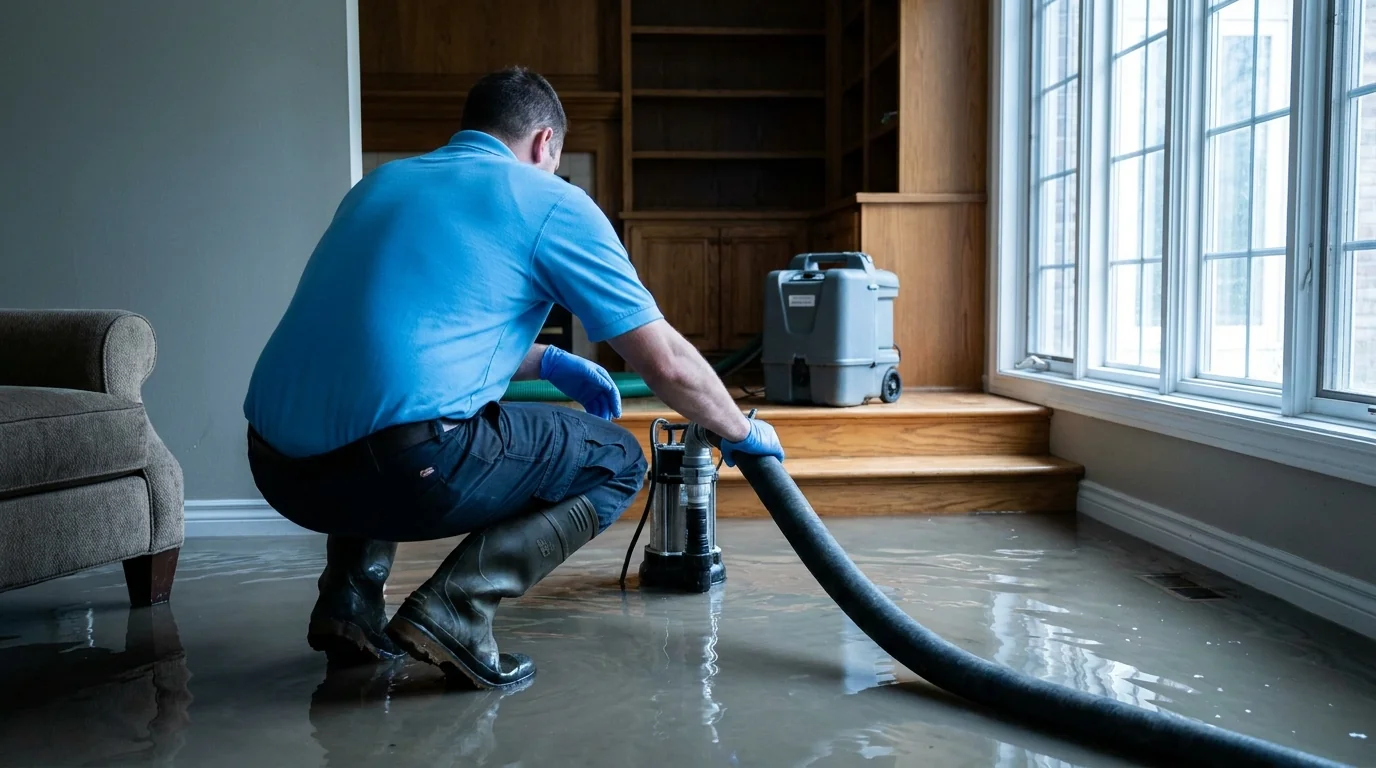
Flood Damage Restoration in West Orange
24/7 flood damage restoration in West Orange, NJ. IICRC-certified, insurance billing accepted. Call (855) 650-7422.
Our IICRC-certified technicians are dispatched from our Fair Lawn, NJ headquarters and are typically on-site in West Orange within 60 minutes of your call.
When storms roll off the Watchung ridge and funnel runoff down through West Orange’s hillside neighborhoods, basements fill fast — sometimes faster than a sump pump can cycle. The finished lower levels that are nearly universal in Pleasantdale ranches and the grand Victorians of Llewellyn Park turn a few inches of standing water into a multi-room loss within hours. The Restoration Group responds 24/7 to flood damage calls across 07052, bringing industrial extraction and drying equipment to homes and commercial properties before secondary damage compounds the cost.
Why West Orange Properties See Flood Damage So Often
West Orange’s topography is the root cause. The town climbs steeply from the valley floor up toward Eagle Rock Reservation, and that grade means stormwater moves quickly and concentrates in low pockets before drainage infrastructure can handle it. Streams draining South Mountain Reservation swell during heavy rain events, and the headwaters of the Rahway River system run through corridors that can back up into nearby residential streets with little warning.
Tropical Storm Ida in September 2021 made this concrete for thousands of Essex County residents. West Orange saw flash flooding and sewer surcharge events that pushed sewage-contaminated water into basements across multiple neighborhoods — a Category 3 contamination scenario that requires a different response than a clean-water pipe burst. Homes in the Gregory and St. Cloud areas, many of them postwar splits and colonials built with finished recreation rooms below grade, took on water through window wells, floor drains, and overwhelmed sump pits simultaneously.
Older housing stock adds another layer of complexity. Pre-1950 construction in Llewellyn Park and parts of the Pleasantdale corridor often includes stone or brick foundation walls with original mortar that has deteriorated over decades. Those walls wick moisture laterally in ways that poured-concrete foundations do not, and drying protocols have to account for that slower, deeper moisture migration.
Our Flood Damage Restoration Process in West Orange
Every job starts with moisture mapping — thermal imaging and pin-type meters across every affected surface, including inside wall cavities and under flooring. In West Orange’s finished basements, that typically means pulling back carpet and pad, probing the subfloor, and checking the base of framed partition walls before any drying equipment is placed. What looks like a localized puddle is often a much wider saturation footprint.
Water classification matters here. A sump overflow fed by groundwater is not the same as a sewer backup during a storm. We test and document the contamination category before extraction begins, because Category 2 and Category 3 losses require antimicrobial treatment and, in some cases, controlled demolition of porous materials that cannot be reliably dried and sanitized. We photograph and document every step — both for your insurance file and because NJ-licensed contractors are required to maintain records of scope and method.
After extraction, we set commercial-grade desiccant or refrigerant dehumidifiers and high-velocity air movers calibrated to the room volume and the measured moisture load. Drying typically runs three to five days for a finished basement, though stone-foundation walls in older West Orange homes can extend that window. We monitor daily and adjust equipment placement based on readings — we do not set equipment and disappear.
Reaching West Orange from Kenilworth
The Restoration Group is based in Kenilworth, roughly eight miles from the center of West Orange. Our crews travel Route 22 to I-78 West or use Springfield Avenue depending on traffic and time of day, and we are available around the clock. Llewellyn Park, which sits in the northwestern corner of West Orange near the Essex County border, is reachable via Northfield Avenue and the park’s private gate access — we are familiar with the entry protocol and call ahead on those addresses to avoid staging delays. For commercial losses along the Northfield Avenue or Prospect Avenue corridors, we coordinate with property managers on equipment access and after-hours entry before we arrive.
West Orange Insurance Coordination
Most standard homeowner policies in New Jersey distinguish between sudden-and-accidental water losses and flood losses caused by surface water or sewer backup — and that distinction determines which coverage applies. Sewer backup riders are common but not universal, and many West Orange homeowners discover the gap only after a storm event. We document the loss origin as specifically as possible — drain backup versus groundwater intrusion versus appliance failure — because that language in the initial report affects how your adjuster categorizes the claim.
We bill carriers directly and provide the moisture logs, photo documentation, and scope of work in the format most major adjusters request. If a scope dispute arises, our IICRC Certified Firm documentation (Firm #210213) supports the drying methodology we used.
Local Note
In West Orange’s older Llewellyn Park and adjacent Victorian-era homes, original horsehair plaster over wood lath is still common on basement stairwells and utility rooms. Unlike modern drywall, plaster does not wick water upward as aggressively — but it holds absorbed moisture for significantly longer once saturated. We have seen plaster walls in these homes read elevated on a moisture meter for ten or more days after extraction is complete, long after a drywall surface would have cleared. Rushing demolition decisions on plaster can mean unnecessary historic material loss; rushing closure on drying can mean hidden mold colonization behind intact surfaces. We take daily readings and do not call a job dry until the numbers confirm it.
If your West Orange home or commercial property has taken on water — whether from a storm drain backup, a sump failure, or a roof breach over the Essex Green commercial corridor — call The Restoration Group at (855) 650-7422. We will assess the loss, explain the scope honestly, and get drying equipment in place before the damage clock runs any further.
Serving West Orange from our Fair Lawn headquarters — ★ 4.8 · 158 Google reviews
“The folks at TRG were professional, punctual, and pleasant to deal with. They did a great job addressing our issue and performed appropriate follow up to ensure our satisfaction.” — Jw, August 2026Read our reviews on Google →
Flood Damage Restoration in West Orange: Service Coverage
Frequently Asked Questions
How fast can you arrive for flood damage restoration in West Orange?
How quickly can The Restoration Group reach a flooded basement in Pleasantdale or the Gregory neighborhood?
After a storm event like Ida, how do I know whether my West Orange basement flood is a clean-water loss or a sewer backup?
Do West Orange's older stone-foundation homes in areas like Llewellyn Park take longer to dry after a flood?
Will my homeowner's insurance cover a flood in my West Orange basement, or do I need a separate policy?
What equipment do you use for flood drying in a finished West Orange basement, and how long does it typically run?
Flood Damage Restoration response in West Orange
Most West Orange calls see a technician on-site within 60 minutes from our Fair Lawn headquarters.