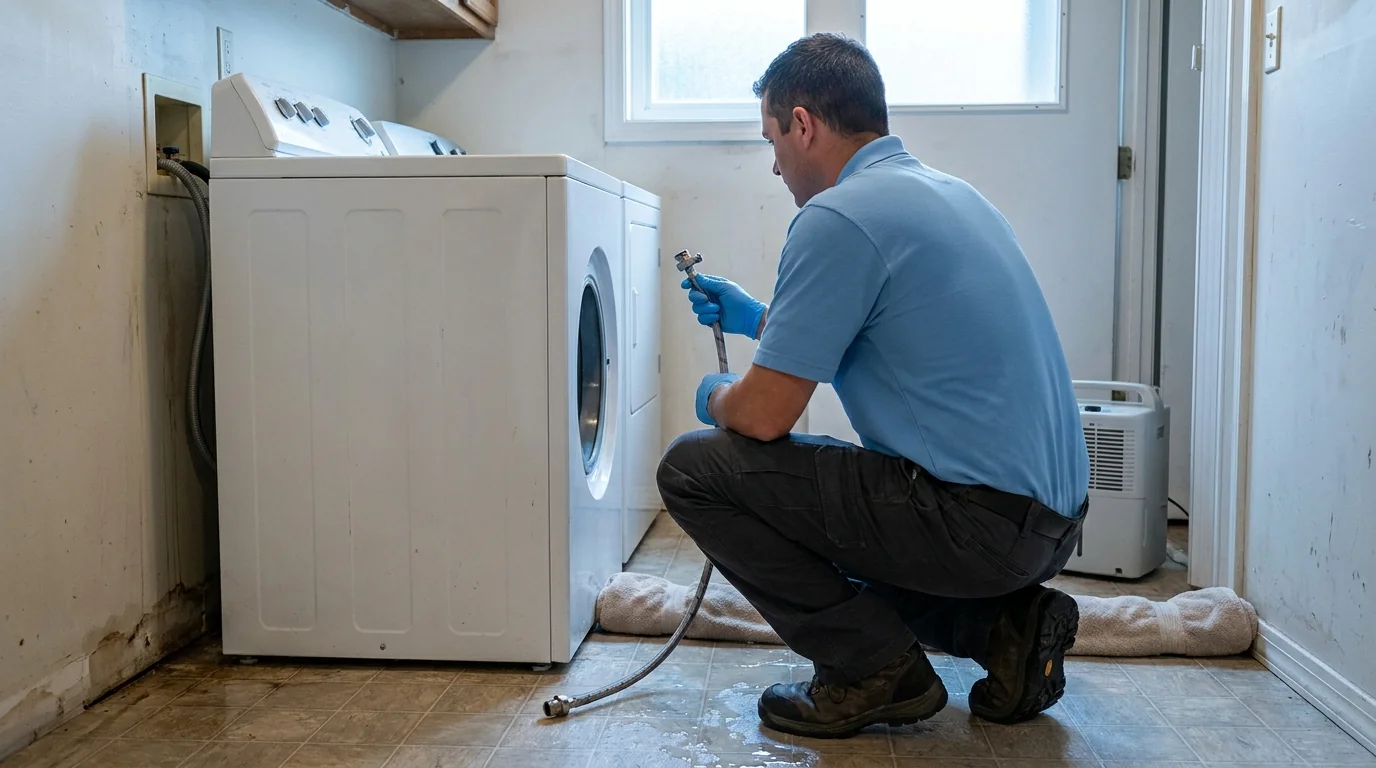
Appliance Leak Cleanup in Wayne
24/7 appliance leak cleanup in Wayne, NJ. IICRC-certified, insurance billing accepted. Call (855) 650-7422.
Our IICRC-certified technicians are dispatched from our Fair Lawn, NJ headquarters and are typically on-site in Wayne within 60 minutes of your call.
Wayne’s midcentury split-levels and ranches — especially the lake communities around Packanack Lake and Pines Lake — were built in an era when appliance supply lines were copper or early braided steel, and many of those connections are still in place today. When a washing machine hose finally lets go or a refrigerator ice maker line weeps behind a finished wall, the water doesn’t just pool on the floor: it disappears into subfloor cavities, insulation batts, and the framed basement ceilings that homeowners spent years finishing. The Restoration Group responds 24/7 to appliance leak cleanup in Wayne, NJ, and the surrounding 07470 corridor.
Why Wayne Homes See More Appliance Leak Damage Than You’d Expect
The housing stock tells most of the story. The colonials and capes built through the 1950s–70s in neighborhoods like Mountain View and Preakness were designed around appliances that sat on vinyl or linoleum — materials that show water fast. Today those same laundry rooms and kitchens have been updated with engineered hardwood, laminate plank, or tile over cement board, and those surfaces hide slow leaks beautifully until the subfloor is already saturated.
Refrigerator ice maker lines are a particular culprit in Wayne’s older homes. The supply lines run behind cabinetry and through wall cavities that were never intended to be inspected, and a pinhole drip at a compression fitting can go undetected for weeks. By the time the homeowner notices a soft spot in the floor or a musty smell near the kitchen, mold can begin colonizing porous materials in as little as 24–48 hours after initial saturation — and Wayne’s humid summers accelerate that window considerably.
Water heater failures follow a similar pattern. Many Wayne homes have water heaters tucked into finished basement utility corners, and a failing pressure relief valve or corroded tank bottom can release 40–80 gallons before anyone notices. In a sump-dependent basement — common throughout the lake communities — that water has nowhere to go until it’s extracted.
Our Appliance Leak Cleanup Process in Wayne
When we arrive, the first priority is stopping ongoing water introduction: shutting the supply valve to the affected appliance, confirming the leak source, and doing a rapid moisture scan of the surrounding structure with thermal imaging and calibrated moisture meters. Appliance leaks are deceptive because the visible wet area is almost always smaller than the actual wet area — water tracks along joists, wicks into wall bottom plates, and pools inside cabinet toe-kicks.
Extraction comes next. We use truck-mounted and portable extraction units to pull standing water from hard surfaces and carpet, then transition to drying equipment: commercial-grade low-grain refrigerant dehumidifiers and high-velocity air movers positioned to create a drying chamber around the affected zone. Drying timelines in Wayne homes vary by construction — a 1960s ranch with original hardwood subfloor over a vented crawl dries differently than a 1980s colonial with OSB subfloor over a conditioned basement — so we set equipment based on daily moisture readings, not a fixed schedule.
If affected materials need to come out — saturated drywall, swollen cabinet bases, buckled flooring — we document everything photographically before any demolition, which your insurance adjuster will need.
Reaching Wayne from Kenilworth
The Restoration Group operates out of Kenilworth, NJ, and Wayne is a direct run up Route 9W to I-78 West to Route 23 North — a route we run around the clock. For calls in the Hoffman Grove and Mountain View sections near the Passaic River, we’re familiar with the access constraints those neighborhoods present, particularly after heavy rain when low-lying roads near the river can be compromised. We route through Wayne Towne Center and come in from the Route 46 side when needed. Because our hours are 24/7, a dishwasher flood at 2 a.m. in the Packanack Lake area gets the same crew response as a midday call.
Wayne Insurance Coordination
Most appliance leak losses in Wayne are covered under standard HO-3 homeowner policies as sudden and accidental water damage — a burst washing machine hose qualifies; a slow drip that went ignored for months typically does not. We document the loss thoroughly from the moment we arrive: moisture readings with timestamps, photos of source and affected materials, and a scope of work that aligns with Xactimate line items your adjuster will recognize. We work directly with most major carriers and can communicate with your adjuster on your behalf throughout the claim.
If you’re in one of Wayne’s lake community associations — Packanack, Pines Lake, or Lionshead — check whether your HOA master policy has any bearing on shared-wall or common-area losses before we close out the job. We can provide documentation to support both your personal claim and any HOA-required reporting.
Local Note
In the Packanack Lake and Pines Lake communities, many of the midcentury ranches and split-levels have finished lower levels that sit only a few inches above the water table during wet seasons. When an appliance leak hits one of these homes, the moisture doesn’t just come from above — if the event coincides with a high water table period (common after the kind of prolonged rain events Wayne saw during Ida in 2021), the basement slab can be wicking from below at the same time the leak is wetting from above. We account for this by monitoring slab moisture readings separately from wall and framing readings, and we don’t pull drying equipment until both are trending consistently downward.
If you’re dealing with an appliance leak anywhere in Wayne — a washing machine flood in a Preakness colonial, a water heater failure in a Mountain View split-level, or a refrigerator line leak in a Packanack Lake ranch — call The Restoration Group at (855) 650-7422. We’re available around the clock and know exactly what Wayne’s housing stock demands from a cleanup crew.
Serving Wayne from our Fair Lawn headquarters — ★ 4.8 · 158 Google reviews
“Teams were very prompt and respectful.. company responded quickly and kept in touch” — Peggy, August 2026Read our reviews on Google →
Appliance Leak Cleanup in Wayne: Service Coverage
Frequently Asked Questions
How fast can you arrive for appliance leak cleanup in Wayne?
Are the finished basements in Wayne's lake communities — Packanack, Pines Lake, and Lionshead — harder to dry after an appliance leak?
How quickly can you reach the Mountain View or Hoffman Grove areas of Wayne for an appliance leak emergency?
My ice maker line has been leaking slowly behind the wall in my Wayne home — does that affect insurance coverage?
What's the typical drying timeline for a washing machine flood in a 1960s Wayne colonial?
Does Wayne, NJ have any permit or inspection requirements that affect appliance leak cleanup or the repairs that follow?
Appliance Leak Cleanup response in Wayne
Most Wayne calls see a technician on-site within 60 minutes from our Fair Lawn headquarters.