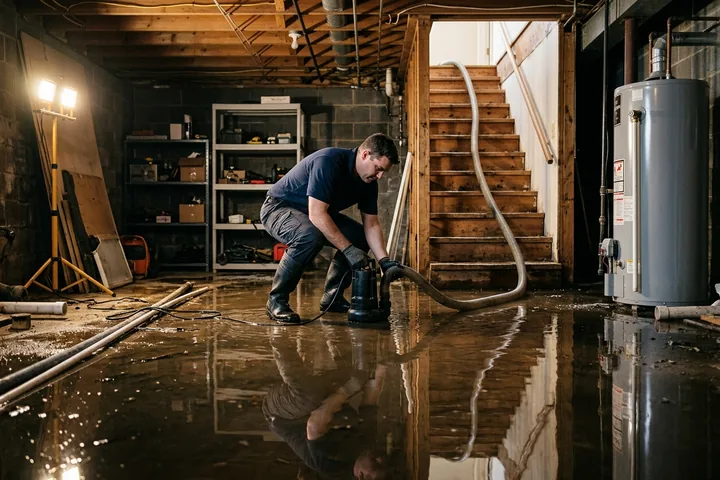
Basement Flood Cleanup in Union
24/7 basement flood cleanup in Union, NJ. IICRC-certified, insurance billing accepted. Call (855) 650-7422.
Our IICRC-certified technicians are dispatched from our Fair Lawn, NJ headquarters and are typically on-site in Union within 60 minutes of your call.
When the ground saturates fast enough to overwhelm a window well or push water through a floor crack, Union basements fill up quietly — sometimes overnight. The Elizabeth River and Rahway River tributaries that thread through low-lying pockets of town, particularly near Vauxhall and the Morris Avenue corridor, have a history of jumping their banks during heavy summer storms. Tropical Storm Ida made that painfully clear for homeowners in 07083 who woke up to several inches of standing water in finished basement spaces they’d spent years building out. The Restoration Group responds 24/7 from Kenilworth — minutes away — to stop the damage before it compounds.
Why Union Basements Flood More Than Homeowners Expect
Union Township’s housing stock tells a lot of the story. The dense postwar construction that defines neighborhoods like Battle Hill and Union Center — capes, split-levels, and colonials built between the 1940s and 1960s — came with original galvanized supply lines and cast-iron drain stacks that are now well past their design life. When those pipes fail, they fail inside finished or semi-finished basements: drop ceilings, framed walls, carpet over concrete. Water doesn’t sit on an open slab — it wicks into framing, insulation, and drywall before anyone notices a smell.
Beyond aging plumbing, Union’s soil profile doesn’t drain aggressively. During hard rain events, the water table rises faster than storm infrastructure can handle, and hydrostatic pressure forces water through foundation walls and floor joints that look perfectly intact on a dry day. Homes on the lower elevations near Vauxhall are especially exposed to this pattern. Even properties further from the river tributaries — closer to the Kean University corridor or the Route 22 retail strip — see sump pump failures when power flickers during a storm, which is exactly when the pump is needed most.
Our Basement Flood Cleanup Process in Union
The first step on any flooded basement call is containment and assessment — not just pulling water. A crew member walks the space with a thermal imaging camera and moisture meter before any equipment runs, because what reads dry at the surface of a 1950s plaster-and-lath wall can be fully saturated two inches in. That distinction changes the drying plan entirely.
From there, the process follows the IICRC S500 standard for water damage restoration:
- Extraction — truck-mounted and portable extractors pull standing water from carpet, subfloor, and slab joints. In finished basements, this includes removing saturated carpet and pad, which hold far more water than they appear to.
- Structural drying — commercial-grade desiccant and refrigerant dehumidifiers run continuously, paired with high-velocity air movers positioned to dry wall cavities, not just open air.
- Moisture monitoring — readings are logged at each visit so drying progress is documented, not estimated. Insurance carriers expect this data.
- Controlled demolition if needed — saturated drywall below the flood line typically has to come out. In Union’s older split-levels, that often means opening framed walls to dry the wood stud behind the finish material.
The goal is to reach dry standard before any reconstruction begins — skipping that step is how mold takes hold inside a wall cavity weeks after cleanup looks complete.
Reaching Union from Kenilworth
The Restoration Group’s base in Kenilworth puts Union Township a short drive away via the direct routes connecting the two municipalities. Whether a call comes from the Union Center business district, a residential street off Galloping Hill Road, or a home backing up to one of the low drainage corridors near Vauxhall, crews can mobilize and be on-site quickly — any hour, any day of the week. Because 24/7 availability is built into how the company operates, a pipe that lets go at 2 a.m. gets the same response as one that fails on a Tuesday afternoon.
Union Insurance Coordination
Most standard homeowner policies cover sudden and accidental water discharge — a burst pipe, a failed appliance supply line, an overflowing fixture. Gradual seepage through a foundation wall is a different claim category and often excluded, which is why the initial documentation matters. The Restoration Group photographs affected materials, logs moisture readings, and prepares scope documentation that insurance adjusters can work from directly. That process reduces back-and-forth and keeps the claim moving while drying is still underway.
If your policy includes loss-of-use coverage and the basement is a finished living space, that’s worth raising with your adjuster early — especially in homes where the lower level functions as a rental unit or in-law suite.
Local Note
In Union’s postwar split-levels and raised ranches, the basement floor is often only a few steps below grade — which sounds like a minor detail until you’re trying to stage extraction equipment. Bulkhead doors are common, but the angle and clearance vary enough that crews sometimes need to run hoses through a window well or ground-level side entry rather than through the main living space. It’s a small logistics point, but knowing the housing type before arrival means the crew shows up with the right hose lengths and doesn’t lose time reconfiguring setup on a wet floor.
If your home in the 07083 or 07088 ZIP codes has a finished lower level with limited exterior access, mention that when you call — it helps the crew arrive prepared.
When standing water is in your basement right now, every hour matters for the framing, the flooring, and the air quality in the floors above. Call The Restoration Group at (855) 650-7422 — Union crews are available around the clock, and the assessment starts the moment we arrive.
Basement Flood Cleanup in Union: Service Coverage
Frequently Asked Questions
How fast can you arrive for basement flood cleanup in Union?
Are homes near Vauxhall and the Morris Avenue corridor at higher flood risk than other parts of Union?
How does Union's postwar housing stock affect basement flood cleanup compared to newer construction?
Will my homeowner's insurance cover basement flooding in Union, NJ?
How quickly can The Restoration Group reach a flooded basement in the Union Center or Battle Hill area?
What does the drying process actually look like inside a finished Union basement — how long does it take?
Basement Flood Cleanup response in Union
Most Union calls see a technician on-site within 60 minutes from our Fair Lawn headquarters.