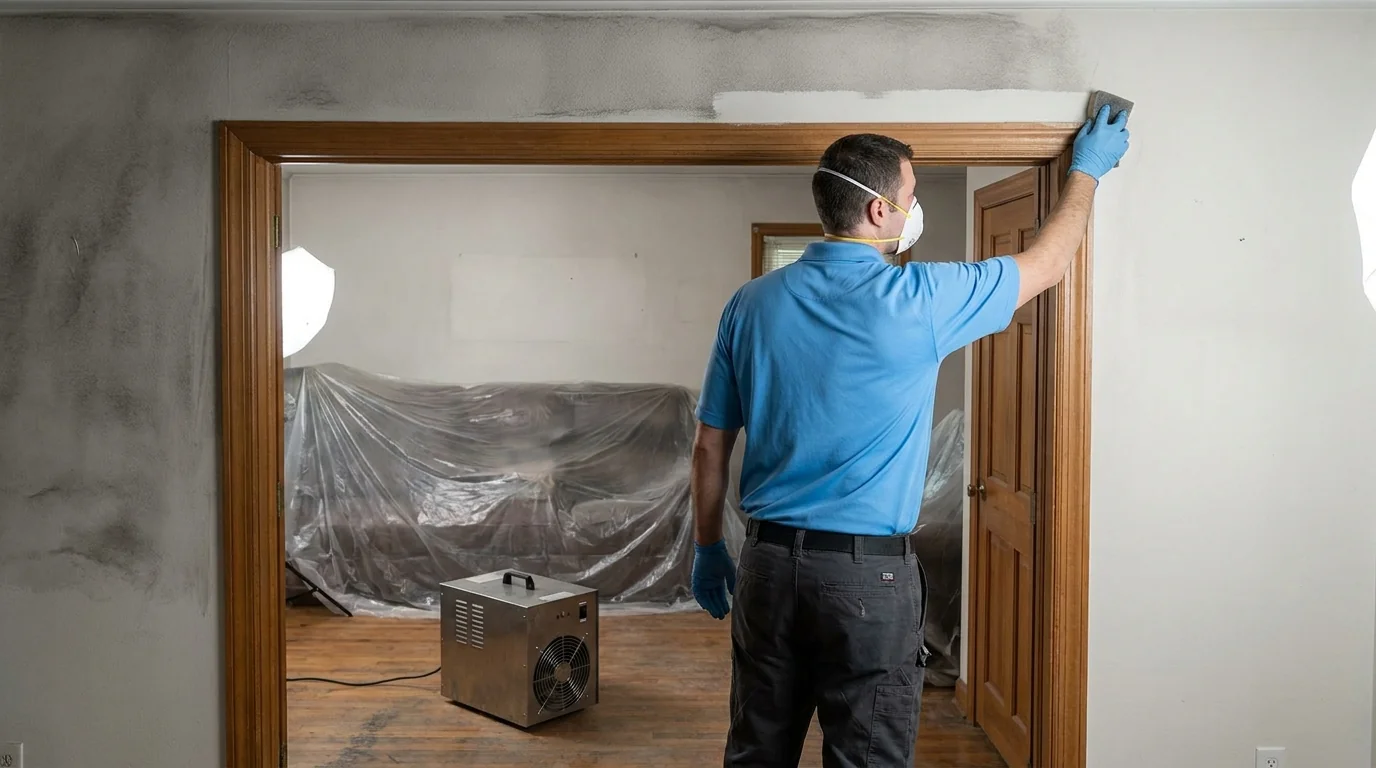
Smoke Damage Restoration in Teaneck
24/7 smoke damage restoration in Teaneck, NJ. IICRC-certified, insurance billing accepted. Call (855) 650-7422.
Our IICRC-certified technicians are dispatched from our Fair Lawn, NJ headquarters and are typically on-site in Teaneck within 60 minutes of your call.
A kitchen fire that gets knocked down fast can still leave a house unlivable for weeks. Smoke travels through ductwork, seeps behind the plaster walls common in Teaneck’s 1930s and 1940s brick Tudors and colonials, and settles into finished basement ceilings — the same lower-level spaces that took on water during Ida in 2021. By the time the fire department clears the scene, soot has already begun bonding to surfaces, and the acrid, oily smell that follows a structure fire is a chemical process, not just an odor. Acting within the first 24 to 48 hours is the difference between cleaning and replacing.
Why Teaneck’s Housing Stock Complicates Smoke Damage
Teaneck’s residential neighborhoods — from the center-hall colonials near the Bryant School area to the brick Tudors scattered through West Englewood — were built in an era when interior walls were plaster over wood lath, not gypsum drywall. Plaster is porous and absorbs smoke residue at a different rate than modern materials. Soot migrates deeper into the substrate, and the wall cavities behind that lath act like chimneys, pulling smoke up and distributing it far from the room of origin. A fire in a first-floor kitchen can leave detectable smoke odor in second-floor closets and attic framing within hours.
The density of the Cedar Lane commercial district also creates a distinct loss pattern. Restaurants and retail spaces along that corridor often run suppression systems, and when a suppression event follows a cooking fire, crews arrive to a scene with both wet smoke residue — the stickiest, most penetrating type — and standing water. Those combined losses require a sequenced approach: water extraction and drying must begin before full smoke remediation can proceed, or the moisture drives soot deeper into porous finishes.
Our Smoke Damage Restoration Process in Teaneck
Every job starts with a room-by-room scope assessment before any cleaning begins. Smoke residue is not uniform — dry smoke from a fast-burning fire behaves differently than the protein residue left by a grease fire, and wet smoke from a slow, smoldering burn is the most difficult to remove. Identifying the smoke type determines which cleaning agents and mechanical methods apply.
For Teaneck’s older homes, that typically means:
- Structural pre-cleaning of plaster surfaces with dry chemical sponges before any wet cleaning agent is applied — wet-cleaning plaster that hasn’t been dry-sponged first drives soot into the substrate permanently.
- HVAC and ductwork inspection, because cast-iron forced-air systems common in pre-war homes have joints and seams that trap particulate; contaminated ducts re-distribute odor every time the system runs.
- Thermal fogging or hydroxyl generation for odor neutralization in finished basements and enclosed spaces where surface cleaning alone won’t reach embedded odor molecules.
- Controlled demolition of materials that cannot be cleaned to pre-loss condition — documented for insurance purposes before removal.
All drying and dehumidification work follows IICRC S500 and S520 standards. The Restoration Group holds IICRC Certified Firm status (#210213) and is licensed through the NJ Division of Consumer Affairs as a Home Improvement Contractor.
Reaching Teaneck from Kenilworth
The Restoration Group’s base in Kenilworth puts Teaneck within a straight shot up Route 9W or the Garden State Parkway to Route 4. Because the firm operates 24/7, a call at 2 a.m. from a homeowner near Votee Park or a property manager dealing with a suppression discharge on Teaneck Road gets the same response as a daytime call. Crews stage equipment and materials before dispatch, so arrival in Teaneck means work begins immediately rather than a second trip for supplies.
Teaneck Insurance Coordination
Smoke damage claims in Bergen County follow standard homeowner’s policy language, but the documentation requirements matter. Carriers want itemized room-by-room photo logs, moisture readings, and a written scope of work before they authorize demolition or content disposal. The Restoration Group produces that documentation as part of the initial assessment — not as an afterthought — so the adjuster has what they need without delays that let smoke residue set further. If your policy includes additional living expenses, we can note displacement conditions in our report to support that portion of your claim as well.
Local Note
Teaneck’s older Tudors and colonials frequently have original horsehair-reinforced plaster, which is denser and harder than standard lime plaster. That density is actually an advantage during smoke remediation — it resists deep penetration better than modern drywall — but it requires slower, more deliberate dry-sponge work and cannot tolerate aggressive alkaline cleaners without surface damage. Crews unfamiliar with this material sometimes skip the dry phase and go straight to wet cleaning, which pushes soot into the surface permanently and triggers a repaint that could have been avoided. It’s a detail that comes up repeatedly in the West Teaneck and Whittier neighborhoods where the pre-war housing stock is most concentrated.
If you’re dealing with smoke damage at a property in Teaneck (ZIP 07666) — whether it’s a single-family home, a multi-unit, or a commercial space on Cedar Lane — call The Restoration Group at (855) 650-7422. The assessment is the starting point, and the sooner it happens, the more of the structure and its contents can be saved.
Serving Teaneck from our Fair Lawn headquarters — ★ 4.8 · 158 Google reviews
“Great customer service. I was kept well informed throughout the entire process. I received nothing but respect and sympathy from everyone I dealt with.” — Ryan, July 2026Read our reviews on Google →
Smoke Damage Restoration in Teaneck: Service Coverage
Frequently Asked Questions
How fast can you arrive for smoke damage restoration in Teaneck?
How quickly can The Restoration Group reach a smoke damage emergency in the West Englewood or Whittier neighborhoods of Teaneck?
Teaneck has a lot of pre-war plaster homes — does that change how smoke residue is cleaned?
A suppression system discharged after a cooking fire in a Cedar Lane commercial space — is that treated differently than a residential smoke loss?
What does smoke damage restoration typically cost for a Teaneck single-family home, and will my homeowner's insurance cover it?
How long does smoke odor take to return to normal in a Teaneck home after remediation?
Smoke Damage Restoration response in Teaneck
Most Teaneck calls see a technician on-site within 60 minutes from our Fair Lawn headquarters.