Odor Removal and Deodorization in Teaneck
24/7 odor removal and deodorization in Teaneck, NJ. IICRC-certified, insurance billing accepted. Call (855) 650-7422.
Our IICRC-certified technicians are dispatched from our Fair Lawn, NJ headquarters and are typically on-site in Teaneck within 60 minutes of your call.
The brick Tudors and center-hall colonials that line the streets of West Englewood and The Grange were built to last a century — and many of them have. What their original builders didn’t anticipate was the way those thick masonry walls, plaster ceilings, and finished basements would hold onto odors long after the source was gone. Whether a sewer backup soaked through a cedar-paneled rec room, a kitchen fire left smoke residue embedded in original woodwork, or a slow pipe leak bred mildew behind a lathe-and-plaster wall, odors in Teaneck’s older housing stock don’t just ventilate away. They need to be chemically neutralized at the molecular level.
Why Teaneck Properties Develop Persistent Odors
Teaneck’s ZIP code 07666 sits in a low-lying corridor shaped by the Hackensack River to the east and Teaneck Creek winding through its interior wetlands. That geography matters for odor work. When Hurricane Ida moved through in 2021, dozens of finished basements across the township took on water mixed with sewer surcharge — a combination that leaves behind hydrogen sulfide and microbial off-gassing that no amount of bleach or box fans will resolve. The cast-iron drain stacks common in homes built between the 1920s and 1940s are prone to root infiltration and partial blockages that allow sewer gases to migrate into living spaces even without a visible flood event.
Beyond residential stock, the Cedar Lane commercial district and the Teaneck Road corridor generate their own odor scenarios. Overnight sprinkler activations in restaurants leave smoke and char residue baked into HVAC ductwork. Grease fires in kitchen exhaust systems coat adjacent spaces with acrolein — a sharp, penetrating compound that clings to porous surfaces. The density of retail and food-service tenants along Cedar Lane means these events happen regularly, and the odors that follow them require professional-grade intervention, not commercial air fresheners.
Our Odor Removal and Deodorization Process in Teaneck
Effective deodorization isn’t a single step — it’s a sequence calibrated to the odor source, the affected materials, and the construction of the building.
The process begins with a thorough source assessment. Odor molecules don’t stay where the damage happened; they migrate into HVAC systems, settle into soft goods, and absorb into plaster and wood substrates. In Teaneck’s older homes, that often means tracing smoke odor from a first-floor kitchen fire all the way into second-floor bedroom closets through gaps in original balloon-frame construction.
Once the source and migration path are mapped, we select the appropriate treatment method:
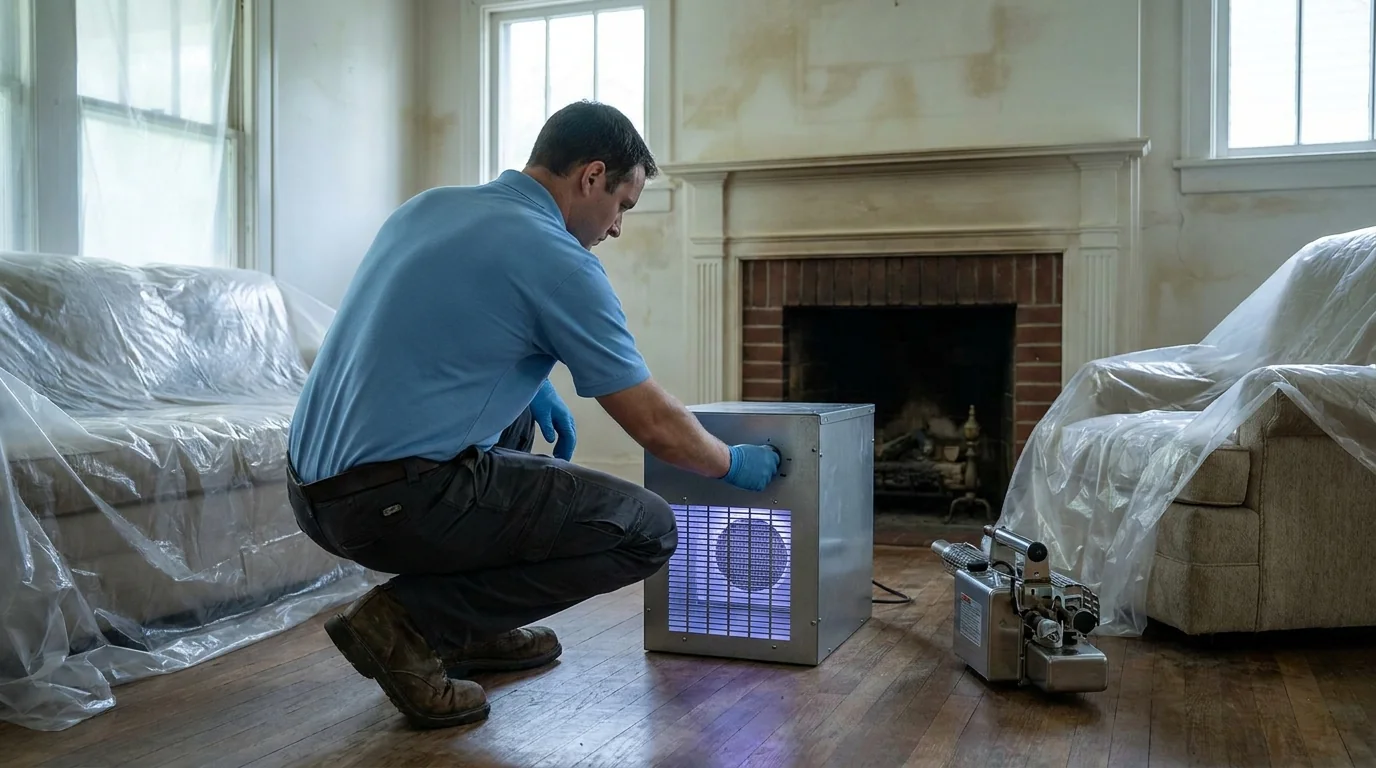
- Thermal fogging disperses a deodorizing agent as a fine dry fog that penetrates the same pathways smoke traveled — effective for post-fire work in homes with original plaster walls and irregular cavity spaces.
- Hydroxyl deodorization uses UV-generated hydroxyl radicals to oxidize odor compounds at the molecular level. Unlike ozone, hydroxyl generators are safe to operate in occupied or partially occupied spaces, which matters when a homeowner near Votee Park can’t vacate for multiple days.
- Ozone treatment is reserved for unoccupied spaces with severe, deeply embedded odors — particularly useful in vacant units or commercial spaces along the Cedar Lane district after a significant fire or long-term moisture event.
- Direct application and encapsulation addresses surfaces that have absorbed odor compounds — subfloor sheathing, wall cavities, HVAC duct interiors — using EPA-registered antimicrobial sealants where appropriate.
All drying and deodorization work is performed in accordance with IICRC standards. The Restoration Group holds IICRC Certified Firm status (#210213), and our technicians document conditions before, during, and after treatment to support insurance claims and provide a verifiable record of completed work.
Equipment and Methods Matched to Teaneck’s Building Stock
Older construction creates specific challenges that off-the-shelf deodorization equipment isn’t designed for. Balloon-frame walls — common in Teaneck homes built before 1940 — have open stud bays that run from basement to attic without fire blocking, allowing odor-laden air to travel vertically through the entire structure. Standard fogging equipment may not reach those cavities without targeted injection at multiple access points.
Plaster walls also absorb odor compounds differently than modern drywall. The denser substrate holds more, releases more slowly, and requires longer dwell times for hydroxyl and ozone treatments to be effective. We account for this in our equipment placement and treatment duration — running hydroxyl generators longer than a typical suburban tract home would require, and re-testing air quality before clearing a space.
For commercial losses along the Cedar Lane district, we deploy industrial-capacity hydroxyl units capable of treating large open floor plans and connected HVAC systems simultaneously, minimizing business interruption time.
Reaching Teaneck from Kenilworth
Our crews dispatch from Kenilworth, NJ, and reach Teaneck via Route 3 East and the Garden State Parkway or via Route 9W depending on traffic. The drive typically puts us in the Bryant School area or West Teaneck within 30–45 minutes under normal conditions. Because we operate 24/7, we can respond to overnight commercial losses along Teaneck Road or early-morning calls from residential properties near Fairleigh Dickinson University without waiting for business hours.
Local Note
One thing that catches out-of-area contractors in Teaneck: the finished basements in the Whittier and West Teaneck neighborhoods were often converted in the 1960s and 70s using knotty pine paneling and drop ceilings installed directly over original concrete block walls. When sewer backups or flood events hit those spaces — as they did repeatedly during and after Ida — the pine paneling wicks odor compounds deep into the wood grain while the drop-ceiling tiles trap contaminated air above them. Removing the tiles and treating the paneling as a porous, odor-saturated substrate (rather than a hard surface) is the only way to get a lasting result. We’ve seen homeowners repaint over that paneling and call it remediated, only to have the odor return within weeks when summer humidity opens the wood grain back up.
If your Teaneck home or commercial property is holding onto an odor that won’t clear on its own, call The Restoration Group at (855) 650-7422. We’ll assess the source, explain the treatment options in plain language, and get the work done right the first time.
Serving Teaneck from our Fair Lawn headquarters — ★ 4.8 · 158 Google reviews
“Great customer service. I was kept well informed throughout the entire process. I received nothing but respect and sympathy from everyone I dealt with.” — Ryan, July 2026Read our reviews on Google →
Odor Removal and Deodorization in Teaneck: Service Coverage
Frequently Asked Questions
How fast can you arrive for odor removal and deodorization in Teaneck?
How quickly can The Restoration Group reach a Teaneck address for an odor emergency?
My West Teaneck home has original 1930s plaster walls. Does that change how odor removal works?
After the Ida flooding, my finished basement in the 07666 ZIP code still smells like sewage. Is that treatable?
What's the difference between ozone treatment and hydroxyl deodorization, and which is right for my Teaneck property?
Will my homeowner's insurance cover professional odor removal after a fire or sewer backup in Teaneck?
Odor Removal and Deodorization response in Teaneck
Most Teaneck calls see a technician on-site within 60 minutes from our Fair Lawn headquarters.