Basement Flood Cleanup in Springfield
24/7 basement flood cleanup in Springfield, NJ. IICRC-certified, insurance billing accepted. Call (855) 650-7422.
Our IICRC-certified technicians are dispatched from our Fair Lawn, NJ headquarters and are typically on-site in Springfield within 60 minutes of your call.
When Ida stalled over the Watchung ridges and turned Route 22 into a channel, Springfield homeowners got a vivid reminder of what the west branch of the Rahway River can do when it has nowhere else to go. That geography hasn’t changed. Every significant storm cycle pushes water off those ridges and into the low spots across the township — and in a community where the majority of homes were built between the 1920s and 1950s with finished basements, that water finds its way in fast. If you’re standing in a wet basement in 07081 right now, the clock on secondary damage is already running.
Why Springfield Properties See Basement Flood Cleanup Issues
Springfield’s topography is the root cause. The township sits at the foot of the Watchungs, and the west branch of the Rahway River drains a wide watershed before it passes through. During heavy rain events, storm sewers along the Route 22 corridor and the lower sections near Springfield Center can back up before surface water even crests — meaning basements take on water from below through floor drains and cracks in block foundations, not just from above.
The housing stock compounds the problem. Colonials and capes built in the 1930s and 40s — the kind you’ll find throughout the Baltusrol area and along the Mountain Avenue corridor — typically have poured concrete or concrete block foundations that develop hairline cracks over decades. Many of those basements were finished in the 1970s and 80s with fiberglass insulation batted between wood framing, materials that hold moisture long after the visible water is gone. Newer townhome complexes toward the Millburn line often have sump systems, but a power outage during the same storm that floods the basement takes the pump offline at exactly the wrong moment.
Our Basement Flood Cleanup Process in Springfield
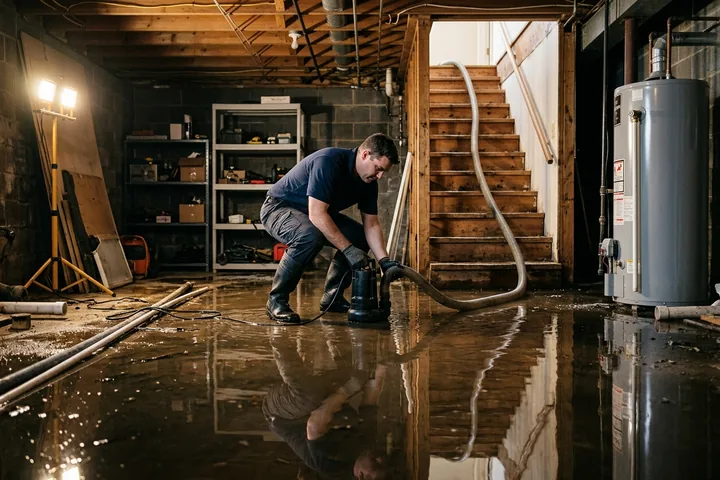
The first step is always water removal — not assessment, not paperwork. We arrive with truck-mounted and portable extraction units capable of pulling standing water from finished and unfinished spaces, including from beneath floating floors and inside wall cavities where it migrates before you notice it.
Once the bulk water is out, we use thermal imaging and calibrated moisture meters to map what the eye can’t see. In Springfield’s older colonials, water behind plaster can read dry at the surface while the wood lath behind it stays saturated. That hidden moisture is where mold colonization begins — typically within 24 to 48 hours in a closed basement space during warm months. We set drying targets based on the IICRC S500 standard and monitor daily until affected materials reach equilibrium with the surrounding structure.
If flooring, drywall, or insulation has absorbed enough water to prevent drying in place, we remove only what cannot be saved. Selective demolition — pulling the bottom 12 to 18 inches of drywall rather than entire walls — preserves more of the finished space and reduces reconstruction costs. Every affected area is documented with photographs and moisture readings before, during, and after, which matters when you’re filing a claim.
Reaching Springfield from Kenilworth
The Restoration Group operates out of Kenilworth, which puts Springfield within a short drive via Route 22 east — a route our crews run regularly. The Route 22 commercial strip and the residential neighborhoods south of it, including Springfield Center, are straightforward to reach around the clock. We’re available 24/7, so whether a sump pump fails at 2 a.m. or a pipe bursts on a Sunday, you’re not waiting until business hours to get someone moving.
Springfield Insurance Coordination
Most standard homeowner policies cover sudden and accidental water intrusion — a burst pipe, a failed sump pump, a washing machine supply line — but not gradual seepage or flood events tied to rising surface water, which typically requires separate flood coverage through the NFIP. Springfield’s location in a storm-prone drainage corridor means some homeowners carry both.
We document losses in the format carriers expect: moisture logs, photo evidence, scope of work, and itemized line items. We work directly with adjusters and can communicate with your insurer throughout the process so the paperwork doesn’t fall on you during an already stressful situation.
Local Note
In Springfield’s older colonials — particularly those built before 1950 in the Baltusrol area and along Mountain Avenue — basement walls are frequently constructed with hollow concrete block rather than poured concrete. Hollow block wicks and traps water inside the cores of the blocks themselves, which means a wall can appear dry on the interior face while holding significant moisture inside the masonry. Standard moisture meters read the surface; we use both contact meters and thermal imaging to catch what’s trapped inside. Drying a hollow-block wall takes longer than a poured wall of the same thickness, and skipping that step is how a “dried” basement ends up with efflorescence and mold six weeks later.
If your Springfield basement took on water — whether from a storm, a failed sump, or a plumbing failure — call The Restoration Group at (855) 650-7422. We’ll assess the damage honestly, start extraction immediately, and carry the documentation through to your insurance claim.
Basement Flood Cleanup in Springfield: Service Coverage
Frequently Asked Questions
How fast can you arrive for basement flood cleanup in Springfield?
How quickly can The Restoration Group reach Springfield Center or the Baltusrol area after I call?
Springfield's storms often cause sewer backups alongside flooding — does that change the cleanup process?
My Springfield home was built in the 1940s with a finished basement. What should I expect from the drying timeline?
Does my homeowner's insurance cover basement flooding in Springfield, or do I need separate flood coverage?
Are townhome complexes near the Millburn line handled differently than single-family homes for basement flood cleanup?
Basement Flood Cleanup response in Springfield
Most Springfield calls see a technician on-site within 60 minutes from our Fair Lawn headquarters.