Commercial Restoration in Ridgewood
24/7 commercial restoration in Ridgewood, NJ. IICRC-certified, insurance billing accepted. Call (855) 650-7422.
Our IICRC-certified technicians are dispatched from our Fair Lawn, NJ headquarters and are typically on-site in Ridgewood within 60 minutes of your call.
When the Ho-Ho-Kus Brook overtopped during Ida in 2021, businesses along East Ridgewood Avenue faced a scenario that plays out in some form nearly every storm season: standing water in finished lower levels, saturated drywall behind display cases, and the clock ticking toward mold colonization within 24 to 48 hours. Commercial restoration in a walkable downtown like Ridgewood’s carries stakes that a suburban strip mall doesn’t — every closed day costs foot traffic, and every delayed decision risks deeper structural damage to buildings that were already old when Eisenhower was president.
Why Ridgewood Commercial Properties See Repeated Losses
The East Ridgewood Avenue corridor is dense with mixed-use buildings dating to the early twentieth century. Many sit on shallow foundations with minimal waterproofing, and the finished basement retail and office spaces that make the Village center so lively are also the first to flood when a supply line fails or a flat roof gives way under standing water. Older galvanized and cast-iron supply lines throughout the 07450 ZIP code are well past their design life; pinhole leaks and sudden pipe failures are a routine call for any commercial restoration crew working this area.
Flat and low-slope roofs on historic commercial buildings near Van Neste Square trap water and ice in ways that sloped residential roofs don’t. A two-inch rain in October can become a ceiling collapse in November if a drain is partially blocked by leaf debris from Ridgewood’s famously dense tree canopy. Sprinkler systems in older buildings — required by code upgrades over the past two decades — add another failure point: a single frozen head in an unheated storage room can discharge thousands of gallons before anyone arrives Monday morning.
Our Commercial Restoration Process in Ridgewood
The first hour on a commercial loss is documentation, not demolition. Before a single piece of drywall comes down, the team photographs and meters every affected surface — walls, subfloor, ceiling assemblies — to establish a moisture baseline that your insurance adjuster can work from directly. For historic commercial buildings near the Ridgewood train station, that documentation also flags any lead paint or plaster conditions that change how demolition proceeds under NJ Division of Consumer Affairs licensing requirements.
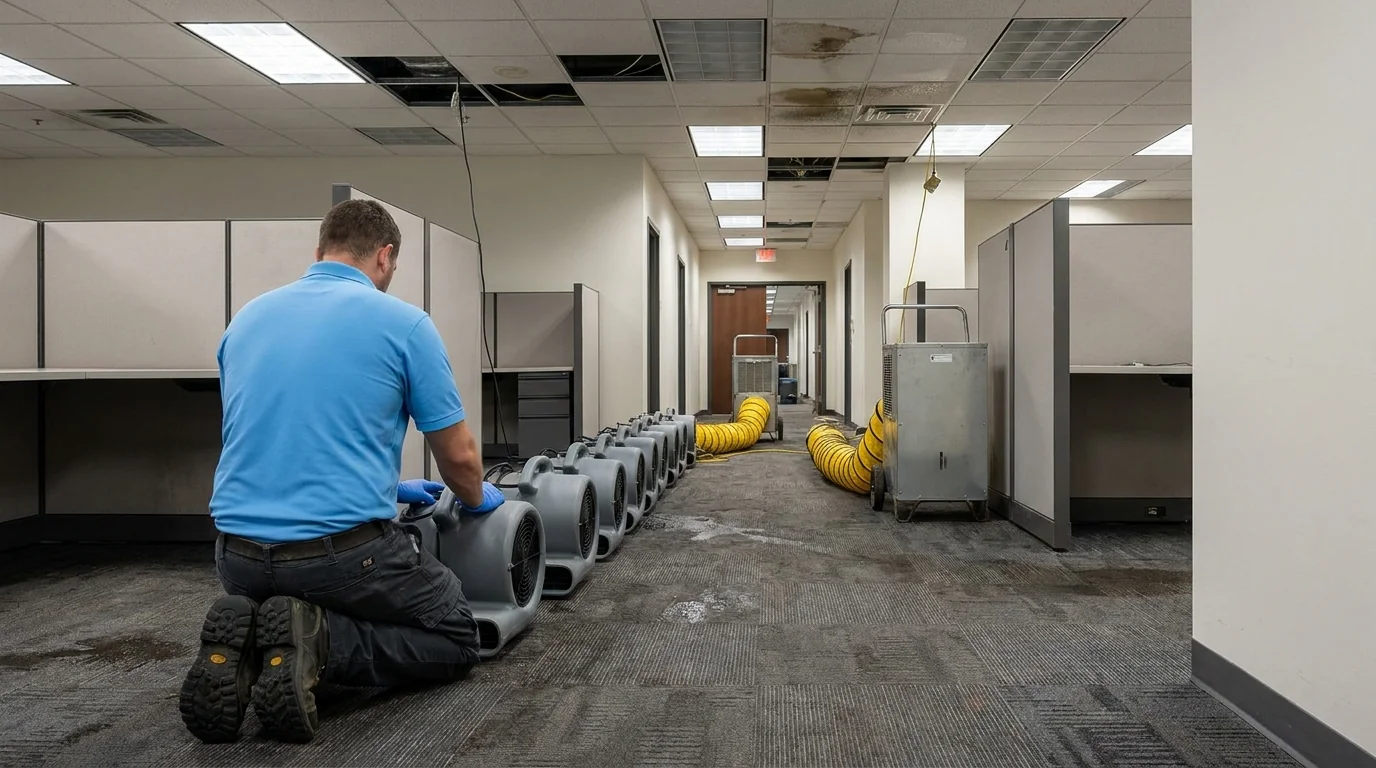
Drying commercial spaces differs from residential work in one critical way: business continuity. Where possible, the crew establishes containment barriers so that unaffected areas of your retail space or office remain operational during drying. Industrial desiccant dehumidifiers and high-velocity air movers run on a documented schedule calibrated to the building’s construction type — concrete block and plaster absorb and release moisture more slowly than modern stud-and-drywall assemblies, so drying timelines for older Ridgewood storefronts are set conservatively and verified with daily moisture readings rather than estimated and hoped for.
As an IICRC Certified Firm (#210213), all drying is conducted to the S500 standard, which gives your insurance carrier a defensible scope and gives you a paper trail if secondary damage surfaces later.
Reaching Ridgewood from Kenilworth
The Restoration Group operates 24/7 out of Kenilworth, and Ridgewood is a direct run up Route 17 or Garden State Parkway to Route 208 — a route the crew knows well enough to navigate around the typical morning backup near the Paramus interchange. For losses in the Heights or on the West Side of the village, the approach via Linwood Avenue keeps response straightforward even during peak commute hours. Because Ridgewood’s downtown streets narrow considerably around Van Neste Square, larger equipment trucks stage on side streets rather than blocking East Ridgewood Avenue — a small logistics detail that matters when neighboring businesses are still open.
Ridgewood Insurance Coordination for Commercial Claims
Commercial property claims in Bergen County follow a different documentation rhythm than residential losses. Carriers writing policies on mixed-use buildings often require a scope that separates the structural loss from business-interruption components, and adjusters assigned to older Ridgewood properties frequently ask for evidence that pre-existing conditions — aging plaster, original cast-iron drains — are distinguished from storm or water damage. The team prepares moisture logs, photo documentation, and drying reports formatted to support that separation, reducing the back-and-forth that delays claim settlement.
For tenants in multi-unit commercial buildings, the question of who files — landlord or tenant — comes up on almost every loss. The team can work with both parties’ adjusters simultaneously and document scope by unit so neither side is left holding costs that belong to the other.
Local Note
One thing that catches out-of-area contractors off guard on East Ridgewood Avenue losses: the basement-level retail spaces in several blocks near the Ridgewood train station have their electrical panels mounted low on the wall — sometimes within inches of the flood line on a significant event. Bergen County electrical inspectors require a licensed electrician to sign off before restoration crews can energize drying equipment in those spaces, which adds a coordination step that needs to happen on day one, not day three. Knowing to make that call immediately keeps the drying timeline from slipping by 48 hours while everyone waits on a permit.
If your Ridgewood business has taken water, fire, or storm damage, call (855) 650-7422 any hour. The sooner the moisture baseline is established and the scope is documented, the better the outcome — for your building, your tenants, and your claim.
Serving Ridgewood from our Fair Lawn headquarters — ★ 4.8 · 158 Google reviews
“Prompt and professional work. Kept in contact thru out the process which was very important to me.” — F., July 2026Read our reviews on Google →
Commercial Restoration in Ridgewood: Service Coverage
Frequently Asked Questions
How fast can you arrive for commercial restoration in Ridgewood?
How quickly can The Restoration Group reach businesses in the East Ridgewood Avenue corridor after a pipe failure or flood?
Ridgewood's older commercial buildings have plaster walls and original cast-iron plumbing — does that change how drying is handled?
After a flooding event like Ida, are businesses in the Heights or West Side neighborhoods of Ridgewood at higher risk for mold if cleanup is delayed?
Does Bergen County or Ridgewood's historic building stock create any permitting or inspection requirements that affect commercial restoration timelines?
When a commercial loss involves both a building owner and a tenant — common in Ridgewood's mixed-use storefronts — how is the insurance scope handled?
Commercial Restoration response in Ridgewood
Most Ridgewood calls see a technician on-site within 60 minutes from our Fair Lawn headquarters.