Odor Removal and Deodorization in Rahway
24/7 odor removal and deodorization in Rahway, NJ. IICRC-certified, insurance billing accepted. Call (855) 650-7422.
Our IICRC-certified technicians are dispatched from our Fair Lawn, NJ headquarters and are typically on-site in Rahway within 60 minutes of your call.
When a flooded basement in the Milton Lake neighborhood finally dries out, or when a kitchen fire leaves smoke baked into the plaster walls of a 1920s Downtown Rahway rowhouse, the visible damage is only half the problem. Odors from smoke, mold, sewage, and water intrusion embed themselves into porous surfaces — old horsehair plaster, original hardwood subfloors, the mortar joints of century-old masonry — and no amount of ventilation or store-bought spray will reach them. The Restoration Group responds 24/7 to odor calls throughout Rahway’s 07065 ZIP code, using professional-grade equipment calibrated to the specific building stock and moisture conditions found in this city.
Why Rahway Properties See Persistent Odor Problems
Rahway’s housing stock creates conditions that make odors harder to eliminate than in newer construction. The Victorian-era and early 20th-century homes concentrated near Downtown Rahway and the streets radiating out toward the Clark border were built with materials that absorb and hold contaminants at a molecular level. Horsehair plaster, old-growth pine framing, and brick cavity walls are highly porous — smoke particles and microbial VOCs (the gases that produce mold smell) penetrate far deeper than they would in fiberglass-insulated drywall construction.
The Rahway River compounds the problem. Low-lying neighborhoods near Rahway River Park and the downtown riverfront flooded significantly during Tropical Storm Ida in 2021 and during Irene-era events before that. Flood water carrying sewage, sediment, and organic debris leaves behind a layered odor profile — not just the immediate smell of standing water, but the slow-developing sulfur and ammonia signatures of anaerobic bacterial activity in wall cavities and under finished basement slabs. By the time a homeowner notices the smell weeks later, the source is often hidden behind drywall or under flooring.
The transit-oriented development around Rahway Train Station and the Main Street business district adds a commercial dimension: multi-unit buildings, restaurants, and mixed-use spaces that experience sprinkler activations, cooking-smoke events, and tenant-related odor losses — all of which require a different deodorization approach than a single-family home.
Our Odor Removal and Deodorization Process in Rahway
Effective deodorization isn’t a single treatment — it’s a sequence of methods matched to the odor source, the affected materials, and the building’s construction. The process typically follows this order:
Source removal first. No deodorization technology eliminates an odor that’s still being generated. Charred wood, contaminated insulation, and saturated drywall are removed before any treatment begins.
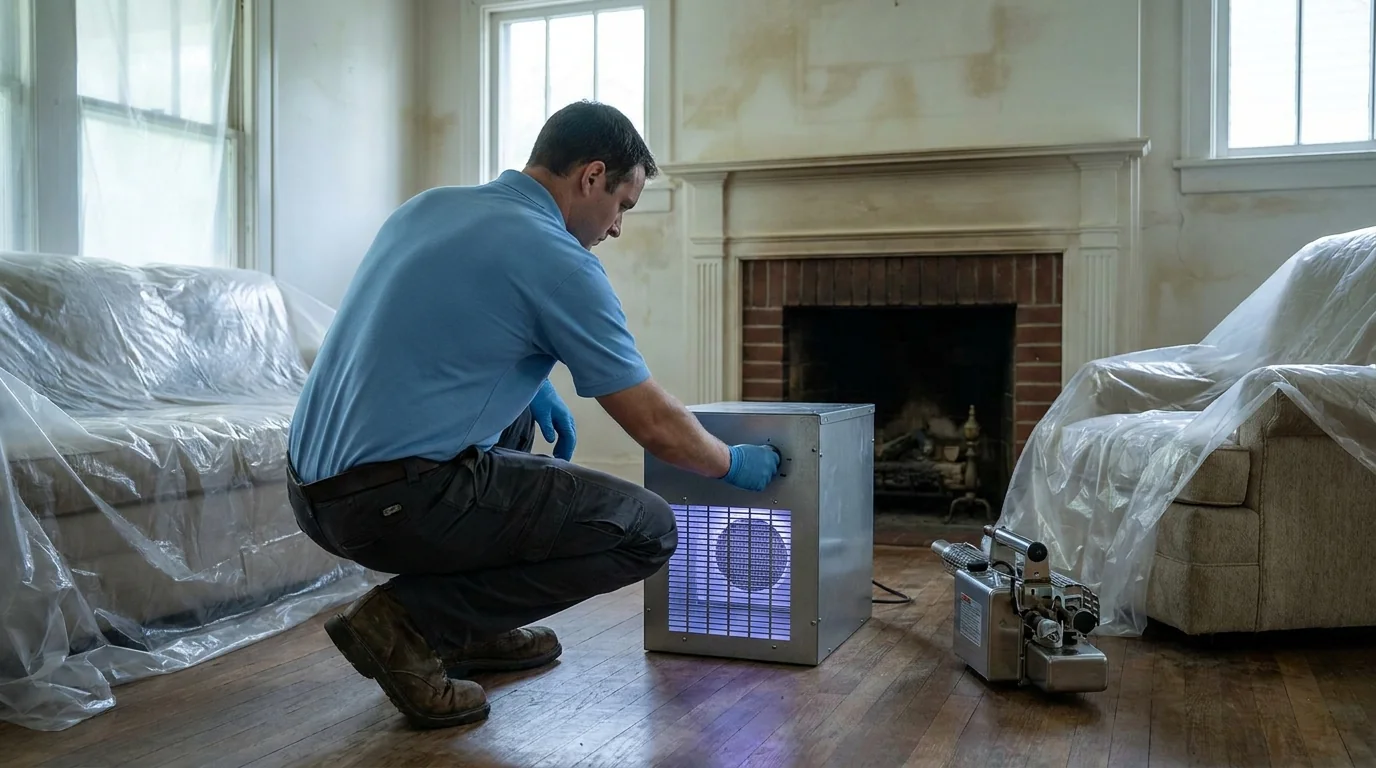
Thermal fogging penetrates the same pathways smoke or odor-laden air traveled through — wall voids, subfloor cavities, HVAC ductwork. The fog particles are sized to reach surfaces that sprays and wipes cannot. This is particularly effective in Rahway’s older homes, where smoke from a kitchen fire can migrate through gaps in original plaster lath and settle in adjacent rooms.
Hydroxyl deodorization uses UV-generated hydroxyl radicals to break down odor molecules at a chemical level. Unlike ozone treatment, hydroxyl generators are safe to run in occupied or semi-occupied spaces and do not require building evacuation — an important consideration for multi-unit properties near the Merck & Co. campus corridor or in the Hazelwood neighborhood where owner-occupied duplexes are common.
Ozone treatment, when conditions permit full evacuation, delivers high-concentration oxidation for severe smoke or sewage odors embedded in structural materials. Re-entry protocols are followed strictly after treatment.
HEPA air scrubbing runs continuously throughout the process to capture particulates released during source removal and treatment.
All drying and deodorization work is performed to IICRC standards — the same protocols insurers and adjusters reference when evaluating claims.
Equipment and Methods We Use for Odor Removal
The equipment on a Rahway odor job is chosen based on the odor category, the building’s age, and whether the space can be vacated. Thermal foggers, hydroxyl generators, ozone machines, HEPA air scrubbers, and injection systems for wall cavities are all part of the inventory. For smoke odor specifically — one of the most common calls following cooking fires and fireplace malfunctions in Rahway’s older homes — thermal fogging combined with HEPA scrubbing addresses both the gaseous and particulate components of smoke residue. For post-flood microbial odors, hydroxyl treatment running over 24–48 hours in the affected area typically eliminates the sulfur and ammonia signatures without requiring full evacuation of an occupied home.
Local Note
Rahway’s pre-war homes near Downtown and Leesville often have original cast-iron drain stacks and clay sewer laterals. After a flood event or a drain backup, the odor source isn’t always the visible water — it’s the dried organic residue left inside wall cavities where cast-iron cleanout fittings are located, or under basement slabs where the lateral transitions from cast iron to clay tile. Crews working these addresses probe those specific locations before assuming the odor source is limited to the flooded floor area. Missing a contaminated cleanout fitting behind a finished wall is one of the most common reasons a deodorization job has to be redone.
If you’re dealing with a persistent smell in a Rahway home or commercial property — whether it followed a flood, a fire, a sewage backup, or something less obvious — call (855) 650-7422. The Restoration Group dispatches from Kenilworth around the clock and can assess and begin treatment the same day.
Serving Rahway from our Fair Lawn headquarters — ★ 4.8 · 158 Google reviews
“Prompt and professional work. Kept in contact thru out the process which was very important to me.” — F., July 2026Read our reviews on Google →
Odor Removal and Deodorization in Rahway: Service Coverage
Frequently Asked Questions
How fast can you arrive for odor removal and deodorization in Rahway?
How quickly can The Restoration Group reach the Milton Lake or Downtown Rahway area for an odor emergency?
Rahway flooded badly during Ida — can odor from a 2021 flood event still be treated now?
Are the older homes in the Leesville and Hazelwood neighborhoods harder to deodorize than newer construction?
What's the difference between ozone treatment and hydroxyl deodorization, and which is used in Rahway multi-unit buildings?
Will my homeowner's insurance cover odor removal after a fire or flood at my Rahway property?
Odor Removal and Deodorization response in Rahway
Most Rahway calls see a technician on-site within 60 minutes from our Fair Lawn headquarters.