Basement Flooding Cleanup in Plainfield
24/7 basement flooding cleanup in Plainfield, NJ. IICRC-certified, insurance billing accepted. Call (855) 650-7422.
Our IICRC-certified technicians are dispatched from our Fair Lawn, NJ headquarters and are typically on-site in Plainfield within 60 minutes of your call.
When Tropical Storm Ida tore through Union County in September 2021, the Green Brook and Cedar Brook overflowed into Plainfield’s lowest-lying streets, and the East Front Street corridor took some of the worst of it — basements that had stayed dry for decades filled in hours. That kind of flooding doesn’t just leave standing water; it soaks into the framing, saturates decades-old insulation, and starts the mold clock running within 24 to 48 hours. If your basement is wet right now, the decisions you make in the next few hours determine whether this is a cleanup job or a full rebuild.
Why Plainfield Properties Are Especially Vulnerable to Basement Flooding
Plainfield’s topography works against homeowners in the low-lying areas near Cedar Brook and Green Brook. Water drains toward those corridors, and neighborhoods like Sleepy Hollow and the Crescent Area sit in the natural path of that runoff. During heavy rain events — and Union County sees them regularly, especially in late summer — storm drains back up, sump pumps get overwhelmed, and water finds the path of least resistance into finished basements.
The housing stock makes things worse. Plainfield’s Victorian and Queen Anne homes in the Van Wyck Brooks Historic District are architectural gems, but they were built with cast-iron drain lines, original clay tile laterals, and basement walls that predate modern waterproofing membranes. Those cast-iron drains corrode from the inside out; a pipe that looks intact can collapse under surge pressure. Postwar homes in the West End and Netherwood neighborhoods often have original footing drains that are partially or fully clogged after 60-plus years. When the ground is saturated, hydrostatic pressure pushes water through every crack in the block or poured-concrete foundation wall.
Finished basements amplify the loss. A wet concrete floor is a cleanup. A finished basement with framed walls, drywall, carpet, and a drop ceiling is a multi-day structural drying project — and in Plainfield, a large share of homes have exactly that.
Our Basement Flooding Cleanup Process in Plainfield
We respond 24/7, and from our Kenilworth headquarters Plainfield is a straightforward run — typically via Route 28 or the Garden State Parkway to Route 22 west, depending on traffic. When we arrive, the first step is a moisture mapping inspection: we use thermal imaging and pin-type meters to trace exactly how far water has migrated into walls, subfloor, and framing before we touch anything.
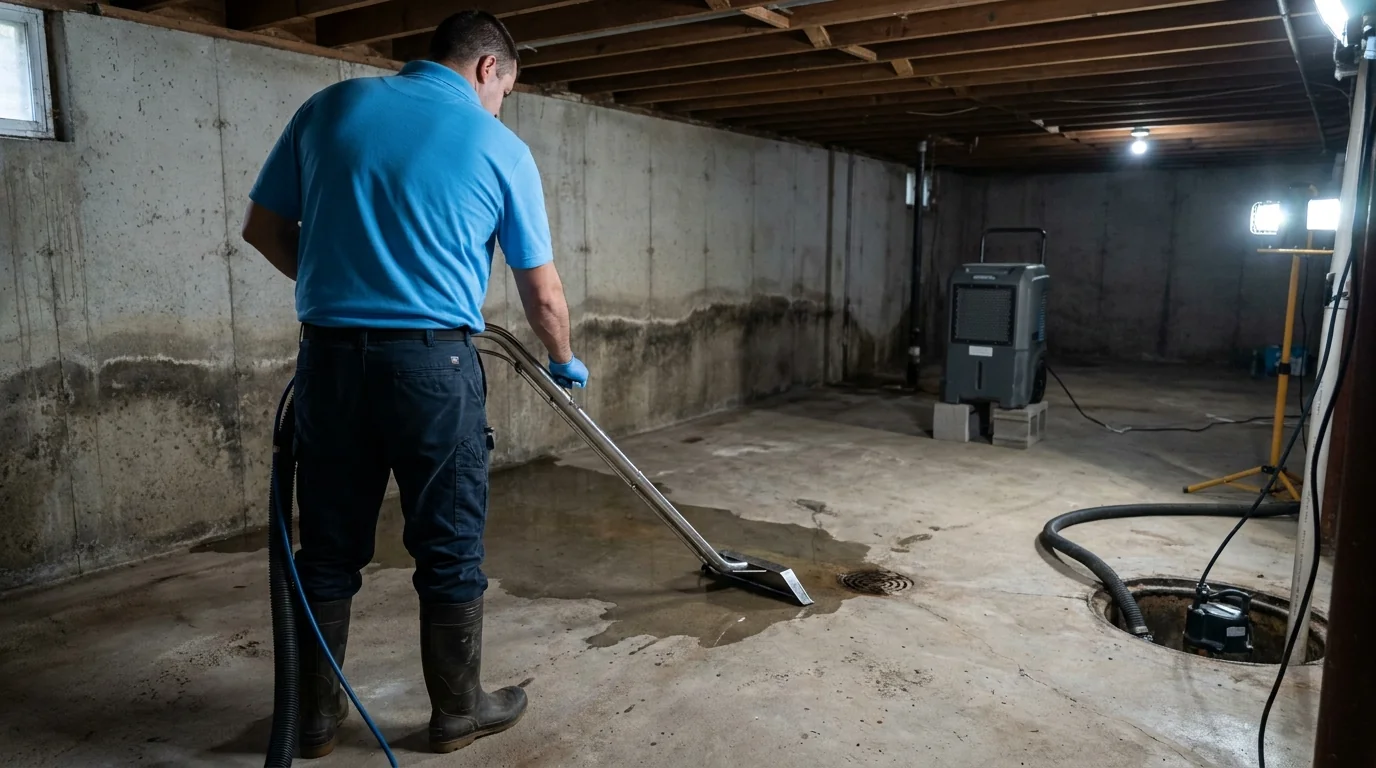
Water removal comes next. Depending on depth, that means truck-mounted extraction or submersible pumps for standing water, followed by wet-vac work along wall bases and under any floating floor systems. In Plainfield’s older homes with original hardwood over sleepers, we probe carefully — water wicks laterally under those floors much farther than it appears on the surface.
Once bulk water is out, we set a calibrated drying system: commercial-grade desiccant or refrigerant dehumidifiers, axial air movers positioned to create directed airflow across wet surfaces, and in-wall drying panels where framing cavities have absorbed moisture. We log temperature, relative humidity, and material moisture content at every visit — documentation that matters both for drying decisions and for your insurance claim. We work as an IICRC Certified Firm (#210213) and dry to the IICRC S500 standard, which gives your adjuster a defensible scope.
Plainfield Insurance Coordination
Most basement flooding claims in Plainfield fall under one of two buckets: homeowner’s policy (for sudden and accidental discharge — a burst pipe, a failed sump pump) or a separate flood insurance policy through the NFIP (for storm-driven groundwater intrusion, which is what Ida caused). The distinction matters because the documentation requirements differ. We photograph affected materials before any demolition, write a detailed scope with line-item pricing, and communicate directly with adjusters — including NFIP adjusters, who often require a separate inspection appointment.
For the Front Street and Park Avenue commercial properties that carry sprinkler-system or roof-leak claims, we can also work under commercial property policies. If you’re unsure which coverage applies, we can walk through the loss cause with you before you file.
Local Note: What Plainfield’s Older Foundations Tell Us Before We Start
In Plainfield’s pre-1950 homes — particularly the block-foundation houses common in the Netherwood and Van Wyck Brooks Historic District areas — we’ve learned to check the mortar joints between foundation blocks before we finalize a drying plan. Original lime-based mortar in those joints is porous; water doesn’t just come through cracks, it weeps through the block faces themselves. That changes the drying approach: we often need to run dehumidification longer and at higher capacity than a comparable modern poured-concrete foundation would require, and we set moisture targets at the block surface rather than just the interior air. Skipping that step leads to callbacks — moisture that reads dry at the air gets trapped in the masonry and shows up as efflorescence or mold growth two months later.
If your home in the 07060 or 07062 ZIP code was built before 1955 and has a block foundation, mention it when you call — it helps us bring the right equipment on the first trip.
If your basement is wet today, call (855) 650-7422. We’re available around the clock, and we can typically reach most Plainfield neighborhoods the same day you call — before that moisture has time to migrate further into your walls and framing.
Serving Plainfield from our Fair Lawn headquarters — ★ 4.8 · 158 Google reviews
“Prompt and professional work. Kept in contact thru out the process which was very important to me.” — F., July 2026Read our reviews on Google →
Basement Flooding Cleanup in Plainfield: Service Coverage
Frequently Asked Questions
How fast can you arrive for basement flooding cleanup in Plainfield?
How quickly can The Restoration Group reach Sleepy Hollow or the Crescent Area after I call?
My home near Cedar Brook flooded during a storm — does my homeowner's insurance cover that, or do I need flood insurance?
Are Plainfield's older Victorian and Queen Anne homes harder to dry out after basement flooding?
How long does basement drying typically take in a finished Plainfield basement?
Do Plainfield's historic district guidelines affect what you can demolish or replace during basement flood cleanup?
Basement Flooding Cleanup response in Plainfield
Most Plainfield calls see a technician on-site within 60 minutes from our Fair Lawn headquarters.