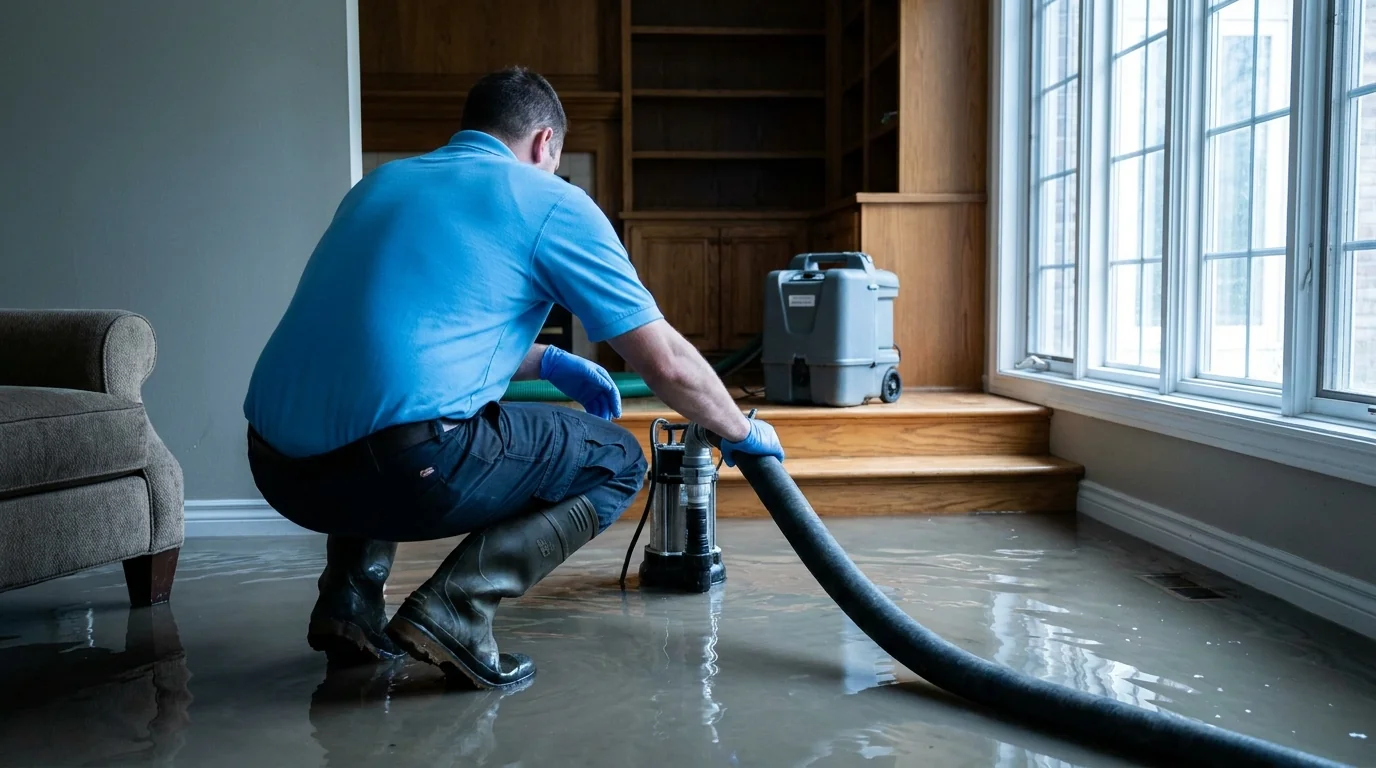
Flood Damage Restoration in Paterson
24/7 flood damage restoration in Paterson, NJ. IICRC-certified, insurance billing accepted. Call (855) 650-7422.
Our IICRC-certified technicians are dispatched from our Fair Lawn, NJ headquarters and are typically on-site in Paterson within 60 minutes of your call.
The Passaic River doesn’t give much warning. When heavy rain stalls over Passaic County, water can rise several feet within hours in the low-lying blocks near downtown Paterson and the neighborhoods that hug the river below the Great Falls. Residents in those areas learned that lesson during Hurricane Irene in 2011 and again when Ida tore through in 2021, leaving basements, first floors, and ground-level units submerged under murky, contaminated floodwater. The Restoration Group responds to flood damage calls in Paterson around the clock — extracting water, drying structures, and documenting losses so families can get back into their homes.
Why Paterson Properties See Repeated Flood Damage
Paterson’s geography sets the stage. The city sits directly on the Passaic River, and the terrain drops sharply from the ridge neighborhoods like Hillcrest and Lakeview down to the flats near the water. That elevation change funnels runoff fast, overwhelming aging combined sewer lines that were never designed for modern storm volumes. When the system backs up, water doesn’t just pool in yards — it pushes through floor drains and toilet bases into finished basements.
The housing stock compounds the problem. Much of Paterson’s residential fabric dates to the late 1800s and early 1900s, built to house workers from the silk mills that once lined the river. Those 19th-century brick rowhouses and two- and three-family frame walkups — dense in areas like Sandy Hill and South Paterson — were built with cast-iron drain lines, unlined masonry foundations, and crawl spaces that were never intended to stay dry. Converted silk-era industrial buildings, now apartment complexes, add another layer: aging standpipe and sprinkler systems that can fail quietly, releasing hundreds of gallons before anyone notices.
Then there’s the rental density. Paterson’s overcrowded rental market means basements and lower units are frequently occupied and often unventilated — conditions where a single flood event can trigger mold colonization within 24 to 48 hours if water isn’t extracted and drying equipment deployed quickly.
Our Flood Damage Restoration Process in Paterson
Every flood job starts with a moisture assessment — not a visual walk-through, but thermal imaging and calibrated moisture meters that map saturation inside wall cavities, subfloor assemblies, and behind tile. In Paterson’s older homes, that step is especially important because water travels unpredictably through rubble-stone foundations and hollow-core plaster walls.
Once we understand the full scope, we move through a structured sequence:
- Water extraction: truck-mounted and portable extractors pull standing water from floors, carpets, and saturated insulation. In multi-family buildings, we coordinate access across units when water has migrated between floors.
- Controlled demolition: saturated drywall, flooring, and insulation that cannot be dried in place are removed to the flood cut line. In Paterson’s pre-1950 homes, we frequently encounter plaster-and-lath construction, which we handle carefully — plaster holds moisture longer than drywall and requires extended drying cycles.
- Structural drying: industrial desiccant dehumidifiers and high-velocity air movers run in a closed drying system. We set drying goals based on IICRC S500 standards and monitor daily with moisture logs that become part of your insurance documentation.
- Antimicrobial treatment: applied to all affected surfaces before any reconstruction begins, given the category of water typical in river-adjacent flood events.
- Reconstruction: once materials reach dry standard, we rebuild — flooring, drywall, insulation, paint — so you’re dealing with one contractor from extraction through finished repair.
Reaching Paterson from Kenilworth
Our crews stage out of Kenilworth and travel north on I-78 and Route 21 to reach Paterson, a route that keeps us close to the city’s most flood-prone corridors. Because we operate 24/7, a call at 2 a.m. after a river surge gets the same crew dispatch as a mid-afternoon call. We’re familiar with the access constraints in Paterson’s denser blocks — narrow one-way streets in the Eastside, parking-heavy stretches near Passaic County Community College, and the tight alley access behind some of the older rowhome rows in ZIP code 07501. We account for that when staging equipment so we’re not losing time repositioning trucks.
Local Note
Paterson’s converted mill buildings — particularly those repurposed as residential lofts and apartment complexes near the Great Falls National Historical Park corridor — often have wet-pipe sprinkler systems tied to aging municipal water supplies. When a head activates or a fitting fails, the discharge can run for 20 to 30 minutes before the building’s shutoff is located, releasing thousands of gallons across concrete slab floors that have no drainage. Because the slabs are often polished or coated, water spreads laterally under partition walls rather than draining, saturating adjacent units on the same floor. We’ve learned to check neighboring units immediately on these jobs — what looks like a single-unit loss frequently isn’t.
Paterson Insurance Coordination
Flood losses in Paterson often involve both homeowner policies and National Flood Insurance Program (NFIP) claims, particularly for properties in FEMA-designated flood zones along the Passaic River corridor. We prepare itemized moisture logs, photo documentation, and scope-of-loss reports formatted for adjuster review, and we work directly with your carrier’s field adjuster when they schedule the site visit. If your property is in a higher-risk zone and your claim involves an NFIP policy, we can walk you through the documentation requirements that differ from a standard HO claim — the timelines and proof-of-loss deadlines are stricter.
If you’re dealing with standing water or a saturated structure anywhere in Paterson — from the river-adjacent blocks near downtown to the hillside neighborhoods above Route 20 — call (855) 650-7422. The Restoration Group is NJ Licensed and IICRC Certified (Firm #210213), and we’re available any hour to assess the damage and start drying.
Serving Paterson from our Fair Lawn headquarters — ★ 4.8 · 158 Google reviews
“Prompt and professional work. Kept in contact thru out the process which was very important to me.” — F., July 2026Read our reviews on Google →
Flood Damage Restoration in Paterson: Service Coverage
Frequently Asked Questions
How fast can you arrive for flood damage restoration in Paterson?
How quickly can The Restoration Group reach flood-affected homes near the Passaic River in downtown Paterson?
Are homes in Sandy Hill and South Paterson at higher risk for flood damage than other parts of the city?
Does Paterson's older housing stock — plaster walls, cast-iron drains, rubble foundations — change how flood drying works?
Does Paterson's location in a FEMA flood zone affect the insurance claim process for river-related flood damage?
How long does post-flood restoration typically take for a two- or three-family home in Paterson's 07501 or 07503 ZIP codes?
Flood Damage Restoration response in Paterson
Most Paterson calls see a technician on-site within 60 minutes from our Fair Lawn headquarters.