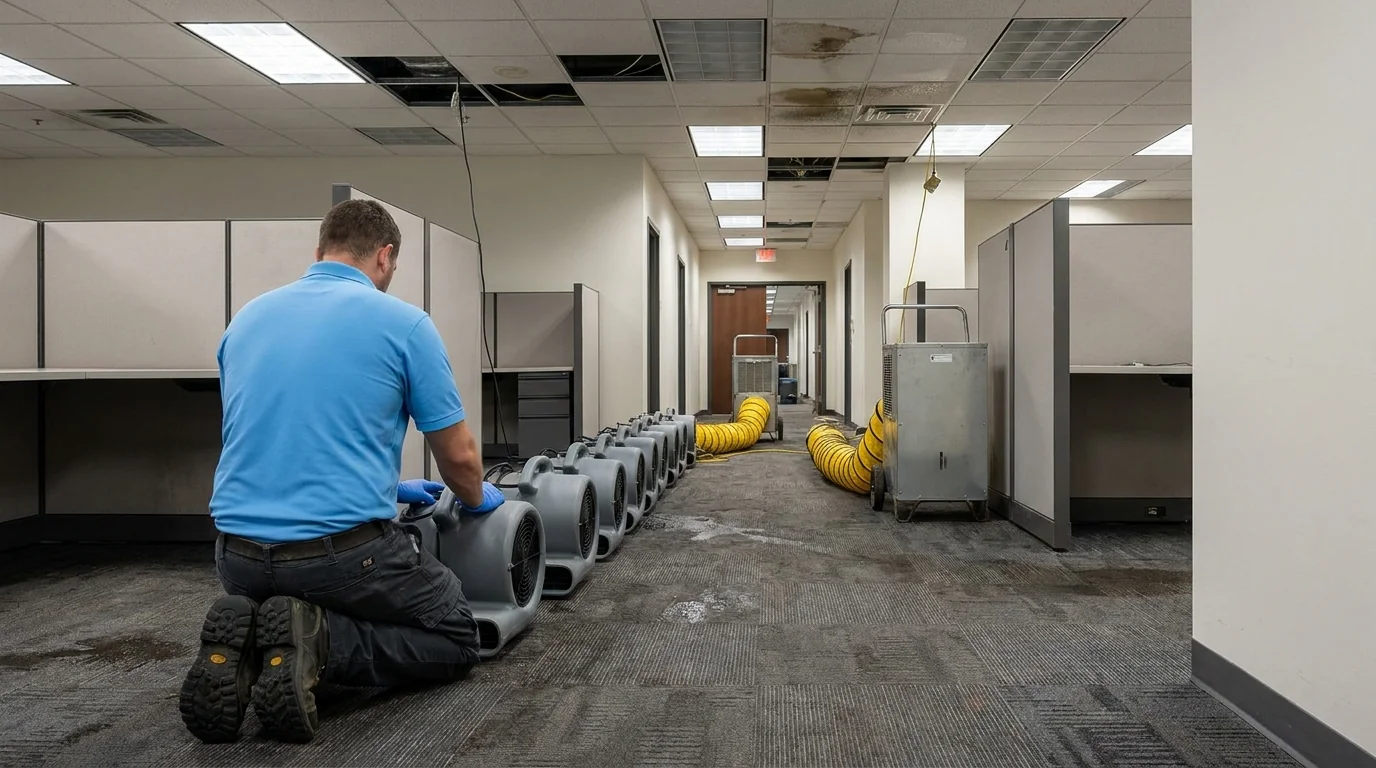
Commercial Restoration in Paterson
24/7 commercial restoration in Paterson, NJ. IICRC-certified, insurance billing accepted. Call (855) 650-7422.
Our IICRC-certified technicians are dispatched from our Fair Lawn, NJ headquarters and are typically on-site in Paterson within 60 minutes of your call.
Paterson’s commercial corridors — from the dense retail blocks of South Paterson to the converted silk-mill lofts near the Great Falls National Historical Park — sit inside one of New Jersey’s most flood-prone urban footprints. The Passaic River has crested into downtown streets twice in the last fifteen years, and the city’s aging building stock means that when water, fire, or smoke reaches a commercial property here, the damage rarely behaves the way it would in a newer suburban office park. The Restoration Group responds 24/7 to commercial losses across Paterson, bringing IICRC Certified Firm (#210213) protocols to a city that genuinely needs them.
Why Paterson Commercial Properties Face Distinct Restoration Challenges
The ZIP codes running through central Paterson — 07501, 07503, 07505 — contain some of the densest concentrations of pre-1920 commercial and mixed-use construction in New Jersey. Many of the buildings along Main Street and Market Street were originally built during the silk industry era, with thick unreinforced masonry walls, cast-iron drain stacks, and gravity-fed standpipe systems that were never designed for modern occupancy loads. When a sprinkler head fails or a standpipe fitting lets go in one of these structures, water migrates vertically through floor assemblies in ways that moisture meters miss on the first pass — you need thermal imaging to catch what’s wicking into the masonry cavity behind the finished walls.
The flood exposure compounds this. Low-lying commercial blocks near the Eastside and Sandy Hill neighborhoods have documented histories of river intrusion during major storm events. After Hurricane Ida in 2021, several ground-floor retail and warehouse spaces in those areas sat under standing water long enough for Category 3 contamination to set in before extraction crews arrived. Businesses that had never flooded before found themselves dealing not just with wet inventory but with sewage-laden water that required full containment and antimicrobial treatment before any rebuild could begin.
Older electrical infrastructure adds a fire-risk layer that’s specific to Paterson’s building stock. Knob-and-tube remnants still exist in some of the city’s multi-story commercial walkups, and when a fire originates in one of these buildings, smoke and soot travel through open wall cavities and unlined chases in ways that are difficult to trace without a systematic room-by-room inspection.
Our Commercial Restoration Process in Paterson
Every commercial job starts with a documented scope — not a verbal estimate. For Paterson properties, that means a walk-through that accounts for the specific construction type: masonry cavity walls, original hardwood subfloors, plaster-over-brick finishes, and the cast-iron or galvanized supply lines that are common in buildings constructed before 1950. We photograph and log affected materials before any demolition, which matters when you’re coordinating with a commercial carrier or preparing documentation for a business interruption claim.
For water losses, we follow the IICRC S500 standard for drying — but the drying timelines on Paterson’s older masonry buildings are longer than what you’d see in a 1990s-era strip mall. Dense brick and plaster release moisture slowly, and rushing the drying phase to save a day on the schedule leads to secondary mold growth inside wall cavities. We set drying goals based on daily moisture readings, not a fixed calendar.
For fire and smoke losses, containment is established before any cleaning begins. Smoke odor in a converted industrial building can penetrate exposed concrete and brick surfaces deeply enough that surface wiping alone won’t eliminate it — thermal fogging and hydroxyl treatment are typically required for full odor neutralization in those spaces.
Throughout the project, we maintain a daily log that your property manager, tenant, and insurance adjuster can reference. Commercial losses in Paterson often involve multiple stakeholders — a building owner, a retail or restaurant tenant, and a carrier — and clear documentation prevents disputes about what was damaged, what was removed, and what was restored.
Reaching Paterson from Kenilworth
From The Restoration Group’s base in Kenilworth, Paterson is accessible via Route 21 North directly into the city’s core, or via I-78 West to I-287 North depending on conditions. Under normal traffic, the drive reaches downtown Paterson in roughly 30–40 minutes. Because we operate 24/7, middle-of-the-night calls from commercial property managers dealing with a burst pipe or post-fire board-up need avoid the Route 3 and Route 46 interchange congestion that can add significant time during peak hours. For properties in the Lakeview or Hillcrest sections, the approach via Rifle Camp Road off Route 19 is typically the most direct.
Insurance Coordination for Paterson Commercial Losses
Commercial claims in Paterson frequently involve carriers that are familiar with the city’s flood history and will scrutinize pre-existing conditions carefully — particularly on older masonry buildings where deferred maintenance and storm damage can look similar. We document the loss cause separately from any pre-existing deterioration, which protects your claim from being partially denied on the grounds that the building was already compromised.
For tenants in mixed-use buildings, the question of whose policy responds — the building owner’s or the tenant’s — comes up regularly. We can work with both carriers simultaneously, keeping the scope of work for each party clearly separated so neither adjuster is paying for the other’s portion of the loss.
Local Note
Paterson’s converted silk-mill buildings — several of which sit within a few blocks of the Great Falls National Historical Park — present a specific challenge that crews unfamiliar with the city’s building stock sometimes underestimate: the original floor systems in these structures use heavy timber joists set into masonry pockets. When those pockets stay wet, the wood swells and the masonry around it cracks. We’ve learned to probe those joist pockets with pin-type moisture meters before signing off on drying completion, because the pocket itself holds moisture long after the visible floor surface reads dry. Skipping that step leads to callbacks three months later when the tenant notices a soft spot in the floor.
If your Paterson commercial property has been affected by water, fire, smoke, or mold, call The Restoration Group at (855) 650-7422. We’ll assess the damage, document the loss, and get your business back to operating condition — without cutting corners on a building that deserves to be done right.
Serving Paterson from our Fair Lawn headquarters — ★ 4.8 · 158 Google reviews
“Prompt and professional work. Kept in contact thru out the process which was very important to me.” — F., July 2026Read our reviews on Google →
Commercial Restoration in Paterson: Service Coverage
Frequently Asked Questions
How fast can you arrive for commercial restoration in Paterson?
How quickly can The Restoration Group reach a commercial property in the Eastside or Sandy Hill sections of Paterson?
Paterson has a lot of older masonry commercial buildings — does that affect how long a water damage restoration takes?
My building near the Great Falls area flooded during a storm — the water had sewage in it. What does that mean for the restoration process?
Does Paterson's older electrical infrastructure — knob-and-tube wiring in some buildings — create additional complications for fire and smoke restoration?
How does insurance documentation work for a commercial loss in Paterson when both a building owner and a retail tenant are involved?
Commercial Restoration response in Paterson
Most Paterson calls see a technician on-site within 60 minutes from our Fair Lawn headquarters.