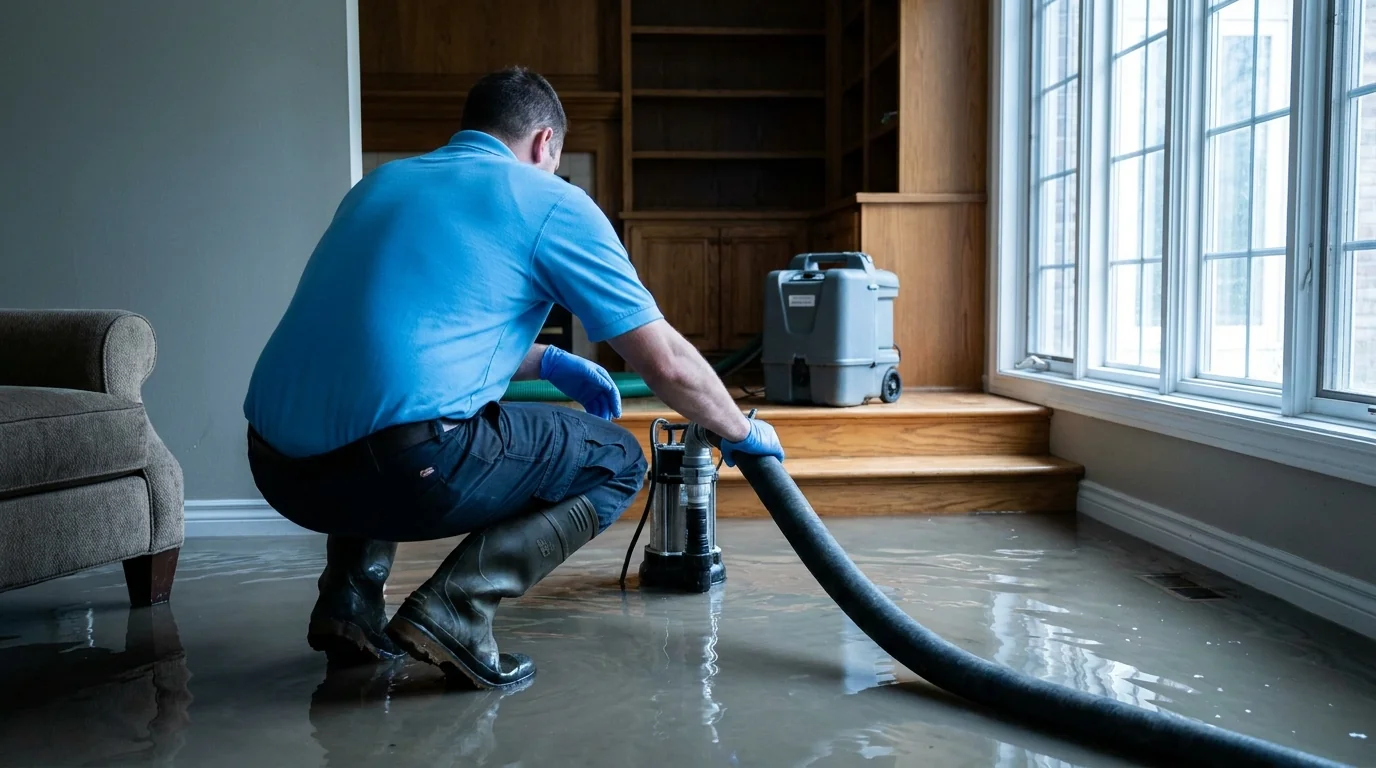
Flood Damage Restoration in Parsippany
24/7 flood damage restoration in Parsippany, NJ. IICRC-certified, insurance billing accepted. Call (855) 650-7422.
Our IICRC-certified technicians are dispatched from our Fair Lawn, NJ headquarters and are typically on-site in Parsippany within 60 minutes of your call.
When the Whippany River backs up after a heavy nor’easter, or when a decades-old supply line finally gives out in a finished Lake Hiawatha basement, the water doesn’t wait for business hours — and neither do the consequences. Flood damage in Parsippany moves fast: within 24 to 48 hours, saturated subfloor panels begin to swell, drywall wicks moisture up the wall cavity, and the humid conditions that define a New Jersey summer give mold a running start. The Restoration Group responds 24/7 from Kenilworth, reaching Parsippany properties with the equipment needed to stop that clock.
Why Parsippany Properties See Flood Damage Issues
Parsippany-Troy Hills was largely built out between the 1940s and 1970s — a wave of capes, ranches, and split-levels platted around the lake communities, plus the tight Victorian cottages of the Mount Tabor Historic District. That housing stock carries two chronic vulnerabilities. First, the original cast-iron drain stacks and galvanized supply lines in those older lake-tract homes corrode from the inside out; a pinhole failure in a finished basement can run undetected behind paneling for days before the floor gives it away. Second, the low-lying geography around Lake Hiawatha and Troy Brook means that even a moderate storm event can push stormwater into window wells and crawlspaces that were never designed for that kind of hydrostatic pressure.
Ida in 2021 made that risk impossible to ignore. Lake Hiawatha flooded severely — streets became channels, finished lower levels took on two and three feet of standing water, and many homeowners discovered their sump pumps were either undersized or had lost power. The same pattern repeated echoes of Floyd and Irene. For properties in the 07054 ZIP code especially, flood damage isn’t a freak event; it’s a recurring exposure that shapes how restoration work needs to be planned.
The Route 46 corridor and the Waterview commercial district add a different category of loss: large-footprint office buildings and hotels with commercial sprinkler systems that can discharge thousands of gallons before a suppression panel is silenced. Those jobs require high-capacity extraction equipment and coordinated drying across multiple floors — a different scope than a residential basement, but the same urgency.
Our Flood Damage Restoration Process in Parsippany
Every job starts with a moisture mapping survey — thermal imaging and calibrated moisture meters across walls, floors, and ceilings to establish exactly where water traveled, not just where it’s visible. In the split-level and bi-level homes common around Rainbow Lakes and Troy Hills, water often migrates through floor assemblies to the level below before it shows up as a stain, so that mapping step is not optional.
Once the scope is documented, standing water is extracted using truck-mounted units capable of removing hundreds of gallons quickly. Saturated materials — carpet, pad, damaged drywall, compromised insulation — are removed and documented before drying begins. Industrial desiccant and refrigerant dehumidifiers, paired with high-velocity air movers, are positioned according to the IICRC S500 standard for structural drying. Moisture readings are logged daily so drying progress is measurable, not estimated. When readings reach target levels across all monitored points, equipment is removed and the rebuild phase can begin.
As an IICRC Certified Firm (#210213) and NJ Licensed Home Improvement Contractor, the team can carry the project from emergency extraction through finished reconstruction — one point of contact rather than two separate contractors.
Reaching Parsippany from Kenilworth
The Restoration Group’s Kenilworth location puts crews on Route 22 West to Interstate 78 West, connecting to Interstate 287 North toward Parsippany in well under an hour under normal conditions. The I-80/287 interchange is the practical gateway to the township’s interior, with quick access to Lake Hiawatha, the Mount Tabor area, and the commercial corridors along Route 46. Because the team operates 24/7, a call at 2 a.m. after a sump pump failure during a storm gets the same dispatch response as a call at noon.
Parsippany Insurance Coordination
Flood losses in Parsippany frequently involve both a homeowner’s policy and, for properties in designated flood zones near the Whippany River or Lake Hiawatha, a separate NFIP (National Flood Insurance Program) policy. Those two claims run on different timelines and require different documentation. The Restoration Group photographs and itemizes affected materials before removal, produces moisture logs that adjusters require for structural drying claims, and communicates directly with carriers to keep the process moving. Homeowners are not left to translate technical scope sheets into insurance language on their own.
Local Note
In the older lake-tract neighborhoods — particularly the streets immediately surrounding Lake Hiawatha — many finished basements were converted from utility space decades ago without permits, using wood-paneled walls over unfaced fiberglass batts. When those walls flood, the insulation compresses and holds water against the framing long after the visible surface looks dry. Moisture meters read the panel face, not the cavity. Crews working these homes probe behind paneling at multiple points before closing out the drying phase, because a reading that looks good at the surface can mask a framing system that’s still well above safe moisture content.
If your Parsippany home or commercial property has taken on water, call The Restoration Group at (855) 650-7422. The sooner extraction begins, the narrower the window for secondary damage — and the shorter the road back to normal.
Serving Parsippany from our Fair Lawn headquarters — ★ 4.8 · 158 Google reviews
“The folks at TRG were professional, punctual, and pleasant to deal with. They did a great job addressing our issue and performed appropriate follow up to ensure our satisfaction.” — Jw, August 2026Read our reviews on Google →
Flood Damage Restoration in Parsippany: Service Coverage
Frequently Asked Questions
How fast can you arrive for flood damage restoration in Parsippany?
How quickly can The Restoration Group reach Lake Hiawatha or the surrounding neighborhoods after a flood call?
Homes near Lake Parsippany and Rainbow Lakes flooded badly during Ida — are those properties harder to dry out than a typical NJ home?
Does having both a homeowner's policy and an NFIP flood policy — common for properties near the Whippany River — complicate the claims process?
How long does structural drying typically take in Parsippany's older housing stock after a significant flood event?
Can The Restoration Group handle both the emergency flood cleanup and the reconstruction for a Parsippany home, or do I need a separate contractor for repairs?
Will my homeowners insurance cover flood damage restoration in Parsippany?
Flood Damage Restoration response in Parsippany
Most Parsippany calls see a technician on-site within 60 minutes from our Fair Lawn headquarters.