Basement Flooding Cleanup in New Brunswick
24/7 basement flooding cleanup in New Brunswick, NJ. IICRC-certified, insurance billing accepted. Call (855) 650-7422.
Our IICRC-certified technicians are dispatched from our Fair Lawn, NJ headquarters and are typically on-site in New Brunswick within 60 minutes of your call.
The Raritan River has flooded the low-lying streets near Boyd Park before — most memorably during Ida in 2021 — but the majority of basement flooding calls in New Brunswick never make the news. They start with a failed sump pump on a Tuesday night, a cracked cast-iron drain under a century-old rowhouse near Rutgers Village, or a burst supply line in one of the postwar apartment buildings along the Edgebrook corridor. Water moves fast in a basement, and the older the structure, the faster it finds new places to go. The Restoration Group responds to flooded basement emergencies in New Brunswick 24/7, dispatching from Kenilworth with the equipment to extract standing water, dry structural assemblies, and document everything your insurance adjuster needs.
Why New Brunswick Basements Flood More Than You’d Expect
New Brunswick’s housing stock is unusually diverse for a city its size, and that diversity creates a wide range of flood vulnerabilities. The dense rowhouses and two- and three-family homes built in the early 1900s near Rutgers University and the Fifth Ward typically have stone or brick foundation walls with no interior waterproofing membrane — walls that wick groundwater during heavy rain events and crack under decades of freeze-thaw cycling. Cast-iron drain stacks in these buildings corrode from the inside out; by the time a homeowner notices slow drains, the pipe may already be partially collapsed and backing up into the basement floor drain.
Downtown and along the George Street business district, the picture shifts to commercial mixed-use buildings and newer high-rises where sprinkler line failures and HVAC condensate overflows generate the bulk of water events. Student rental properties near Rutgers add another layer: deferred maintenance, high tenant turnover, and appliances that run around the clock. The result is a steady stream of water damage calls across ZIP codes 08901 and 08903 that spans every building type the city has.
Soil saturation compounds all of it. The Raritan floodplain keeps the water table elevated through much of the year, which means sump pumps in low-lying neighborhoods work harder and fail sooner than in drier parts of Middlesex County.
Our Basement Flooding Cleanup Process in New Brunswick
When we arrive at a flooded basement in New Brunswick, the first priority is safety — confirming that utilities are isolated before anyone steps into standing water. In older homes near Robeson Village and the Fifth Ward, electrical panels are sometimes located in the basement itself, which changes the entry protocol.
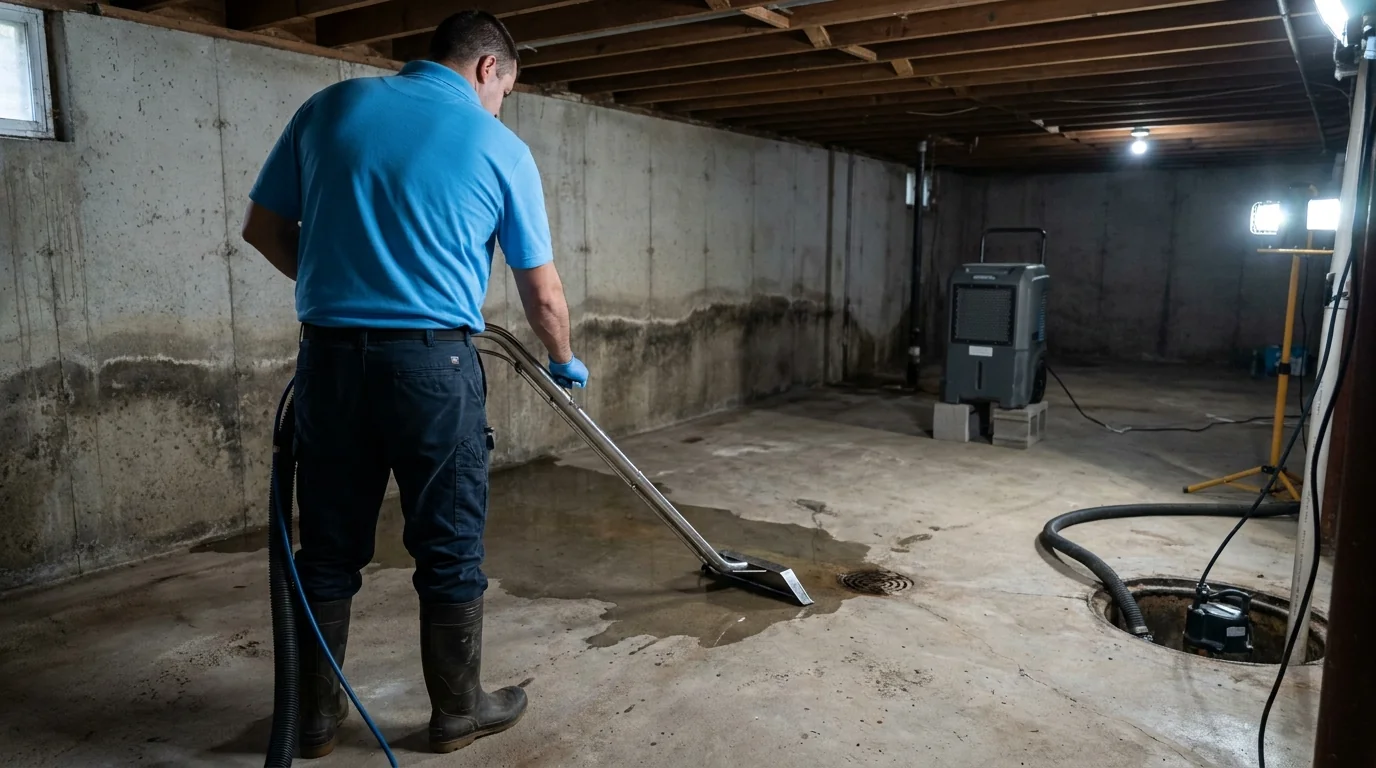
Once the space is safe, extraction begins with truck-mounted or portable submersible pumps sized to the volume of water present. A finished basement with two inches of standing water across 800 square feet holds roughly 1,000 gallons — that comes out in the first hour. What takes longer is the water you can’t see: moisture that has wicked into concrete block walls, migrated under vinyl flooring, or saturated the bottom plates of stud walls.
We use thermal imaging cameras and calibrated moisture meters to map the full extent of saturation before we place drying equipment. In New Brunswick’s older masonry-foundation homes, this step consistently reveals wet areas that aren’t visible to the eye. Drying systems — commercial-grade desiccant or refrigerant dehumidifiers and high-velocity air movers — run continuously, with moisture readings logged daily against the IICRC S500 drying standard. We don’t pull equipment until the readings confirm the structure has returned to a normal moisture range, typically three to five days depending on the materials involved.
Reaching New Brunswick from Kenilworth
Kenilworth sits roughly 15 miles northeast of New Brunswick via the Garden State Parkway to Route 1, or through US-9 depending on traffic. Because we operate 24/7, we can dispatch at any hour — a meaningful advantage when a sump pump fails during a nor’easter and the window between “wet floor” and “saturated subfloor” is measured in hours, not days. We serve the full city, from the Highland Park border neighborhoods in the northeast to the riverfront blocks near Boyd Park in the south.
New Brunswick Insurance Coordination
Most standard homeowners policies cover sudden and accidental water discharge — a burst pipe or appliance failure — but exclude long-term seepage through foundation walls. The distinction matters in New Brunswick because many of the city’s older homes have both problems simultaneously: a recent pipe failure on top of years of slow moisture intrusion. We photograph and document each cause separately so your adjuster can make a clean coverage determination. We work with all major carriers and can bill directly, reducing the out-of-pocket burden during an already stressful event. For landlords managing student rental properties near Rutgers, we can also prepare the loss documentation needed for commercial landlord policies.
Local Note
In New Brunswick’s early-1900s rowhouses — particularly the attached two- and three-families common near the Fifth Ward and Rutgers Village — basement floors are often original poured concrete with no vapor barrier beneath them. After a flood, these slabs release absorbed moisture upward for days after the visible water is gone, which can stall drying timelines and fool a less thorough crew into pulling equipment too early. We account for slab off-gassing when we set drying targets in these buildings, extending the dehumidification phase rather than chasing a number that looks good on the surface but leaves the structure damp underneath.
If your basement is holding water right now — or if you’re dealing with the aftermath of a recent flood anywhere in New Brunswick — call The Restoration Group at (855) 650-7422. We’ll assess the damage, start extraction, and walk you through every step of the process from water removal to final drying verification.
Serving New Brunswick from our Fair Lawn headquarters — ★ 4.8 · 158 Google reviews
“Teams were very prompt and respectful.. company responded quickly and kept in touch” — Peggy, August 2026Read our reviews on Google →
Basement Flooding Cleanup in New Brunswick: Service Coverage
Frequently Asked Questions
How fast can you arrive for basement flooding cleanup in New Brunswick?
How quickly can The Restoration Group reach a flooded basement in New Brunswick's Fifth Ward or Robeson Village?
Are the older rowhouses near Rutgers University harder to dry after a basement flood?
Does New Brunswick's proximity to the Raritan River affect flood insurance or the cleanup process?
What equipment do you use for basement water removal, and how long does the drying process take?
My New Brunswick rental property near Rutgers has a flooded basement — can you handle landlord insurance documentation?
Basement Flooding Cleanup response in New Brunswick
Most New Brunswick calls see a technician on-site within 60 minutes from our Fair Lawn headquarters.