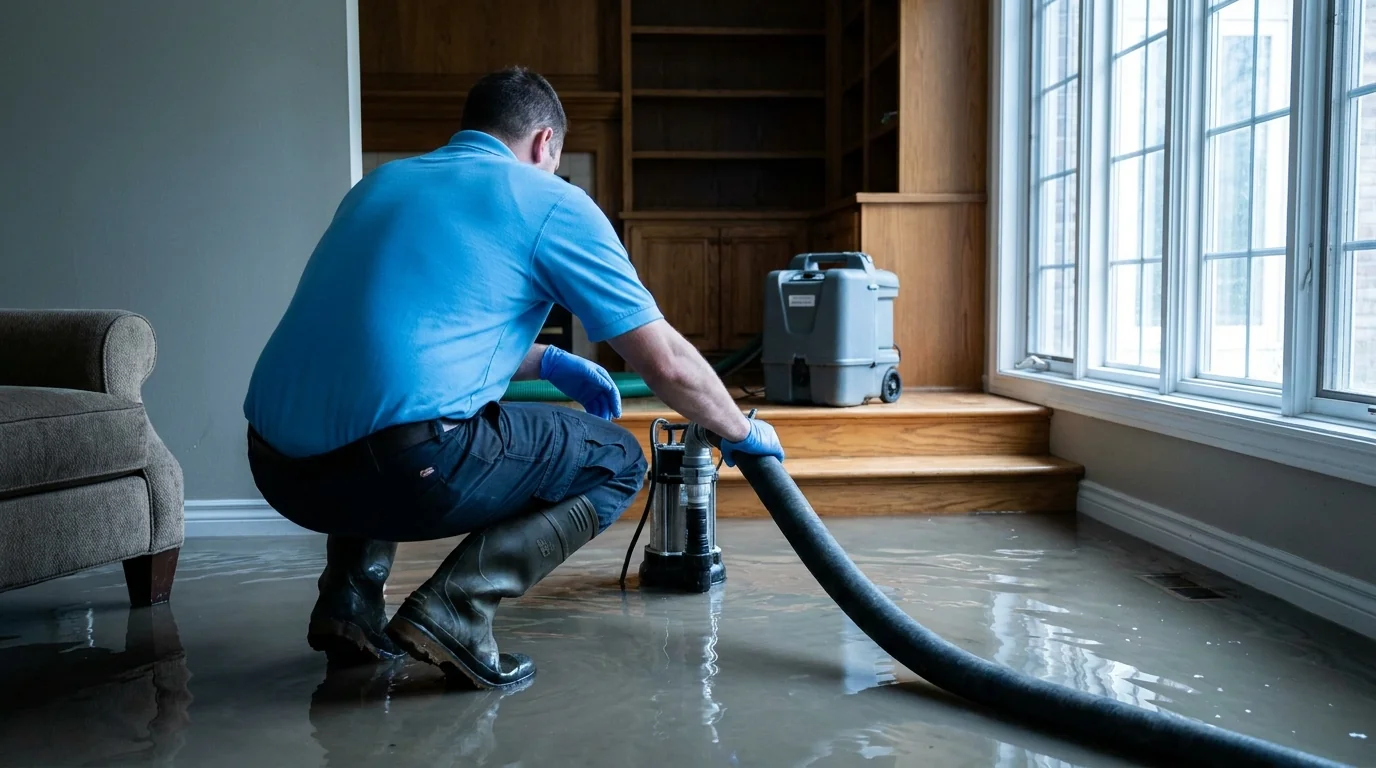
Flood Damage Restoration in Morristown
24/7 flood damage restoration in Morristown, NJ. IICRC-certified, insurance billing accepted. Call (855) 650-7422.
Our IICRC-certified technicians are dispatched from our Fair Lawn, NJ headquarters and are typically on-site in Morristown within 60 minutes of your call.
When the Whippany River backs up after a hard rain — or a corroded galvanized supply line finally gives out inside one of the Historic District’s century-old Victorians — the window between a manageable cleanup and a gut-to-the-studs rebuild is measured in hours, not days. The Restoration Group responds to flood damage calls across Morristown 24/7, dispatching from Kenilworth with equipment loaded and ready so standing water doesn’t spend the night soaking into your subfloor.
Why Morristown Properties See Flood Damage So Often
Morristown’s appeal is partly its age, and that age comes with plumbing that was never designed for today’s water pressure or usage patterns. The dense residential blocks near the Green — colonials, brick multifamily buildings, and late-Victorian homes in the 07960 ZIP code — commonly have galvanized steel pipes that corrode from the inside out over decades. When they fail, they fail fast, and finished basements that homeowners use as living space take the full hit.
The Whippany River corridor adds a second, weather-driven risk. During Tropical Storm Ida’s remnants in 2021, low-lying areas along the town’s edge flooded with little warning, pushing water into crawl spaces and first-floor units before sump pumps could keep up. The Speedwell Avenue corridor, with its mix of storefront retail and older commercial buildings, sees a similar pattern: flat or low-slope roofs that pond water during extended storms, then leak through aging membrane seams into occupied spaces below. New luxury apartment towers downtown introduce a different failure mode — supply-line breaks on upper floors that cascade through multiple units before anyone notices.
Our Flood Damage Restoration Process in Morristown
Every flood job starts with a moisture survey, not a guess. We use thermal imaging and calibrated moisture meters to map exactly how far water has migrated — behind baseboards, under hardwood, into wall cavities — before a single piece of material is removed. In Morristown’s older housing stock, that step matters more than usual: plaster walls common in pre-1940 homes absorb water at a different rate than modern drywall and can hold moisture deep in the substrate even when the surface feels dry to the touch.
Once the scope is mapped, the process follows a structured sequence:
- Water extraction using truck-mounted and portable units to pull standing water and saturated material
- Controlled demolition of non-salvageable materials — wet insulation, wicking drywall, swollen subfloor sections — documented with photos for your insurance adjuster
- Drying and dehumidification using commercial-grade desiccant and refrigerant dehumidifiers, with daily moisture readings logged until the structure reaches dry standard per the IICRC S500
- Antimicrobial treatment of affected cavities before any rebuild begins
- Reconstruction coordination so you have one point of contact from extraction through finished repairs
As an IICRC Certified Firm (#210213), our drying protocols are documented and defensible — something insurance carriers and Morristown’s building department both appreciate when permits are pulled for structural repairs.
Reaching Morristown from Kenilworth
Kenilworth sits roughly 20 minutes from Morristown under normal conditions via Route 24 west. We route crews through I-78 to Route 24 depending on time of day, and we’re familiar with the access quirks that slow response in denser parts of town — narrow streets in the Cauldwell neighborhood, limited staging near the Morristown Medical Center campus, and the parking constraints around the Green that make equipment positioning a real consideration, not an afterthought. When you call, we ask for the cross street and building type so the crew arrives with the right equipment configuration, not a one-size-fits-all truck load.
Because we operate around the clock, a burst pipe discovered at 2 a.m. in a Speedwell-area apartment gets the same crew response as a midday call.
Morristown Insurance Coordination
Most standard homeowners and commercial property policies cover sudden and accidental water losses — a burst pipe, an appliance failure, storm-driven flooding in some cases — but the documentation has to be thorough to avoid disputes. We photograph every affected area before extraction begins, log moisture readings at each drying checkpoint, and produce a scope of loss that mirrors the line-item format adjusters use. We bill carriers directly and work with the major insurers active in Morris County. If your policy has a flood exclusion and the loss stems from the Whippany River overtopping, we can still document the damage and help you understand what a NFIP (National Flood Insurance Program) claim requires.
Local Note
Morristown’s Historic District properties — particularly the large Victorians near the Ford Mansion and along the streets radiating off the Green — often have finished basements with original stone or brick foundation walls that were never waterproofed by modern standards. When those spaces flood, water wicks laterally through the mortar joints and can saturate framing that sits directly on the slab. We’ve learned to check those perimeter walls carefully before declaring a basement dry, because a moisture meter reading taken only at the center of the room will miss the slow release happening at the foundation line. Skipping that step is how a “dry” basement develops a mold problem three weeks later.
If you’re dealing with flood damage at a Morristown property — whether it’s a historic home near the Green, a commercial space on Speedwell Avenue, or a unit in one of the newer downtown buildings — call The Restoration Group at (855) 650-7422. We’ll assess the damage, start extraction, and keep you informed at every step until the property is dry, documented, and ready for rebuild.
Serving Morristown from our Fair Lawn headquarters — ★ 4.8 · 158 Google reviews
“Very professional staff and also helped accommodate working around some other contractors that were simultaneously working in my house. Highly recommend!” — Gautam, July 2026Read our reviews on Google →
Flood Damage Restoration in Morristown: Service Coverage
Frequently Asked Questions
How fast can you arrive for flood damage restoration in Morristown?
How quickly can The Restoration Group reach a flood emergency near Morristown's Historic District or the Green?
Are older homes in Morristown's 07960 ZIP code harder to dry out after a flood than newer construction?
Does flood damage from Whippany River overflow work differently with insurance than an indoor pipe burst in Morristown?
What causes the supply-line failures we're seeing in Morristown's newer downtown apartment buildings?
How long does a typical residential flood restoration take for a finished basement in Morristown?
Flood Damage Restoration response in Morristown
Most Morristown calls see a technician on-site within 60 minutes from our Fair Lawn headquarters.