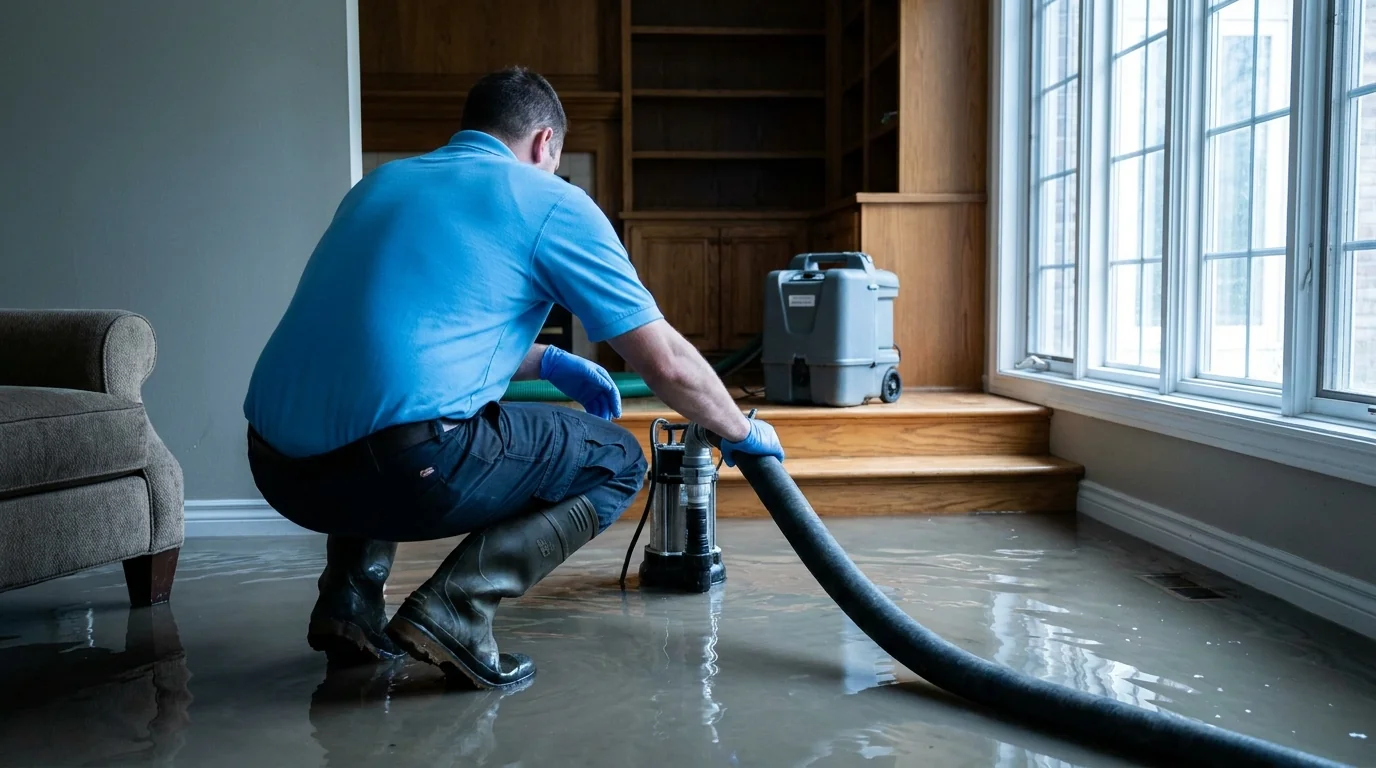
Flood Damage Restoration in Millburn
24/7 flood damage restoration in Millburn, NJ. IICRC-certified, insurance billing accepted. Call (855) 650-7422.
Our IICRC-certified technicians are dispatched from our Fair Lawn, NJ headquarters and are typically on-site in Millburn within 60 minutes of your call.
When the West Branch of the Rahway River crests through downtown Millburn — as it did catastrophically during Hurricane Ida in 2021 — the flooding doesn’t stop at the riverbank. It backs into basements along Millburn Avenue, pushes through foundation walls in the Wyoming and Glenwood neighborhoods, and soaks the finished lower levels of century-old colonials and Tudors that were never designed to shed that kind of hydrostatic pressure. The Restoration Group responds 24/7 to flood losses across Millburn and Short Hills (ZIP codes 07041 and 07078), arriving with the extraction equipment and drying systems the size and age of these homes demand.
Why Millburn Properties Are Especially Vulnerable to Flood Damage
Millburn’s housing stock is a significant factor in how badly a flood loss plays out. The large early-1900s colonials and Tudor estates concentrated in Short Hills and Old Short Hills were built on stone and poured-concrete foundations that, after a century of settling, develop hairline cracks that become fast-moving water channels under storm surge or a backed-up municipal storm drain. Many of these homes have finished basements — home theaters, wine cellars, au pair suites — filled with materials and contents that absorb water quickly and can sustain tens of thousands of dollars in damage within hours.
Beyond the river corridor, aging cast-iron drain lines and copper supply pipes throughout older Millburn Center homes fail with little warning, particularly after a hard freeze or a sudden pressure spike. When a supply line lets go inside a 4,000-square-foot Tudor with plaster walls and oak subfloors, the water migrates through multiple finished levels before anyone notices. The Mall at Short Hills and the Millburn Avenue retail corridor also generate commercial losses from sprinkler discharges — a single activation in a large anchor tenant can release thousands of gallons before the system resets.
Our Flood Damage Restoration Process in Millburn
Every job starts with a thorough moisture mapping of the affected structure. In Millburn’s older homes, that means probing beyond the obvious wet zone — water travels differently through plaster-and-lath assemblies than through modern drywall, and it migrates into wall cavities, under hardwood floors, and into subfloor systems before the surface shows any visible sign of saturation. We use thermal imaging and calibrated moisture meters to trace the full extent of intrusion before a single piece of flooring comes up.
From there, the process follows a defined sequence:
- Extraction: Truck-mounted and portable extractors remove standing water and pull moisture from carpet, padding, and subfloor assemblies.
- Controlled demolition: Saturated drywall, insulation, and flooring that cannot be dried in place are removed to the flood cut — typically 12 to 24 inches above the waterline — to expose wall cavities and allow airflow.
- Structural drying: Industrial desiccant dehumidifiers and high-velocity air movers are positioned according to a drying plan calibrated to the room volume and material types. In plaster-walled rooms, drying cycles run longer because plaster releases stored moisture more slowly than gypsum board.
- Monitoring: We return daily to log moisture readings and adjust equipment placement until all structural materials reach their target dry standard.
- Documentation: Every reading, photo, and equipment log is formatted for insurance submission.
As an IICRC Certified Firm (#210213), our drying protocols follow the S500 Standard for Professional Water Damage Restoration — which matters when an adjuster reviews the claim file.
Reaching Millburn from Kenilworth
The Restoration Group is based in Kenilworth, roughly 8 miles from Millburn Center via Route 22 and Springfield Avenue. Because we operate 24/7, a crew can be dispatched at any hour — including during the overnight and early-morning hours when pipe failures and storm flooding are most often discovered. We’re familiar with the access considerations around Taylor Park and the downtown corridor near the Millburn train station, where street flooding and emergency staging can be complicated by narrow lanes and parked vehicles.
Millburn Insurance Coordination
Most residential flood losses in Millburn involve a combination of homeowner’s policy coverage (for sudden discharge or overflow) and, for properties in mapped flood zones near the Rahway River corridor, NFIP flood insurance through FEMA. We document losses in a format that satisfies both carrier types — itemized moisture logs, photo documentation of affected materials, and scope-of-work reports that align with Xactimate line items. We communicate directly with adjusters and can meet on-site during the inspection to walk through findings. Our license as an NJ Licensed Home Improvement Contractor (NJ Division of Consumer Affairs) means the repair and reconstruction work that follows remediation stays with one accountable contractor.
Local Note
Homes in the Wyoming and Glenwood sections of Millburn that sit on the lower slopes toward the Rahway River corridor often have a drainage pattern that isn’t obvious from the street: their rear yards slope toward a shared swale or easement that channels runoff toward the river. During a heavy storm event, that swale can reverse-flow when the river is already high, effectively turning the backyard into a temporary retention area and pushing water against foundation walls from the outside rather than from above. If your basement flooded during a storm and the source isn’t immediately clear, that reverse-drainage dynamic is worth investigating before assuming the foundation itself has failed.
If your Millburn or Short Hills property has taken on water — whether from the Rahway River, a failed pipe, or a storm drain backup — call The Restoration Group at (855) 650-7422. We’ll assess the damage, start drying, and handle the documentation so the recovery moves as fast as the loss did.
Serving Millburn from our Fair Lawn headquarters — ★ 4.8 · 158 Google reviews
“The folks at TRG were professional, punctual, and pleasant to deal with. They did a great job addressing our issue and performed appropriate follow up to ensure our satisfaction.” — Jw, August 2026Read our reviews on Google →
Flood Damage Restoration in Millburn: Service Coverage
Frequently Asked Questions
How fast can you arrive for flood damage restoration in Millburn?
How quickly can The Restoration Group reach a flooded home in Short Hills or Millburn Center?
The Rahway River flooded my finished basement near Taylor Park — what gets saved and what has to go?
My Short Hills Tudor has plaster walls and original oak floors. Does that change how long the drying process takes?
Will my homeowner's insurance cover flood damage from the Rahway River, or do I need a separate NFIP policy?
Are homes in the Wyoming and Glenwood neighborhoods more prone to foundation flooding than other parts of Millburn?
Flood Damage Restoration response in Millburn
Most Millburn calls see a technician on-site within 60 minutes from our Fair Lawn headquarters.