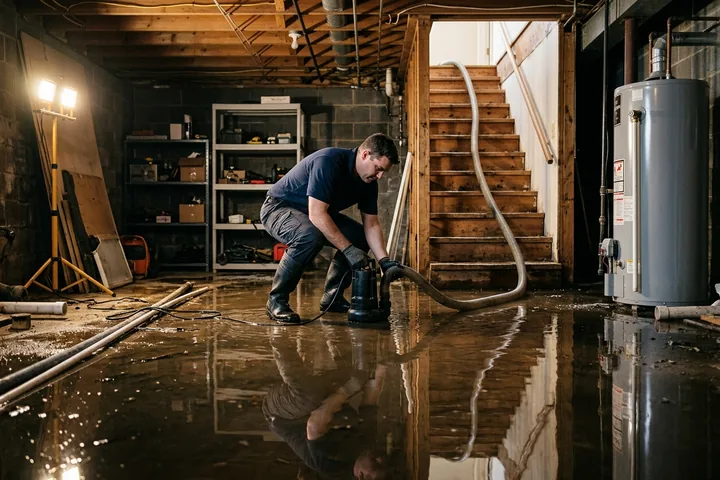
Basement Flood Cleanup in Manhattan
24/7 basement flood cleanup in Manhattan, NY. IICRC-certified, insurance billing accepted. Call (855) 650-7422.
Our IICRC-certified technicians are dispatched from our Fair Lawn, NJ headquarters and are typically on-site in Manhattan within 60 minutes of your call.
Manhattan basements flood differently than anywhere else. When a storm drain backs up during a nor’easter or a century-old cast-iron riser finally gives way, the water doesn’t just pool on a concrete slab — it travels through elevator pits, utility chases, and subgrade storage rooms that connect to neighboring units, retail tenants, and mechanical rooms your building’s super has been managing for decades. The Restoration Group responds 24/7 to basement flood cleanup calls across Manhattan, working within the building protocols that co-op boards, managing agents, and resident managers actually require.
Why Manhattan Properties See Basement Flood Cleanup Issues
Manhattan’s relationship with groundwater is complicated by geology, age, and density. Much of the island sits on bedite and schist, but the low-lying edges — the Financial District, the Lower East Side, stretches of Harlem near the Harlem River — are built on fill and older alluvial soils that drain slowly and hold moisture. When Hurricane Sandy pushed a surge into Lower Manhattan and Ida overwhelmed combined sewer systems from Harlem to Chelsea in a single evening, it wasn’t just bad luck. It was the predictable result of infrastructure designed for a different era meeting rainfall intensity that keeps getting worse.
Pre-war buildings — and Manhattan has an enormous stock of them, from the limestone-clad co-ops of the Upper East Side to the walk-up tenements of the Lower East Side — typically have subgrade spaces that were never designed to be truly waterproof. Drain tile systems are often absent or collapsed. Boiler rooms and storage areas share the same basement level as electrical panels and telecommunications risers. A few inches of standing water in that environment is a multi-system emergency, not just a wet floor.
Modern condo towers in Midtown and along the Far West Side present a different but equally complex picture: below-grade parking structures, loading docks, and mechanical floors that require coordinated shutdown procedures before any extraction work can begin safely.
Our Basement Flood Cleanup Process in Manhattan
The first priority on any Manhattan basement job is documentation — not because we’re bureaucratic, but because your building’s board, your managing agent, and your insurance adjuster will all ask for it. We photograph affected materials, log moisture readings by zone, and produce unit-by-unit drying records that satisfy the paper trail co-ops and condos require before they’ll sign off on work completion.
Extraction comes next. Truck-mounted and portable extraction units pull standing water from concrete, tile, and the kind of original terrazzo you find in pre-war service corridors. Once standing water is removed, we deploy desiccant and refrigerant dehumidifiers alongside high-velocity air movers calibrated to the actual square footage and ceiling height of the space — not a generic setup.
Moisture mapping with thermal imaging and pin-type meters tells us what the surface can’t. Water behind a plaster wall or under a floating slab floor can read dry at the surface while the substrate stays saturated — and in a Manhattan basement, that hidden moisture is what turns a flood cleanup into a mold remediation six weeks later. We dry to IICRC S500 standard and document the final readings before equipment comes out.
Freight elevator scheduling, after-hours access coordination, and certificate of insurance submission to building management are part of every job — not extras we charge for separately.
Manhattan Insurance & Building Coordination
Insurance claims for Manhattan basement floods carry wrinkles that don’t exist in suburban markets. In a co-op, the proprietary lease defines where the building’s responsibility ends and the shareholder’s begins — and that line runs right through the middle of many flood losses. A failed building riser that damages your storage unit and your neighbor’s finished basement space may involve the building’s master policy, your HGA policy, and your neighbor’s individual coverage simultaneously.
We document losses in a format that works for all three: itemized moisture logs, material-specific drying records, and photo documentation organized by unit and affected system. We bill carriers directly where assignment of benefits applies, and we communicate with adjusters in the language they use — not in the vague language that slows claims down.
For commercial tenants — restaurants, retailers, and offices in buildings from the ZIP codes 10001 through 10038 — every closed day is measurable lost revenue. We structure the work schedule to minimize operational downtime, including overnight mitigation shifts when the business needs to open the next morning.
Local Note
One thing that catches out-of-market crews working Manhattan basements: freight elevator availability is not guaranteed, and in many pre-war buildings on the Upper West Side and Upper East Side, it’s governed by union rules or building-specific scheduling windows. Equipment that takes twenty minutes to stage in a suburban driveway can take two hours to move through a Manhattan service entrance if you haven’t coordinated in advance. We call building management before we arrive, confirm the freight schedule, and stage equipment accordingly — which means the actual extraction work starts faster, not slower, despite the logistics.
Basement flood cleanup in Manhattan demands more than extraction equipment and a dehumidifier count. It demands familiarity with how these buildings actually operate — and The Restoration Group brings that to every job. If you’re dealing with standing water, a failed drain, or the aftermath of a storm surge, call us at (855) 650-7422. We’re available around the clock and ready to work within your building’s process from the first call.
Basement Flood Cleanup in Manhattan: Service Coverage
Frequently Asked Questions
How fast can you arrive for basement flood cleanup in Manhattan?
How quickly can The Restoration Group reach a basement flood in the Financial District or Lower East Side?
Manhattan co-op boards require certificates of insurance before contractors enter the building — does The Restoration Group handle that?
Does the age of Manhattan's pre-war building stock affect how long basement drying takes?
A riser failure in our building affected multiple units — how do you handle a multi-unit basement flood in a Manhattan high-rise?
Is basement flooding in ZIP code 10002 or 10038 more likely to involve sewer backup than a clean-water source?
Basement Flood Cleanup response in Manhattan
Most Manhattan calls see a technician on-site within 60 minutes from our Fair Lawn headquarters.