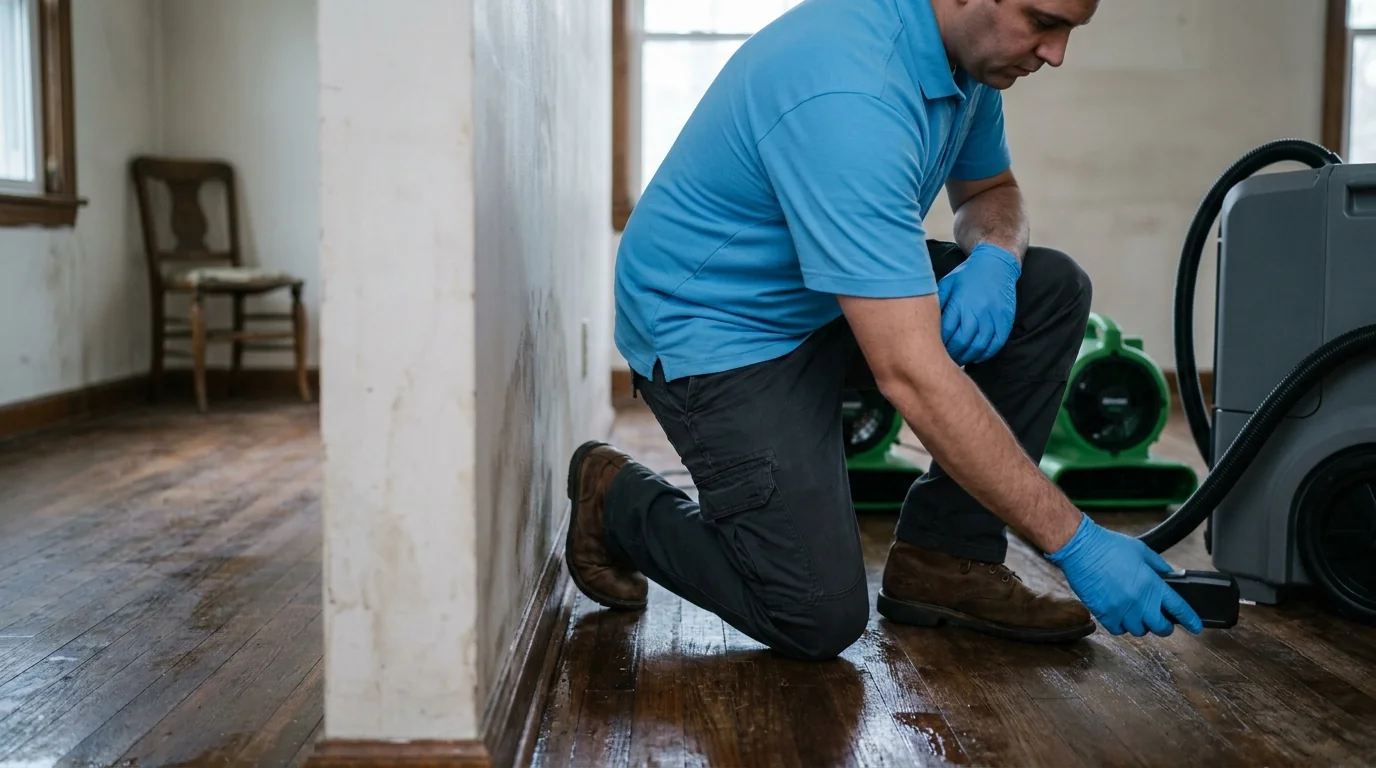
Water Damage Restoration in Livingston
24/7 water damage restoration in Livingston, NJ. IICRC-certified, insurance billing accepted. Call (855) 650-7422.
Our IICRC-certified technicians are dispatched from our Fair Lawn, NJ headquarters and are typically on-site in Livingston within 60 minutes of your call.
When the Canoe Brook watershed backs up during a nor’easter or a summer cloudburst, basements across Livingston fill faster than a sump pump can handle — and in the split-levels and finished colonials that line streets from Northland to Cedar Hill, that water isn’t just sitting on a concrete slab. It’s soaking into framed walls, saturating carpet padding over subfloor, and wicking up into the engineered lumber that builders used when they replaced a 1960s ranch with a four-bedroom McMansion on a fully finished lower level. The Restoration Group responds 24/7 to water damage calls throughout Livingston, bringing IICRC-certified technicians (Firm #210213) and commercial-grade extraction and drying equipment to stop the clock on structural damage.
Why Livingston Properties See Water Damage Issues
Livingston’s housing stock tells the story in the walls. The majority of homes in ZIP code 07039 were built between 1950 and 1980 — an era of cast-iron drain stacks and copper supply lines that are now hitting the end of their service life. A pinhole leak behind a kitchen cabinet can run undetected for weeks inside a plaster-and-lath partition wall. When it finally lets go, the damage footprint is larger than it would be in newer drywall construction because plaster holds moisture differently: it absorbs slowly, releases slowly, and can mask elevated moisture readings on a surface scan while the framing behind it stays wet.
Geography compounds the problem. The Canoe Brook threads through the western and central sections of town, and the low-lying corridors near the West Essex Trail are the first to flood when rainfall totals exceed an inch per hour — a threshold that Tropical Storm Ida blew past in September 2021, pushing water into hundreds of Essex County basements in under two hours. Newer teardown construction near Riker Hill and the Collins neighborhood often features deeper, fully finished basements with home theaters, wet bars, and HVAC equipment — all of it at risk when a sump pump loses power or a discharge line freezes in January.
On the commercial side, the retail corridor around Livingston Mall and the medical campus at Saint Barnabas Medical Center generate a different category of water loss: sprinkler-discharge events, roof-drain overflows, and mechanical-room pipe failures that can affect thousands of square feet of occupied space on a single incident.
Our Water Damage Restoration Process in Livingston
Every job starts with moisture mapping, not assumptions. Technicians use thermal imaging cameras and penetrating moisture meters to trace the full migration path of water through floors, walls, and ceilings — because in a 1960s Livingston split-level, water that entered through the garage-level door can travel laterally through the slab edge and appear as wet drywall in an adjacent bedroom before anyone notices.
Step 1 — Water extraction. Truck-mounted and portable extractors pull standing water from carpet, hardwood, and concrete. In finished basements, this step also means pulling up carpet and pad to expose the subfloor before drying begins.
Step 2 — Structural drying. High-capacity LGR dehumidifiers and axial air movers are positioned according to a drying plan calibrated to the room’s cubic footage, material types, and ambient conditions. Drying is documented daily against the IICRC S500 standard so there is a defensible record for your insurance adjuster.
Step 3 — Antimicrobial treatment. In Livingston’s humid summers, mold colonization can begin within 48 to 72 hours of a water intrusion. Affected surfaces receive EPA-registered antimicrobial treatment as a precautionary measure — not a mold remediation guarantee, but a meaningful reduction in spore load during the drying window.
Step 4 — Clearance and documentation. Before equipment is removed, a final moisture scan confirms that all readings have returned to baseline. The full moisture log, photo documentation, and drying report are packaged for your insurance claim.
Reaching Livingston from Kenilworth
The Restoration Group operates out of Kenilworth, roughly 8 miles from central Livingston via Route 22 East to I-78 East to Exit 50. Because the team is available around the clock, a call placed at 2 a.m. after a water heater failure in the Squiretown area gets the same response as a midday call — technicians load the truck and move. For addresses near the Riker Hill Art Park or the northern end of town, the approach via Northfield Avenue off I-280 West is typically faster during peak commute hours on Route 22.
Local Note
One pattern that comes up repeatedly in Livingston’s older split-levels: the original builders ran copper supply lines through the interior of exterior concrete-block foundation walls — a common 1960s practice that made sense before continuous insulation was standard. When those lines fail, water doesn’t pour out visibly; it seeps into the block cavity and migrates along the footer before surfacing as a wet spot on the opposite side of the basement, sometimes 15 feet from the actual break. If your moisture readings don’t match where you think the water entered, that block-wall migration is worth checking before any drying plan is finalized.
If you are dealing with water in your home or business in Livingston — whether it’s a burst pipe in a Cedar Hill colonial, a flooded finished basement near the Canoe Brook corridor, or a sprinkler discharge at a commercial property — call The Restoration Group at (855) 650-7422. Technicians are available 24/7, and the sooner extraction begins, the smaller the restoration scope.
Serving Livingston from our Fair Lawn headquarters — ★ 4.8 · 158 Google reviews
“Great customer service. I was kept well informed throughout the entire process. I received nothing but respect and sympathy from everyone I dealt with.” — Ryan, July 2026Read our reviews on Google →
Water Damage Restoration in Livingston: Service Coverage
Frequently Asked Questions
How fast can you arrive for water damage restoration in Livingston?
How quickly can The Restoration Group reach a home in Livingston's Northland or Collins neighborhoods?
Are finished basements in Livingston's newer teardown homes harder to dry than older unfinished ones?
My Livingston home has original cast-iron drains and copper supply lines — does that affect how water damage is handled?
What documentation does The Restoration Group provide for an insurance claim on a Livingston water loss?
How does flooding near the Canoe Brook corridor differ from a typical pipe-burst job, and does that change the restoration approach?
Water Damage Restoration response in Livingston
Most Livingston calls see a technician on-site within 60 minutes from our Fair Lawn headquarters.