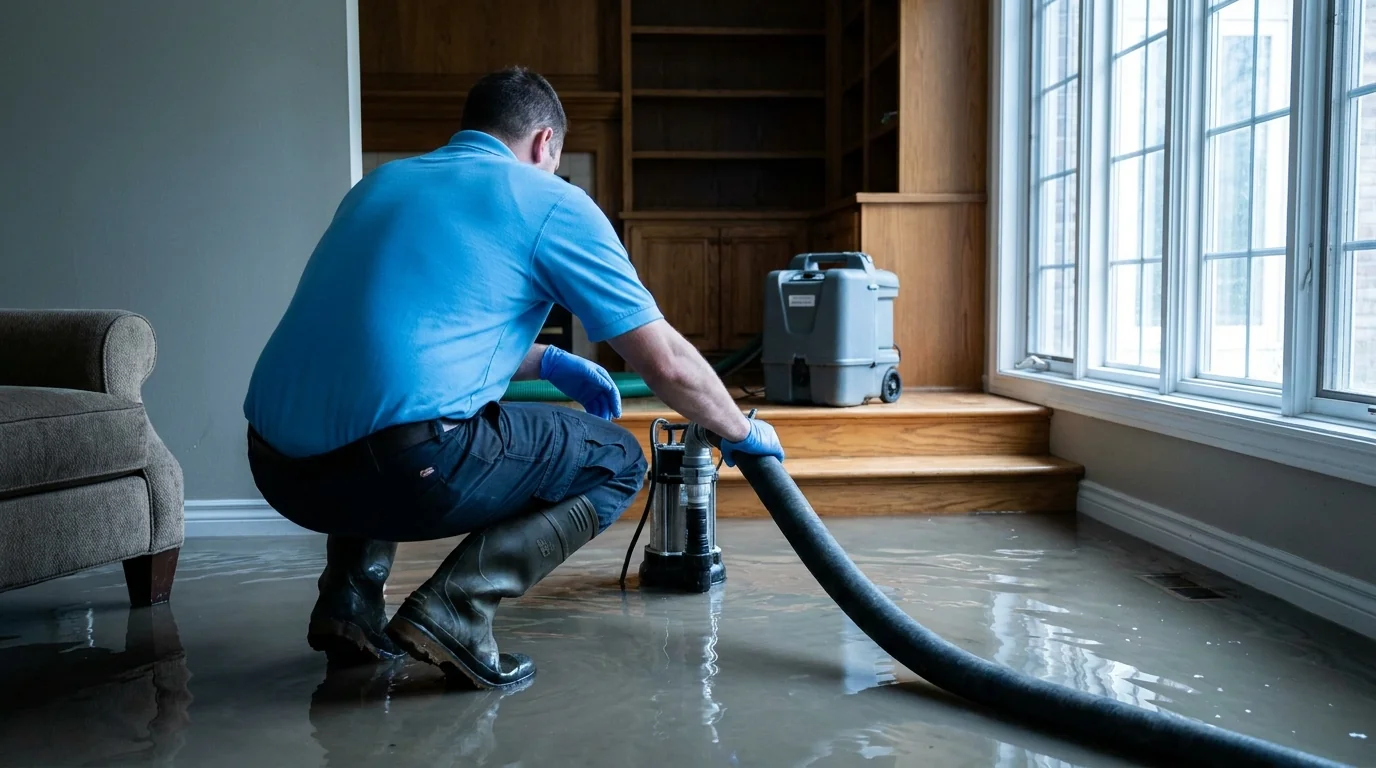
Flood Damage Restoration in Livingston
24/7 flood damage restoration in Livingston, NJ. IICRC-certified, insurance billing accepted. Call (855) 650-7422.
Our IICRC-certified technicians are dispatched from our Fair Lawn, NJ headquarters and are typically on-site in Livingston within 60 minutes of your call.
When Tropical Storm Ida tore through Essex County in September 2021, basements across Livingston filled faster than sump pumps could cycle — and the homes hardest hit weren’t the oldest ones. Many of the finished, fully furnished lower levels in the newer teardown colonials near the Canoe Brook watershed took on two to three feet of standing water within hours. That combination of high-value finished space and low-lying topography is exactly what makes flood damage in Livingston a different problem than it is in most of northern New Jersey.
Why Livingston Properties Are Especially Vulnerable to Flood Damage
Livingston’s western edge runs along the Passaic River, and the Canoe Brook threads through the interior of town before draining into that system. During heavy rain events, low-lying streets near the West Essex Trail and neighborhoods like Northland and Collins can see surface water accumulate quickly — faster than municipal storm drains can handle. The problem compounds underground: many of the 1950s–70s split-levels and ranches that make up a large portion of Livingston’s housing stock still carry original cast-iron drain lines. Those pipes corrode from the inside out, and a moderate storm surge can push sewage-laced water back through floor drains before a homeowner realizes the drain is no longer a one-way valve.
On the newer end of the spectrum, the wave of McMansion rebuilds on large finished basements — home theaters, gyms, wine cellars — means the dollar exposure per inch of flood water is dramatically higher. Flooring, framing, insulation, and mechanicals all compete for drying capacity at the same time.
Our Flood Damage Restoration Process in Livingston
When you call (855) 650-7422, the process starts before a crew arrives. We ask targeted questions about water source (clean supply line, storm intrusion, or sewage backup), visible water depth, and whether power to the affected area is isolated. That triage shapes what equipment loads onto the truck.
On-site, the first priority is extraction. Truck-mounted and portable extractors pull standing water from finished floors, carpet, and subfloor cavities. We use thermal imaging cameras to map moisture migration behind walls and under slab — critical in Livingston’s split-level layouts where water travels laterally through framing before it becomes visible. Once extraction is complete, we establish a drying system calibrated to the specific materials: LGR dehumidifiers for finished basement environments, desiccant units when humidity is already high, and axial air movers positioned to create cross-circulation through wall cavities.
All drying is documented against IICRC S500 standard protocols — moisture readings logged at each monitoring visit so your insurance adjuster receives a defensible drying record, not just a completion invoice.
Reaching Livingston from Kenilworth
The Restoration Group operates out of Kenilworth, roughly 12 miles from central Livingston via Route 24 West. We respond 24 hours a day, every day of the year. For addresses in the Riker Hill and Cedar Hill areas, the fastest routing typically runs through Eisenhower Parkway to South Orange Avenue; for properties closer to the Livingston Mall corridor or the commercial blocks near Saint Barnabas Medical Center, Route 10 West is the more direct approach. Either way, our crews are not dispatched from a call center — when you reach us at night or on a weekend, you’re speaking with someone who can authorize a truck.
Livingston Insurance Coordination
Flood losses in Livingston frequently involve two separate coverage questions: the homeowner’s standard policy (which typically covers sudden and accidental discharge — a burst supply line, a failed water heater) and a separate flood insurance policy, often through the NFIP, which covers storm-driven groundwater intrusion. Many homeowners discover mid-claim that they have one but not the other.
We document losses in the format adjusters expect — moisture mapping, photo logs, scope of work with line-item pricing — and we communicate directly with your carrier throughout the process. We are a licensed NJ Home Improvement Contractor under the NJ Division of Consumer Affairs, which matters when insurers request contractor credentials before approving a scope.
Local Note
Livingston’s split-level homes present a drying challenge that flat-floor colonials don’t: the intermediate level — typically a family room or garage-adjacent space sitting half a story below grade — often has concrete slab on one side and wood-frame floor assembly on the other within the same room. Water migrates differently across those two substrates, and a drying plan that works for the slab section will under-dry the wood framing if the equipment isn’t repositioned mid-cycle. Our monitoring visits aren’t just data collection — they’re an opportunity to adjust airflow as materials release moisture at different rates.
If your home in Livingston’s 07039 ZIP code has taken on water — whether from a storm, a failed sump, a broken supply line, or a backed-up drain — call (855) 650-7422. We’ll assess the damage honestly, start extraction immediately, and carry the documentation through to your final insurance settlement.
Serving Livingston from our Fair Lawn headquarters — ★ 4.8 · 158 Google reviews
“Great customer service. I was kept well informed throughout the entire process. I received nothing but respect and sympathy from everyone I dealt with.” — Ryan, July 2026Read our reviews on Google →
Flood Damage Restoration in Livingston: Service Coverage
Frequently Asked Questions
How fast can you arrive for flood damage restoration in Livingston?
How quickly can The Restoration Group reach a flooded basement in the Northland or Collins area of Livingston?
Livingston has a lot of 1960s split-levels with cast-iron drains — does that change how you approach a flood cleanup?
My finished basement near the Canoe Brook watershed flooded during a heavy rain — will homeowner's insurance cover it?
What does the drying process actually look like inside a Livingston home after flood extraction?
Does the commercial sprinkler discharge at properties near Saint Barnabas Medical Center or the Livingston Mall corridor get handled differently than a residential flood?
Flood Damage Restoration response in Livingston
Most Livingston calls see a technician on-site within 60 minutes from our Fair Lawn headquarters.