Basement Flooding Cleanup in Livingston
24/7 basement flooding cleanup in Livingston, NJ. IICRC-certified, insurance billing accepted. Call (855) 650-7422.
Our IICRC-certified technicians are dispatched from our Fair Lawn, NJ headquarters and are typically on-site in Livingston within 60 minutes of your call.
When the Canoe Brook watershed backs up during a heavy nor’easter or a fast-moving summer storm, basements across Livingston fill faster than most homeowners expect. The 1960s split-levels and colonials that line the streets near Northland and Collins were built before today’s waterproofing standards existed — many sit on poured-concrete walls that have been quietly wicking moisture for decades. When a real flood event hits, those same walls offer little resistance. The Restoration Group responds 24/7 to flooded basements throughout the 07039 ZIP code, bringing certified drying equipment and a documented process designed for exactly the kind of housing stock and hydrology Livingston throws at us.
Why Livingston Properties See Basement Flooding Issues
Livingston’s geography sets the stage. The Passaic River forms the western boundary, and the Canoe Brook threads through low-lying sections of town before draining toward the river. During heavy rain — and especially during events like Tropical Storm Ida in 2021, which pushed water into basements across Essex County — those drainage corridors simply can’t move water fast enough. Homes near the West Essex Trail corridor and the lower elevations around Cedar Hill sit in the path of that overflow.
The housing stock compounds the problem. The wave of 1950s–70s construction that defines much of Livingston means aging cast-iron floor drains that corrode, crack, and back up. Copper supply lines installed fifty years ago are past their service life; pinhole leaks and full-pipe failures both send water into finished lower levels. More recently, teardown McMansions with large finished basements have raised the cleanup stakes considerably — a flooded rec room with LVP flooring, drywall, and built-in cabinetry is a far more complex loss than an unfinished utility space.
Our Basement Flooding Cleanup Process in Livingston
Every basement flooding job starts with a moisture assessment before a single piece of equipment is placed. We use thermal imaging and pin-type moisture meters to map how far water has migrated into concrete block, framing, and subfloor — because water visible on the floor is rarely the full picture.
From there, the process follows a clear sequence:
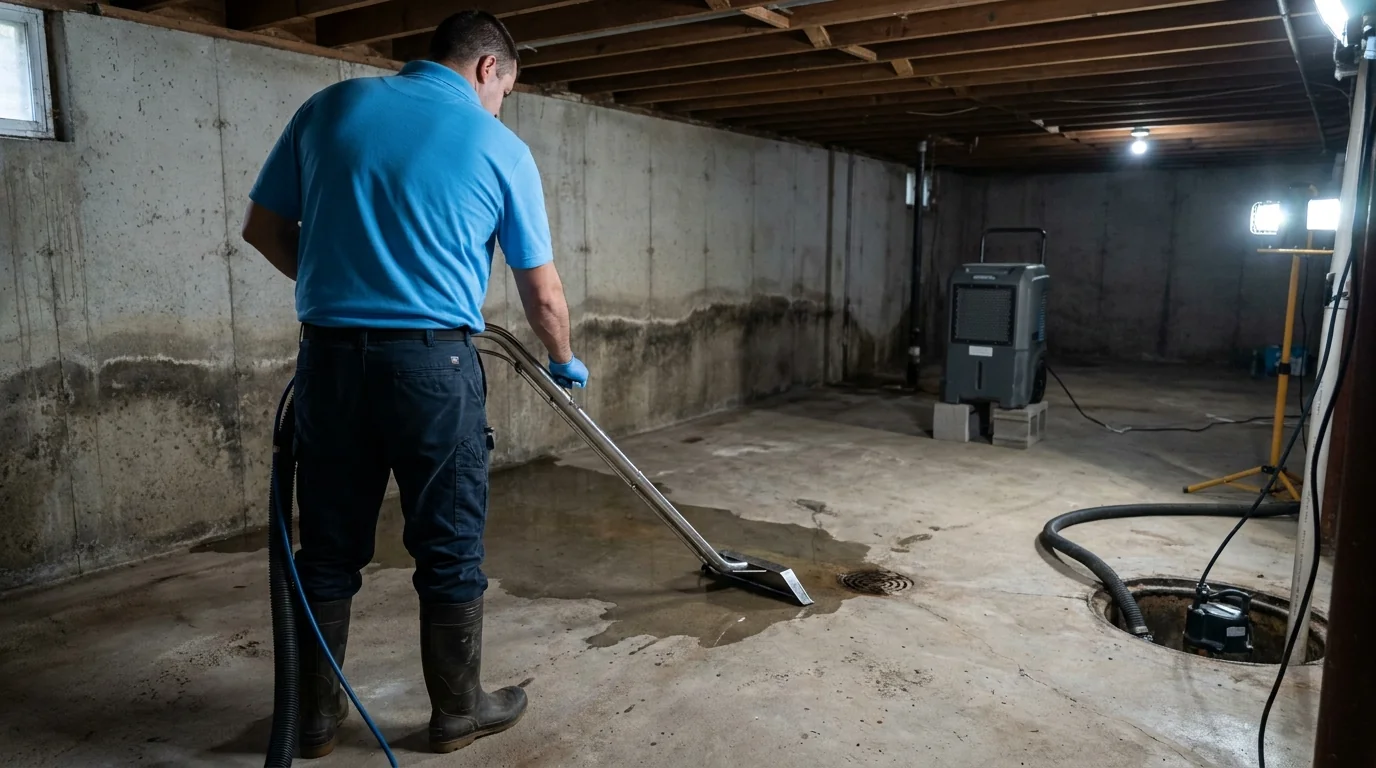
- Standing water extraction — truck-mounted or portable submersible pumps remove bulk water first. In older Livingston homes with low ceiling heights or tight mechanical rooms, portable units often work better than dragging hoses from a truck.
- Structural drying — commercial-grade LGR dehumidifiers and high-velocity air movers are positioned to dry the slab, framing, and any remaining wall assemblies according to the IICRC S500 standard for water damage restoration.
- Material evaluation — drywall, insulation, and flooring are assessed individually. Saturated fiberglass batt insulation in a 1960s block wall cavity holds moisture long after the surface feels dry; we document what needs to come out and what can be saved.
- Antimicrobial treatment — applied to concrete and framing surfaces where warranted, to address the conditions that allow mold to colonize within 24–48 hours of a water intrusion.
- Monitoring and sign-off — we return to check moisture readings until the structure meets dry standard, then provide a drying log for your insurance file.
Reaching Livingston from Kenilworth
The Restoration Group is based in Kenilworth, roughly 10 miles from central Livingston via Route 24 or I-78 west to the Garden State Parkway. Because we operate around the clock, a crew can be dispatched at any hour — whether the call comes in at noon or 2 a.m. after a sump pump fails during an overnight storm. Neighborhoods closer to the Riker Hill Art Park area and the Livingston Mall corridor along Eisenhower Parkway are straightforward to reach; lower-lying residential streets near the Canoe Brook may require us to stage equipment on higher ground during active flooding, which we plan for on arrival.
Local Note
One pattern we see repeatedly in Livingston’s split-level homes: the below-grade portion of the structure often shares a wall with an attached garage, and that garage slab is typically lower than the finished basement floor. During a flood event, water migrates under the shared wall and saturates the garage slab — an area homeowners don’t notice until the drying log shows the concrete isn’t reaching target moisture levels. On any split-level job in Livingston, we include the garage slab in our initial moisture mapping as a matter of course, because missing it means the job isn’t actually finished.
Livingston Insurance Coordination
Most standard homeowners’ policies in New Jersey cover sudden and accidental water damage — a burst pipe or appliance failure — but exclude gradual seepage and rising groundwater. After Ida, many Essex County homeowners discovered that distinction the hard way. We document the loss thoroughly from the moment we arrive: photographs, moisture readings, a written scope of damage, and a drying log. That documentation package is what your adjuster needs to process the claim efficiently. We work directly with most major carriers and can communicate with your adjuster on your behalf so you’re not translating between insurance language and restoration work.
If you’re dealing with a flooded basement anywhere in Livingston — whether it’s a finished lower level in the Collins neighborhood or an older utility space near Cedar Hill — call (855) 650-7422. We’ll assess the damage, start extraction, and give you a clear picture of what comes next.
Serving Livingston from our Fair Lawn headquarters — ★ 4.8 · 158 Google reviews
“Great customer service. I was kept well informed throughout the entire process. I received nothing but respect and sympathy from everyone I dealt with.” — Ryan, July 2026Read our reviews on Google →
Basement Flooding Cleanup in Livingston: Service Coverage
Frequently Asked Questions
How fast can you arrive for basement flooding cleanup in Livingston?
How quickly can The Restoration Group reach a flooded basement in the Northland or Collins neighborhoods?
Are homes near the Canoe Brook watershed in Livingston at higher risk for basement flooding than other parts of town?
Does the age of Livingston's 1950s–70s housing stock change how basement drying is done?
What's involved in drying out a finished basement in one of Livingston's newer teardown homes?
Will my homeowners' insurance cover basement flooding cleanup in Livingston, and what documentation do I need?
Basement Flooding Cleanup response in Livingston
Most Livingston calls see a technician on-site within 60 minutes from our Fair Lawn headquarters.