Contents Restoration & Pack-Out in Jersey City
24/7 contents restoration & pack-out in Jersey City, NJ. IICRC-certified, insurance billing accepted. Call (855) 650-7422.
Our IICRC-certified technicians are dispatched from our Fair Lawn, NJ headquarters and are typically on-site in Jersey City within 60 minutes of your call.
When a supply-line failure soaks a Newport high-rise unit or a combined-sewer backup fills a Bergen-Lafayette rowhouse basement, the damage to the structure is only half the story. Furniture, clothing, documents, electronics, and heirlooms absorb smoke, soot, floodwater, and mold spores at their own pace, and they need a different kind of attention than the walls and floors around them. Contents restoration and pack-out is the process of getting those belongings out of harm’s way, cataloging them precisely, restoring what can be saved, and returning everything in documented condition. In a city as dense and legally layered as Jersey City, doing that work right matters as much as doing it fast.
Why Jersey City Properties Face Distinctive Contents Challenges
Jersey City holds two very different building worlds inside one ZIP code boundary. Along the Exchange Place waterfront and through Newport, glass-and-steel residential towers concentrate dozens of households on a single riser stack. When a pipe fails on an upper floor, water follows the path of least resistance through ceiling assemblies, elevator shafts, and electrical chases, and contents on floors well below the break can be damaged before anyone smells anything. Building management in these properties needs unit-by-unit moisture documentation to satisfy the association’s insurer, which means a pack-out inventory that is granular enough to stand up to an adjuster’s review.
A few miles inland, the Heights, Bergen-Lafayette, and Greenville are full of brownstones and frame rowhouses built between roughly 1890 and the 1930s. These structures were designed before modern waterproofing standards, and their basements sit close to a water table that responds quickly to heavy rain. The remnants of Jersey City’s combined sewer system mean that a hard storm, the kind Ida delivered citywide, can push sewage-contaminated water into cellar spaces where decades of stored belongings sit on shelving or directly on concrete. Category 3 contamination changes the restoration calculus: some materials that might otherwise be cleaned must be disposed of, and the inventory process has to distinguish between salvageable and non-salvageable items before anything leaves the property.
Our Pack-Out and Contents Restoration Process
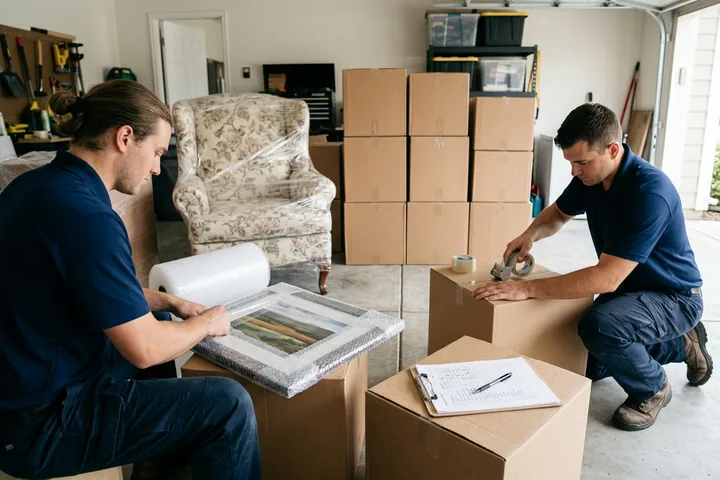
The process starts with a room-by-room inventory before a single item moves. Every piece is photographed, described, and assigned a condition code, this documentation protects the homeowner during the insurance claim and gives the restoration team a clear baseline for what needs cleaning, deodorization, or specialized treatment.
Once inventoried, contents are packed using materials matched to the item type: electronics and artwork travel differently than upholstered furniture or textile goods. Items go to a climate-controlled facility where technicians work through the restoration sequence, ultrasonic cleaning for hard goods, ozone or hydroxyl treatment for odor-bearing soft contents, freeze-drying for water-damaged documents and photographs. Throughout the process, the inventory log is updated so that at any point the owner or their adjuster can see exactly where each item stands.
Return delivery is scheduled around the structural work timeline. Contents come back only after moisture readings confirm the structure is dry and any remediation is complete, returning belongings into a still-damp environment would undo the restoration work.
Insurance and HOA Coordination in Jersey City
Jersey City’s dense multifamily ownership creates claim situations that single-family markets rarely see. A condo board may have a master policy that covers common elements while individual unit owners carry their own HO-6 policies, and a single water loss can trigger both. Landlords managing multi-unit buildings in Journal Square or Downtown Jersey City (ZIP 07302) often need documentation that separates tenant property from owner property for claim purposes.
The Restoration Group is an IICRC Certified Firm (#210213) and a licensed New Jersey Home Improvement Contractor, which means the paperwork we produce, moisture logs, photo inventories, scope-of-work documentation, is formatted to meet what carriers and HOA insurers expect. We work directly with adjusters and can provide line-item inventories in formats most major carriers accept, reducing back-and-forth during the claim process.
Local Note
In Jersey City’s older rowhouse neighborhoods, it is common to find finished basement spaces that were converted without permits, drop ceilings, laminate flooring laid directly on slab, and built-in shelving that was never designed to be waterproof. When a basement floods in these spaces, the contents inventory gets complicated quickly because the shelving itself may be unsalvageable, and items stored on lower shelves may have been sitting in contaminated water longer than the homeowner realizes. We flag these conditions during the initial walkthrough so the inventory accurately reflects what was exposed and for how long, a detail that matters when the carrier reviews the claim.
If you’re dealing with a loss at a property in the Heights, Bergen-Lafayette, or anywhere across Jersey City’s 07304 or 07305 ZIP codes, call The Restoration Group at (855) 650-7422. We’re available around the clock, and we’ll start the inventory process before anything is moved so your claim has the documentation it needs from the first hour.
Serving Jersey City from our Fair Lawn headquarters — ★ 4.8 · 167 Google reviews
“(Translated by Google) Excellent work. The staff were responsible, friendly, and above all, very clean. I was very satisfied and I recommend them 100%. (Original) Excelente trabajo.el personal responsables,amables y sobre todo muy limpios para trabajar .quedé satisfecha y lo recomiendo al 💯.” - Dessy, September 2026Read our reviews on Google →
Contents Restoration & Pack-Out in Jersey City: Service Coverage
Frequently Asked Questions
How fast can you arrive for contents restoration & pack-out in Jersey City?
How does a pack-out work in a Jersey City high-rise where building management controls elevator access?
Can contents be restored after a combined-sewer backup in a Bergen-Lafayette or Greenville basement?
Does a Jersey City condo association's master policy affect how contents restoration is billed?
What happens to water-damaged documents and photographs from an older Jersey City home?
How do you handle contents restoration when a Jersey City property is occupied by tenants rather than the owner?
Will my homeowners insurance cover contents restoration & pack-out in Jersey City?
Contents Restoration & Pack-Out response in Jersey City
Most Jersey City calls see a technician on-site within 60 minutes from our Fair Lawn headquarters.