Basement Flooding Cleanup in Irvington
24/7 basement flooding cleanup in Irvington, NJ. IICRC-certified, insurance billing accepted. Call (855) 650-7422.
Our IICRC-certified technicians are dispatched from our Fair Lawn, NJ headquarters and are typically on-site in Irvington within 60 minutes of your call.
When a hard rain hits Irvington, the basements of the town’s dense rows of early-1900s two- and three-family homes fill faster than most homeowners expect. The Elizabeth River watershed drains directly through this part of Essex County, and low-lying streets near Irvington Center and the Grove Park neighborhood have nowhere to shed the water quickly. If you’re standing in inches of water right now, the clock matters — mold can begin colonizing wet framing and insulation within 24 to 48 hours, and a finished or semi-finished basement compounds every hour of delay.
Why Irvington Properties See Basement Flooding Issues
Irvington’s housing stock is one of the oldest in Essex County. Most of the rowhouses and prewar frame homes throughout the 07111 ZIP code were built before modern drainage standards, with cast-iron drain lines that corrode and collapse over decades and galvanized supply pipes that fail suddenly — often overnight, when no one notices until morning. Finished basements are common in these homes because families converted them for extra living space, which means a single pipe failure or a backed-up floor drain doesn’t just wet a concrete slab — it saturates drywall, carpet, drop ceilings, and stored belongings.
Storm events compound the problem. When Ida swept through in September 2021, widespread basement flooding hit Essex County hard, and Irvington’s low-lying streets took some of the worst of it. The combination of aging municipal storm infrastructure, heavy clay soil that slows absorption, and tightly packed housing leaves little margin when the rain comes fast. Sump pump failures during power outages are another recurring cause — a pump that runs fine all year can fall behind in a 2-inch-per-hour rain event.
Our Basement Flooding Cleanup Process in Irvington
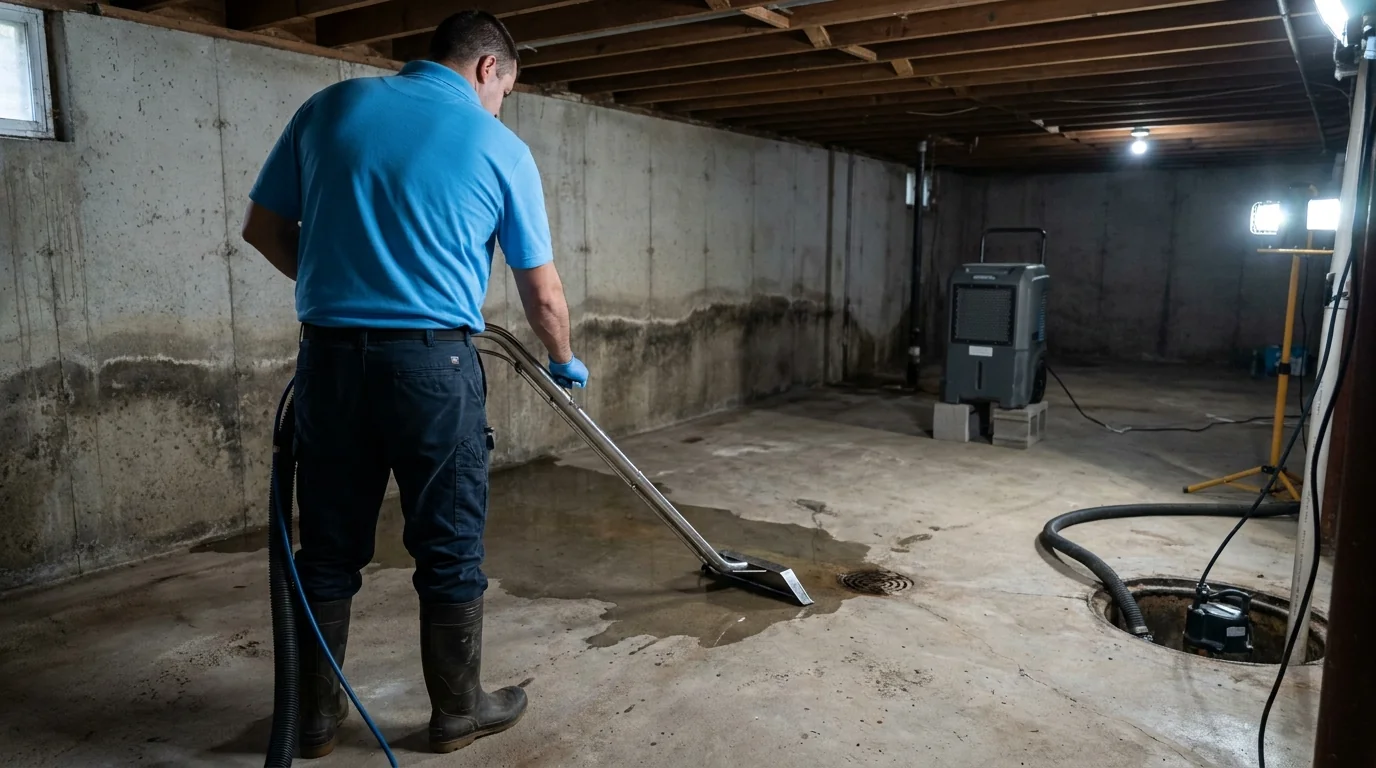
The first priority when we arrive is stopping the source — whether that’s a burst galvanized line, a failed sump, or groundwater intrusion through a cracked foundation wall. Once the water source is controlled, we use truck-mounted and portable extraction units to pull standing water from the floor, then transition to targeted drying with industrial air movers and desiccant or refrigerant dehumidifiers calibrated to the basement’s square footage and the ambient humidity typical of a New Jersey summer or winter.
In Irvington’s older homes, we pay close attention to what’s behind the walls. Many finished basements in this housing stock used 1×3 furring strips and plaster board rather than modern fiberglass-batted stud walls — materials that hold moisture differently and require longer drying cycles. We use thermal imaging cameras and penetrating moisture meters to map the wet zone accurately before we close anything up. Drying is documented against the IICRC S500 standard so your insurance adjuster has a clear record of scope and completion.
When structural materials — subfloor, framing, drywall — have absorbed enough water that drying in place isn’t viable, we perform controlled demolition, removing only what can’t be saved and leaving the rest. We photograph and document every step, which matters when you’re filing a claim.
Reaching Irvington from Kenilworth
The Restoration Group is based in Kenilworth, NJ, roughly 10 miles from Irvington. We operate 24/7, so a call at 2 a.m. after a pipe bursts near Chancellor Avenue or a sump fails during a storm gets the same response as a daytime call. Route 22 east to the Garden State Parkway south, or direct surface routes through Union and Hillside, give us reliable access to Irvington neighborhoods even in heavy weather. We’ll confirm an estimated arrival when you call (855) 650-7422.
Irvington Insurance Coordination
Most standard homeowner policies cover sudden and accidental water losses — a burst pipe, a failed appliance supply line, or a sump pump overflow if you carry the rider. Gradual seepage through a foundation crack is typically excluded, but the line between the two is often contested, and documentation is everything. As an IICRC Certified Firm (#210213) and NJ Licensed Home Improvement Contractor, we produce the moisture mapping, photo documentation, and drying logs that carriers and adjusters expect. We can communicate directly with your insurance company and help you understand what’s covered before work begins, so there are no surprises on the back end.
Local Note
In Irvington’s rowhouse blocks — particularly the tightly spaced properties along Union Avenue and near the Springfield Avenue corridor — basement access is sometimes shared-wall construction, meaning one unit’s wet basement wall is the adjacent unit’s dry one. When we assess a flooded basement in these buildings, we always check the adjoining unit for moisture migration through the shared masonry, even if that neighbor hasn’t reported a problem yet. Missing that moisture pathway is one of the most common reasons a basement drying job appears complete but fails a post-drying inspection weeks later.
If your basement is wet, don’t wait to see if it dries on its own. Call The Restoration Group at (855) 650-7422 — we’re available around the clock and can be on-site in Irvington to assess the damage, stop the spread, and get the drying process started today.
Serving Irvington from our Fair Lawn headquarters — ★ 4.8 · 158 Google reviews
“Very professional staff and also helped accommodate working around some other contractors that were simultaneously working in my house. Highly recommend!” — Gautam, July 2026Read our reviews on Google →
Basement Flooding Cleanup in Irvington: Service Coverage
Frequently Asked Questions
How fast can you arrive for basement flooding cleanup in Irvington?
Are the older rowhouses near Irvington Center more likely to have hidden water damage after a basement flood?
How quickly can The Restoration Group reach a flooded basement in the Grove Park or Chancellor Avenue area?
Irvington had severe basement flooding during Ida in 2021 — if my basement flooded again in a similar storm, is that covered by insurance?
My Irvington home has a semi-finished basement with carpet and drywall. Does that change how long the drying process takes?
What's the risk of mold after a basement flood in a 07111 ZIP code home, and how do you prevent it?
Basement Flooding Cleanup response in Irvington
Most Irvington calls see a technician on-site within 60 minutes from our Fair Lawn headquarters.