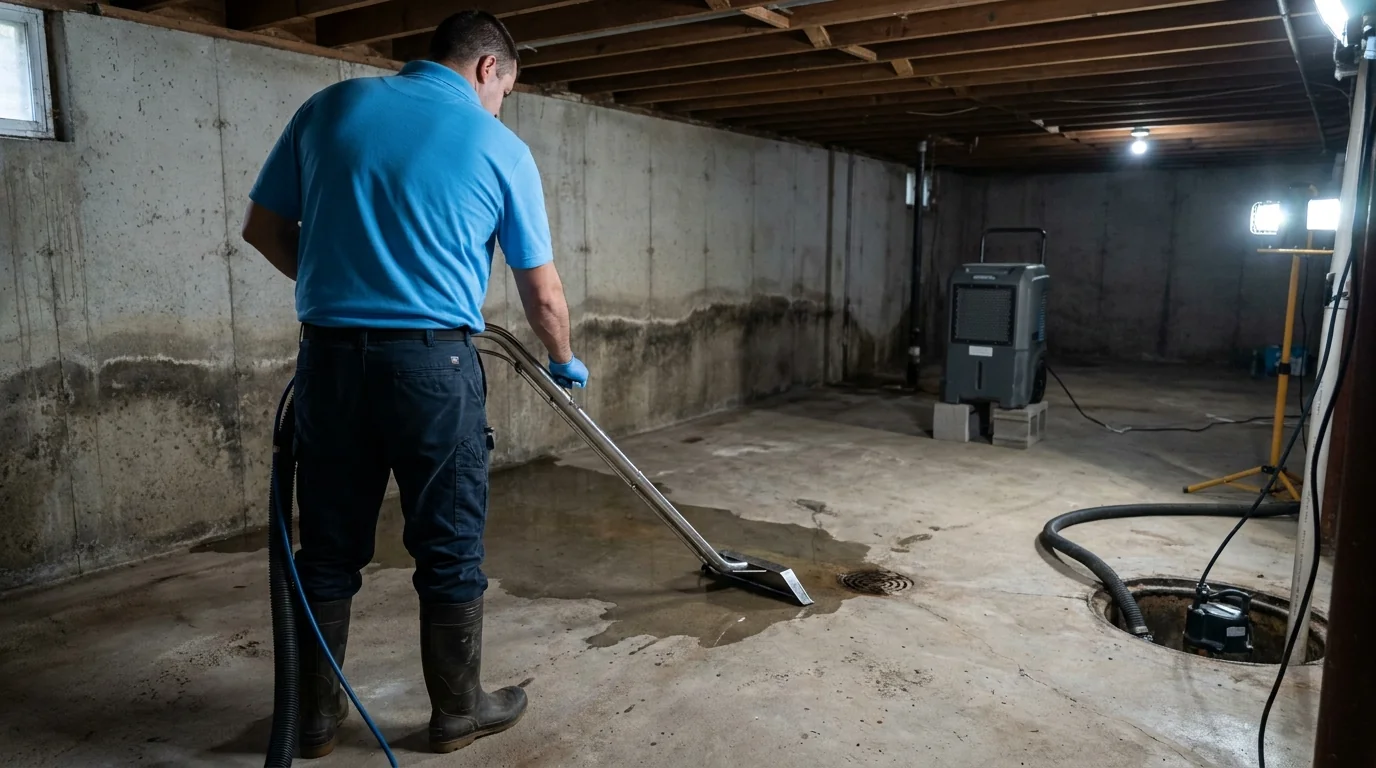
Basement Flooding Cleanup in Hillside
24/7 basement flooding cleanup in Hillside, NJ. IICRC-certified, insurance billing accepted. Call (855) 650-7422.
Our IICRC-certified technicians are dispatched from our Fair Lawn, NJ headquarters and are typically on-site in Hillside within 60 minutes of your call.
When the Elizabeth River backs up during a hard summer storm, basements across Hillside’s eastern lowlands fill faster than a sump pump can cycle. It happened in force during Ida in 2021 — river overflow and sewer surcharges pushed water into finished and semi-finished basements from the Conant Street corridor all the way through Saybrook, leaving homeowners standing in inches of murky water at midnight. The Restoration Group responds to those calls around the clock, dispatching from Kenilworth with truck-mounted extraction equipment ready to work.
Why Hillside Properties See Basement Flooding So Often
Hillside is almost entirely built out with housing stock from the 1920s through the 1950s — colonials, two-families, and postwar capes, most of them sitting on full basements that were finished or partially finished decades after original construction. That era of building used galvanized steel supply lines and cast-iron drains, both of which corrode from the inside out. A galvanized pipe that looks intact from the outside can be running at a fraction of its original diameter, and when pressure spikes during a cold snap or a main-line surge, it fails without warning.
The town’s topography compounds the problem. Low-lying ground near the Elizabeth River collects runoff from the surrounding area, and Hillside’s combined sewer system — common in Union County municipalities of this age — can reverse-flow during heavy rain events, pushing sewage-contaminated water up through floor drains. Homes near Evergreen Cemetery and along the lower sections of Winans have seen this pattern repeatedly. That contamination category (IICRC Category 3) changes how cleanup must proceed: affected materials require removal rather than drying in place, and the space needs antimicrobial treatment before any reconstruction begins.
Our Basement Flooding Cleanup Process in Hillside
The first thing that happens when the crew arrives is a moisture and contamination assessment. Knowing whether the water source was a clean supply-line break, a sump failure, or a sewer backup determines every decision that follows — what stays, what goes, and how aggressively the space needs to be treated.
From there, the process moves through four phases:
Extraction — Truck-mounted and portable extractors pull standing water from the floor. In Hillside’s older basements, that often means working around finished wall assemblies, drop ceilings, and stored belongings. We move what we can and document what we cannot.
Demolition of unsalvageable materials — Saturated drywall, insulation, and wood framing that has been in contact with Category 3 water comes out. Trying to dry contaminated materials in place creates a mold and odor problem within days.
Structural drying — Commercial-grade desiccant dehumidifiers and high-velocity air movers run continuously, calibrated to the square footage and construction of the space. Drying logs are recorded daily and benchmarked against the IICRC S500 standard for water damage restoration.
Post-dry verification — Before any reconstruction, moisture readings in framing, concrete, and remaining wall assemblies confirm the space is dry enough to close up. Skipping this step is how mold problems start.
Reaching Hillside from Kenilworth
The Restoration Group’s base in Kenilworth puts Hillside roughly 10 to 15 minutes away under normal conditions — typically via Route 22 east or through the industrial connector roads near the Conant Street area. Because the team operates 24/7, a call at 2 a.m. after a sump pump trips during a storm gets the same dispatch as a mid-afternoon pipe break. Hillside Center addresses and properties along the Route 22 retail corridor are straightforward to reach; tighter residential blocks in Saybrook and Winans may require a second vehicle for equipment staging, which the crew coordinates on the way.
Hillside Insurance Coordination
Most standard homeowner policies cover sudden and accidental water losses — a burst pipe or appliance failure — but draw a hard line at flooding from surface water or sewer backup unless the homeowner added a rider. In Hillside, where sewer backups are a documented recurring event, that distinction matters at claim time. The Restoration Group documents the loss thoroughly from arrival: photos, moisture readings, contamination classification, and an itemized scope of work. That documentation package is what adjusters need to process the claim, and we work directly with most major carriers so the homeowner is not left managing the paperwork alone during an already stressful event.
Local Note
Hillside’s older two-family homes — common throughout the Winans and Coe’s Corner neighborhoods — frequently have basements that were divided into separate utility and storage areas for each unit, with shared drain lines that were never designed for the loads they carry today. When one unit floods, the other unit’s plumbing is often affected too, and the scope of work has to account for both sides of the structure. Owners of these properties should expect that a thorough assessment will include both units, even if visible water is only present in one.
If your basement in Hillside (07205) is holding water right now, call (855) 650-7422. The Restoration Group is available around the clock, and the sooner extraction begins, the less material has to be replaced.
Serving Hillside from our Fair Lawn headquarters — ★ 4.8 · 158 Google reviews
“Very professional staff and also helped accommodate working around some other contractors that were simultaneously working in my house. Highly recommend!” — Gautam, July 2026Read our reviews on Google →
Basement Flooding Cleanup in Hillside: Service Coverage
Frequently Asked Questions
How fast can you arrive for basement flooding cleanup in Hillside?
How quickly can The Restoration Group reach a flooded basement in the Saybrook or Winans neighborhoods?
My Hillside basement flooded during a heavy rain and the water smells like sewage — does that change the cleanup process?
Are the older two-family homes near Coe's Corner and Winans more complicated to dry out after a basement flood?
What equipment do you use for basement water removal, and how long does drying typically take?
Will my homeowner's insurance cover basement flooding cleanup in Hillside if the water came from a sewer backup?
Basement Flooding Cleanup response in Hillside
Most Hillside calls see a technician on-site within 60 minutes from our Fair Lawn headquarters.