Water Damage Restoration in Highland Park
24/7 water damage restoration in Highland Park, NJ. IICRC-certified, insurance billing accepted. Call (855) 650-7422.
Our IICRC-certified technicians are dispatched from our Fair Lawn, NJ headquarters and are typically on-site in Highland Park within 60 minutes of your call.
When the Raritan River climbed over its banks during Hurricane Ida in 2021, low-lying streets near Donaldson Park and River Road filled faster than sump pumps could respond — and many of Highland Park’s finished basements, tucked beneath 1920s and 1930s colonials, took on water before residents even knew a flood warning had been issued. Water damage in Highland Park carries a specific character: old housing stock, a river that has proven it can overwhelm the borough’s southern edge, and a dense mix of owner-occupied homes and student rentals that each demand a different response. The Restoration Group is available 24/7 and dispatches from Kenilworth, putting crews on-site in Highland Park quickly when a pipe fails or a storm pushes water where it doesn’t belong.
Why Highland Park Properties Are Vulnerable to Water Damage
The borough’s pre-war and early-postwar housing — most of it built between 1910 and 1950 — was plumbed in an era when galvanized steel supply lines and cast-iron drain stacks were standard. Decades of mineral buildup narrow galvanized pipes from the inside until pressure spikes cause them to split, often inside finished walls or below concrete basement floors where the failure isn’t visible until water is already wicking into framing. Cast-iron drains corrode from the outside in humid crawlspaces, and root intrusion from the mature trees that line streets in Livingston Manor and the Triangle neighborhood can fracture lateral lines at the foundation.
Beyond the plumbing, Highland Park’s topography matters. The borough sits on a narrow strip of land between the Raritan River to the south and slightly higher ground to the north, so stormwater from North Highland Park and the Meadow neighborhood drains toward the river corridor. During heavy rain events, that drainage path can back up, pushing water into basements through floor drains and window wells faster than a standard sump pump handles. Homeowners who haven’t upgraded to a battery-backup sump system are particularly exposed.
The Raritan Avenue corridor adds a commercial dimension: restaurants, laundromats, and retail spaces run sprinkler systems and commercial dishwashers that generate large-volume losses when they fail. Multi-unit buildings near Rutgers University — just across the river — experience water events differently than single-family homes; a leak on an upper floor can migrate through multiple units before anyone calls for help.
Our Water Damage Restoration Process in Highland Park
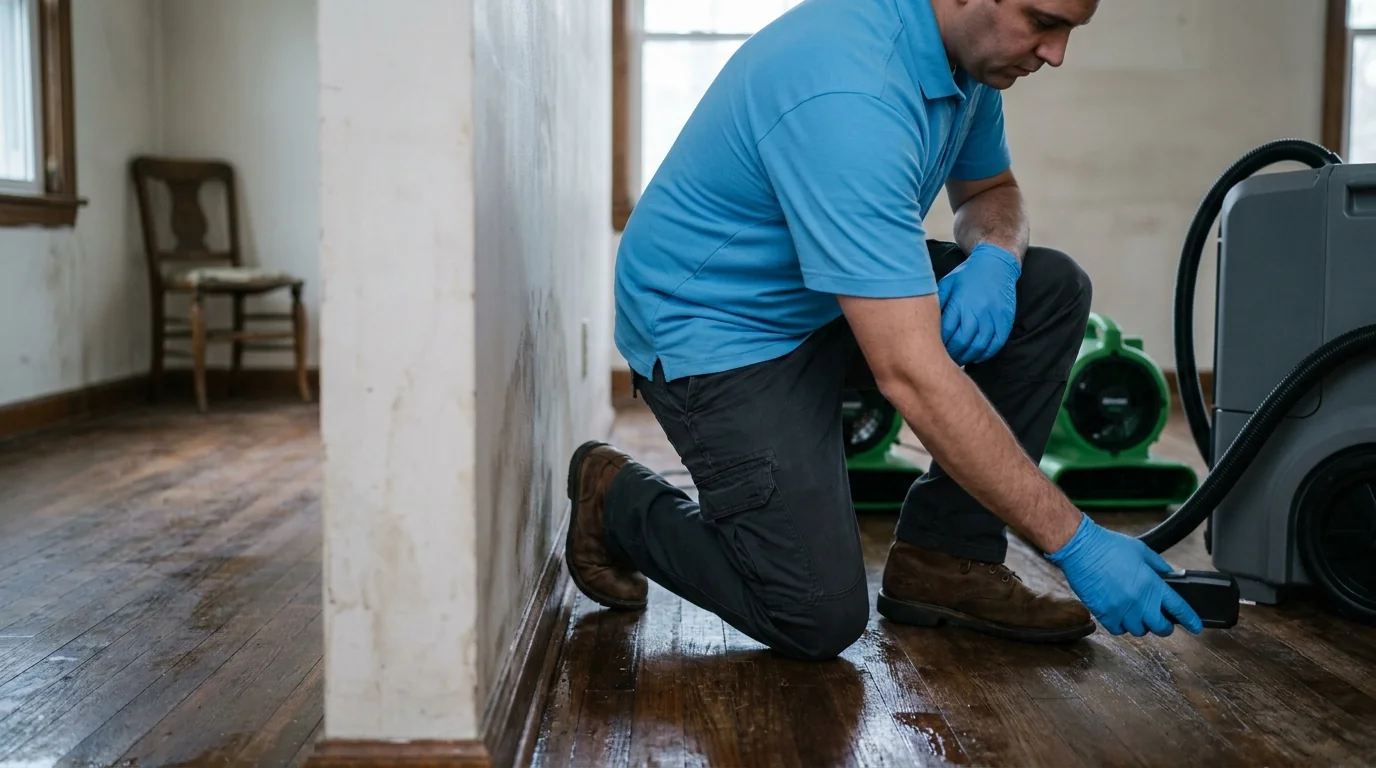
The first thing a crew does on arrival is identify the water source and stop active flow — shutting a supply valve, capping a drain line, or sandbagging a point of entry. Once the source is controlled, the focus shifts to measurement: moisture meters and thermal imaging cameras map how far water has traveled through walls, subfloor assemblies, and insulation. In Highland Park’s older homes, that spread is often wider than it looks. Plaster-and-lath walls, common in pre-1950 colonials, absorb water more slowly than drywall but release it slowly too, meaning drying timelines run longer than a homeowner might expect from reading generic estimates online.
Extraction comes next — truck-mounted and portable units pull standing water from basements, crawlspaces, and above-grade rooms. After extraction, the drying phase begins with industrial air movers and low-grain refrigerant dehumidifiers calibrated to the actual moisture load in the structure, not a one-size estimate. Readings are logged daily against the IICRC S500 standard to confirm drying progress is on track. Affected materials that cannot be dried in place — saturated insulation, compromised subfloor panels, sections of plaster that have delaminated — are removed and documented for the insurance claim before the structure is closed up.
Reaching Highland Park from Kenilworth
The Restoration Group’s Kenilworth location puts Highland Park within a short drive via Route 1 or the Garden State Parkway to Route 27. The Landing Lane Bridge and the main Route 27 corridor are the primary entry points into the borough, and crews familiar with both routes can reach Downtown Highland Park, the Raritan Avenue business district, and residential streets in Livingston Manor without navigating unfamiliar roads under pressure. Because this is a 24/7 operation, a call at 2 a.m. after a pipe bursts gets the same dispatch process as a call at noon.
Highland Park Insurance Coordination
Most homeowner policies in New Jersey cover sudden and accidental water damage — a burst pipe, an appliance failure, an ice dam — but exclude gradual leaks and rising floodwater. Given Highland Park’s documented flood history along the Raritan corridor, many properties in the 08904 ZIP code also carry separate NFIP flood policies, and the documentation requirements for those claims differ from standard homeowner claims. The Restoration Group photographs affected materials before removal, generates moisture logs that adjusters can use to validate the scope of work, and communicates directly with carriers to reduce the back-and-forth that delays drying authorization. Residents should not wait for adjuster approval before beginning extraction — most policies require prompt mitigation, and delay can void coverage for secondary damage.
Local Note
In Highland Park’s older two-family homes — particularly the side-by-side and up-down configurations common in the Triangle and Meadow neighborhoods — finished basement ceilings are often the first casualty of an upstairs plumbing failure, but they’re also the last place a tenant thinks to look. By the time water is visible at the ceiling seam, it has typically been sitting in the joist cavity for hours. When crews respond to these properties, they probe the floor assembly from below before assuming the damage is limited to what’s visible, because joist bays in balloon-frame construction can channel water laterally six to eight feet from the actual leak point.
If you’re dealing with water damage in Highland Park right now — whether it’s a flooded basement near Donaldson Park, a burst supply line in a Livingston Manor colonial, or a commercial sprinkler loss on Raritan Avenue — call The Restoration Group at (855) 650-7422. Crews are available around the clock, and the sooner extraction begins, the narrower the window for mold colonization and structural deterioration.
Serving Highland Park from our Fair Lawn headquarters — ★ 4.8 · 158 Google reviews
“Great customer service. I was kept well informed throughout the entire process. I received nothing but respect and sympathy from everyone I dealt with.” — Ryan, July 2026Read our reviews on Google →
Water Damage Restoration in Highland Park: Service Coverage
Frequently Asked Questions
How fast can you arrive for water damage restoration in Highland Park?
How quickly can The Restoration Group reach Highland Park for a water emergency?
Are basements in Highland Park's pre-war homes harder to dry than those in newer construction?
My Highland Park home is in a flood-prone area near the Raritan River. Does that affect my insurance claim for water damage?
What should a landlord do if a water leak in a Rutgers-area rental damages multiple units?
How long does the full water damage restoration process typically take for a Highland Park home?
Water Damage Restoration response in Highland Park
Most Highland Park calls see a technician on-site within 60 minutes from our Fair Lawn headquarters.