Sewage Cleanup and Sanitization in Highland Park
24/7 sewage cleanup and sanitization in Highland Park, NJ. IICRC-certified, insurance billing accepted. Call (855) 650-7422.
Our IICRC-certified technicians are dispatched from our Fair Lawn, NJ headquarters and are typically on-site in Highland Park within 60 minutes of your call.
When a sewer line backs up in a Highland Park colonial or two-family on a street like Livingston Manor or the Triangle neighborhood, the problem is rarely just a clogged drain. The borough’s dense stock of pre-war and early-postwar homes — many built between 1910 and the 1940s — still runs original cast-iron drain lines that have spent decades corroding from the inside out. When those lines fail, raw sewage doesn’t just pool on a basement floor; it saturates finished framing, wicks into concrete block, and begins generating dangerous pathogens within hours. The Restoration Group operates 24/7 and can dispatch directly from its Kenilworth location to Highland Park addresses in 08904 any time a backup turns critical.
Why Highland Park Properties See Sewage Backup Issues
Highland Park’s geography and housing stock create a specific combination of risk factors that show up repeatedly in sewage loss calls. The borough sits on the north bank of the Raritan River, and the low-lying corridors near Donaldson Park and River Road have demonstrated exactly how vulnerable that position is — during Hurricane Ida in 2021, those areas flooded catastrophically, overwhelming municipal storm and sanitary infrastructure simultaneously. When the storm sewer system surcharges, it can reverse-flow into residential lateral lines, pushing raw sewage up through floor drains and basement toilets in homes that had no internal plumbing failure at all.
Beyond flood events, the age of the housing stock is the more common culprit. The colonials, bungalows, and two-family homes that line streets from North Highland Park down through the Meadow area were built when cast-iron drain pipes and clay sewer laterals were standard. Cast iron corrodes and develops pinhole failures; clay joints shift with soil movement and allow root intrusion. Either failure mode can produce a slow seep that goes unnoticed until a finished basement ceiling or wall cavity is already contaminated. Student-rental and multi-unit properties near the Raritan Avenue corridor and the Rutgers University side of the river add another layer of risk — higher occupancy means higher drain load on aging lines.
Our Sewage Cleanup and Sanitization Process in Highland Park
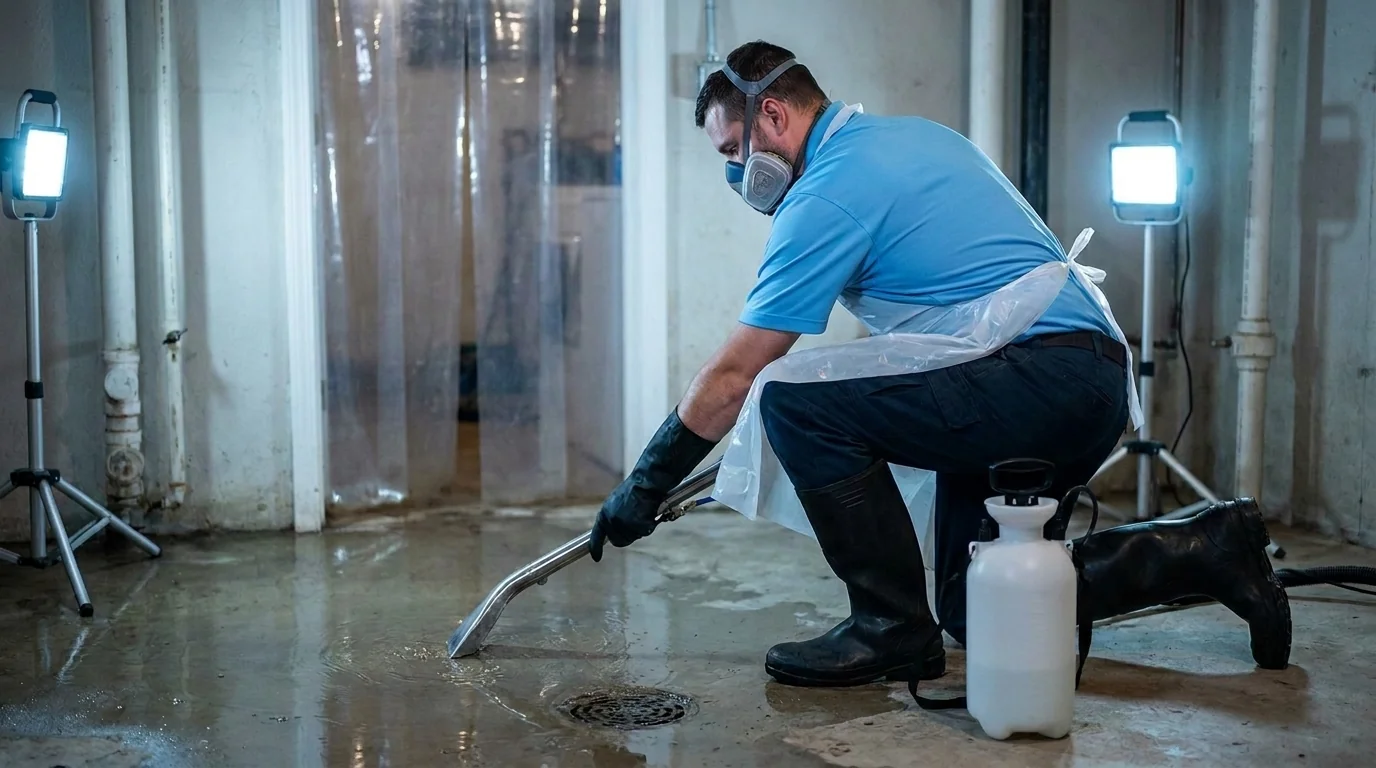
Sewage is classified as Category 3 water — the most contaminated classification under the IICRC S500 standard — which means the removal and sanitization protocol is more involved than a standard water loss. When the crew arrives at a Highland Park property, the first step is containment: isolating the affected zone to prevent cross-contamination into clean living areas, which matters especially in the two-story colonials and split-level homes common in this borough where a basement backup can wick toward a finished first floor.
Extraction comes next. Standing sewage is removed using truck-mounted and portable extraction units, followed by the removal of any porous materials — drywall, insulation, carpet, subfloor — that absorbed Category 3 water and cannot be safely dried in place. In Highland Park’s older homes, this often means encountering original hardwood subfloor over concrete block foundations, a combination that requires careful moisture mapping before any decisions about what stays and what goes.
Once the structure is cleared to clean material, the team applies EPA-registered antimicrobial agents to all affected surfaces, including framing, concrete, and any HVAC components that may have been exposed. Drying equipment — commercial dehumidifiers and air movers — runs until moisture readings return to baseline, and a final clearance check confirms the space is safe before any reconstruction begins.
Reaching Highland Park from Kenilworth
The Restoration Group’s Kenilworth headquarters puts Highland Park well within a fast dispatch radius. The most direct route runs through the Garden State Parkway and Route 1 corridor, with the Landing Lane Bridge providing a direct crossing into the borough from the Edison side when needed. Because the office is close, response to addresses anywhere from Downtown Highland Park up through North Highland Park is genuinely quick — 24-hour availability means a call at 2 a.m. on a Sunday gets the same dispatch as a weekday afternoon.
For commercial losses along the Raritan Avenue business district — restaurants, retail, mixed-use buildings — the crew is also equipped to handle larger-scale extraction and sanitization, including grease-trap adjacent drain failures that are a specific risk in food-service buildings.
Local Note
One thing crews working in Highland Park’s pre-war two-families learn quickly: the finished basements in these homes were often converted informally, with framing built directly against concrete block walls and no vapor barrier between. When sewage or groundwater infiltrates, the block absorbs moisture laterally and releases it slowly into the stud cavity — a wall can read dry on the surface while the block behind it is still saturated. Thermal imaging and deep-probe moisture meters are essential here; skipping that step and relying on surface readings alone leads to hidden mold growth weeks after the job is closed out.
If you’re dealing with a sewage backup anywhere in Highland Park — whether it’s a single-family on a quiet residential block or a multi-unit near the Raritan Avenue corridor — call (855) 650-7422. The Restoration Group responds around the clock, handles insurance documentation, and carries IICRC Firm Certification (#210213) and an NJ Licensed Home Improvement Contractor credential through the NJ Division of Consumer Affairs.
Serving Highland Park from our Fair Lawn headquarters — ★ 4.8 · 158 Google reviews
“Great customer service. I was kept well informed throughout the entire process. I received nothing but respect and sympathy from everyone I dealt with.” — Ryan, July 2026Read our reviews on Google →
Sewage Cleanup and Sanitization in Highland Park: Service Coverage
Frequently Asked Questions
How fast can you arrive for sewage cleanup and sanitization in Highland Park?
Are the older homes near Donaldson Park and the River Road corridor more prone to sewage backups than the rest of Highland Park?
How quickly can The Restoration Group reach a sewage emergency in the Triangle or Meadow neighborhoods of Highland Park?
What happens to the cast-iron drain pipes in Highland Park's pre-war homes during a sewage backup — do they need to be replaced?
Does sewage cleanup in Highland Park's finished basements require removing all the drywall and flooring?
Will my homeowner's insurance cover sewage backup cleanup at a Highland Park property, and does The Restoration Group handle the claim?
Sewage Cleanup and Sanitization response in Highland Park
Most Highland Park calls see a technician on-site within 60 minutes from our Fair Lawn headquarters.